- Animals
- ›Chordates
- ›Vertebrates
- ›Reptiles
- ›Snakes and Lizards
- ›Lizards
- ›Iguanas and Allies
- ›Dragons and Chameleons
- ›Dragons
- ›Bearded Dragons, Water Dragons, and Allies
- ›Physignathus
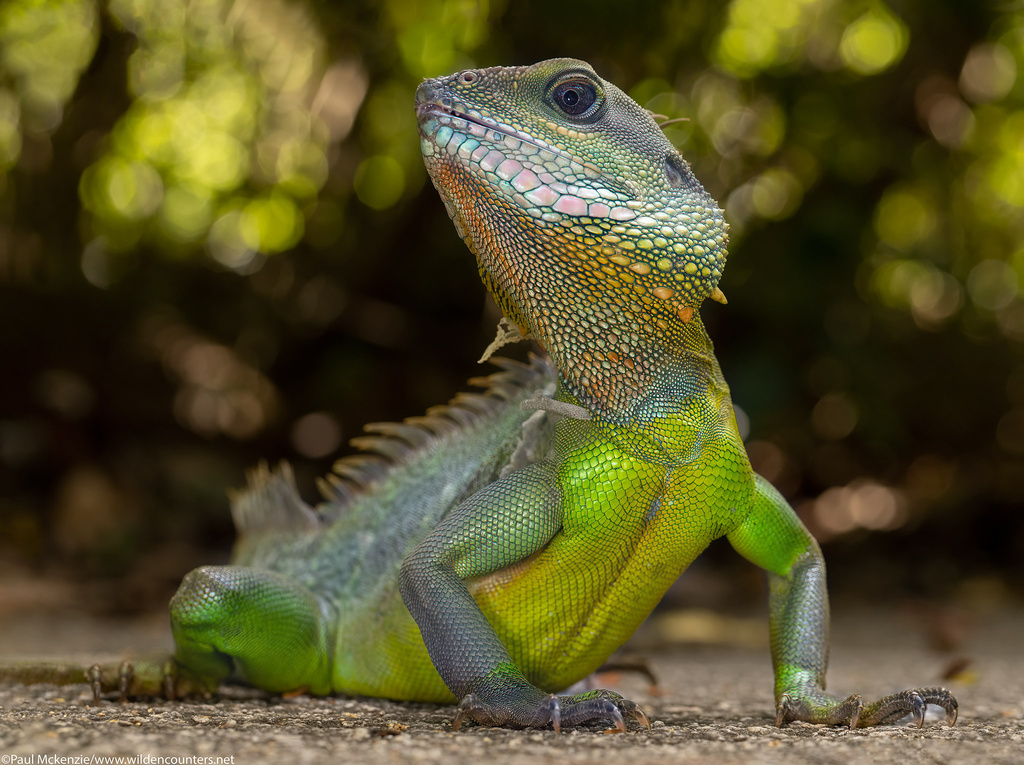
Asian Water Dragon
Physignathus cocincinus
Physignathus cocincinus is a species of agamid lizard native to southern China and mainland Southeast Asia. It is commonly known as the Chinese water dragon, Indochinese water dragon, Asian water dragon, Thai water dragon, or green water dragon.
Chinese water dragons are large diurnal lizards adapted for dense subtropical forests replete with unpolluted streams. They are semi-arboreal, roosting at night on branches overlooking streams, which offer an escape route when the lizards are disturbed. Arthropods are their main source of food, though worms, snails, vertebrates, and plants make up a notable portion of the diet as well. Males are territorial towards each other and bear display features such as crests and jowls. Females are oviparous and reproduce sexually in the wild, though at least one captive Chinese water dragon is known to have reproduced via parthenogenesis. Physignathus cocincinus is related to Australasian lizards in the subfamily Amphibolurinae. One amphibolurine, the Australian water dragon (Intellagama lesuerii) is so anatomically and ecologically similar to Physignathus cocincinus that it was once (erroneously) placed in the same genus.
From the article Chinese water dragon on Wikipedia (CC BY-SA), quoted section by section
Description
Adult Chinese water dragons are large and robust lizards; males can grow up to 90 cm (3.0 ft) in total length, including the tail. The tail is very long, exceeding 70% of the total body length. The maximum snout-vent length (tail excluded) is about 25 cm (9.8 in) in males and 20 cm (7.9 in) in females. The body and tail are compressed (taller than wide) while the limbs are long and muscular, each ending at five sharp claws. In both sexes, a fringe of enlarged scales runs down the length of the spine. The tympanum (eardrum) is partially exposed, with its rim covered by scales. There is a row of 8 or 9 large white plate-like scales on the edge of the lower jaw, below the infralabials (the scale row of the lower lip). Chinese water dragons show distinct sexual dimorphism; the males are heavier (up to 0.6 kg or 1.3 lbs) and have prominent display features. An arched crest extends along the rear of the neck onto the back, and another low crest is present at the base of the tail. The head is larger and more triangular, while the cheeks are swollen into jowls with pale tubercles (prominent pointed scales). There is no dewlap, unlike anoles and iguanas. Males have a functional series of femoral pores on the underside of the thigh, while in females these pores are little more than subtle indentations. …
Range & habitat
Chinese water dragons are native to the subtropical forests of southern China (Guangdong, Guangxi, and Yunnan provinces) and Southeast Asia (Vietnam, Laos, portions of Cambodia, eastern Thailand). There are also unconfirmed reports from Myanmar.
Wikipedia: “Native range”
What it does
Chinese water dragons are diurnal (active during the day) and forage for prey within small territories in the morning and midday. They are also semi-arboreal (spending much of their time in trees or plants). Adult males in particular tend to rest during the night on tree limbs overlooking streams. If threatened, a Chinese water dragon will leap or run to the nearest stream and either swim to safety or remain submerged for up to 90 minutes. In Hong Kong, the average territory size is about 1800 m2, with a small daily range of about 5 meters on average. Male territories generally do not overlap with each other, arguing that males are much more territorial than females. Movement and range patterns appear to be similar between the hot and wet summer and the relatively cool and dry winter, unlike most other subtropical reptiles. This may be an unintentional artefact of the fact that Hong Kong's dry season during the study interval (2015–2016) was unusually warm and wet. Captive male water dragons are very aggressive towards each other while females and juveniles are more tolerant.
Diet. Chinese water dragons are omnivorous and will readily supplement their diet with non-toxic vegetables or fruits in captivity. Nevertheless, their diet consists mainly of insects with occasional small vertebrates, eggs, and snails. …
Wikipedia: “Behavior and ecology”
Where it lives
Recorded sightings
—
geo-referenced records in GBIF, from museums, herbaria and field observers.
Drag the globe to turn it. Dots are where records exist, not a range map; darker means more records.
In the stacks
Searching the stacks…
Every page naming Physignathus cocincinus in the Biodiversity Heritage Library →
This page is assembled live from iNaturalist, GBIF, Wikipedia, the Source Library and the Internet Archive. It is not yet part of the hand-edited codex. iNaturalist taxon 31424.