- Animals
- ›Chordates
- ›Vertebrates
- ›Reptiles
- ›Snakes and Lizards
- ›Lizards
- ›Iguanas and Allies
- ›Iguanas, Anoles, and Allies
- ›Anoles
- ›Anolis
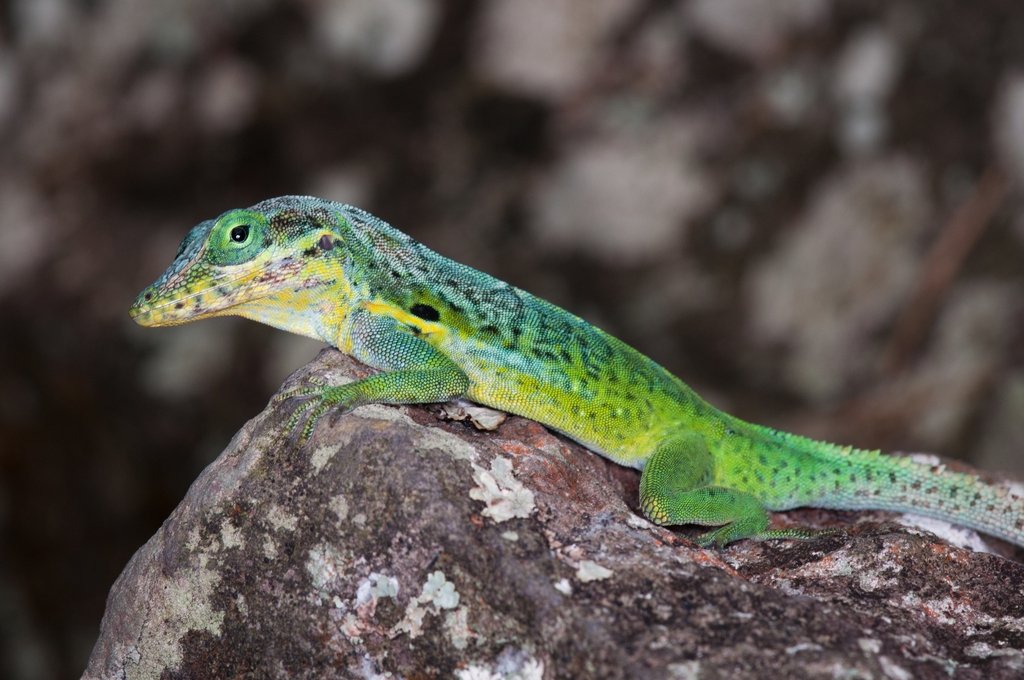
St. Eustatius Anole
Anolis bimaculatus
Anolis bimaculatus, the panther anole, also known as the St. Eustatius anole or Statia Bank tree anole, is a species of anole lizard that is endemic to the Lesser Antilles in the Caribbean. It is found in Sint Eustatius and Saint Kitts and Nevis islands. It was first described by Anders Erikson Sparrman in 1784 based on a holotype from Sint Eustatius held at the Naturhistoriska riksmuseet.
From the article Anolis bimaculatus on Wikipedia (CC BY-SA), quoted section by section
Description
Males reach a snout-to-vent length of 123 mm (4.8 in), with the colorization depending on size. Larger males have a bright green to yellow-green coat, with grey, brown, or black spots on the top, with a dull white to yellow to light green skin on the ventral side. The dewlap is small with yellow or orange colorization with whitish scales. Females and juvenile males are smaller and duller in color than adult males. It has a tail length approximately 2.0 to 2.5 times the snout-to-vent length. It has extended toe pads with lamellae to help the animal grip on to surfaces.
Range & habitat
The anole is endemic to the Lesser Antilles in the Caribbean, and occurs on the islands of Sint Eustatius and Saint Kitts and Nevis. It is relatively common and widespread up to an elevation of 300 m (980 ft) in the islands.
Wikipedia: “Distribution”
What it does
The anole is a diurnal and arboreal species. It is non-venomous and usually consumes insects, which it subdues by mechanically striking it. It has a well developed color-sensitive eyesight that helps in tracking prey. It also uses its eyes along with movements to its head and dewlap, to communicate with other members of its species. It is oviparous, and has been noted to interbreed with other species of the genus such as Anolis leachi in captivity.
Wikipedia: “Ecology and behaviour”
Where it lives
Recorded sightings
—
geo-referenced records in GBIF, from museums, herbaria and field observers.
Drag the globe to turn it. Dots are where records exist, not a range map; darker means more records.
In the stacks
Searching the stacks…
Every page naming Anolis bimaculatus in the Biodiversity Heritage Library →
This page is assembled live from iNaturalist, GBIF, Wikipedia, the Source Library and the Internet Archive. It is not yet part of the hand-edited codex. iNaturalist taxon 36531.