- Animals
- ›Chordates
- ›Vertebrates
- ›Reptiles
- ›Snakes and Lizards
- ›Lizards
- ›Iguanas and Allies
- ›Iguanas, Anoles, and Allies
- ›Anoles
- ›Anolis
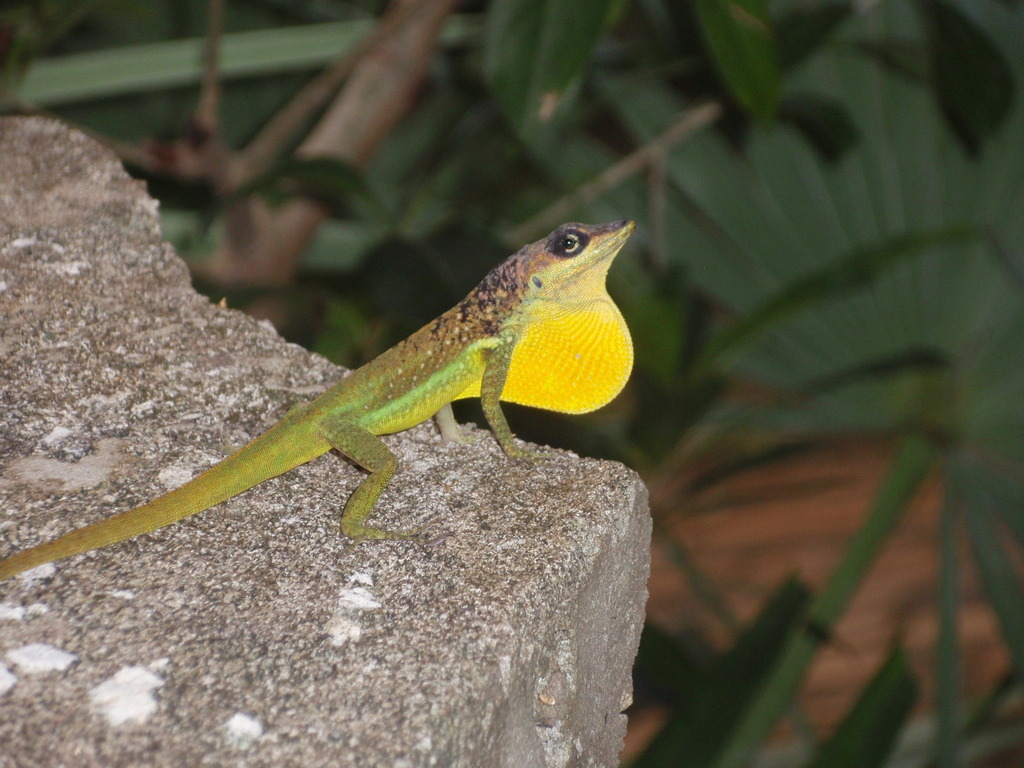
Barbados Anole
Anolis extremus
The Barbados anole (Anolis extremus) is a species of anole lizard that is native to Barbados, an island-nation in the Caribbean. Originally endemic to Barbados, it has since been introduced to Saint Lucia and Bermuda. It was previously treated as a subspecies of Martinique's anole (A. roquet).
From the article Barbados anole on Wikipedia (CC BY-SA), quoted section by section
Description
The Barbados anole is a relatively large, tree-dwelling anole, the males can have a snout-vent length of 85 mm (3.3 in). The background colour is mossy green with dark brown or black markings and occasionally light spots, mostly in the anterior half of the body. The anterior half of the body sometimes also shows a lavender or grey tint and the head may be blue grey or lavender. There is a dark ring around the eye in males and the flap on the throat is yellow or orange. The females and smaller and reach a snout-vent length of 60 mm (2.4 in). The colours are less intense and they may have stripes along the back.
Range & habitat
The Barbados anole was formerly endemic to Barbados, where it is the only species of native anole. It has been introduced to Bermuda, Saint Lucia, Trinidad and Tobago, Florida and Venezuela but it does not appear to have established sustained populations in Florida or Trinidad and Tobago. On Barbados, it is found throughout the island in all habitats except grassland, where it is invasive it tends to be found near human habitation and to avoid native habitats.
Wikipedia: “Distribution and habitat”
Where it lives
Recorded sightings
—
geo-referenced records in GBIF, from museums, herbaria and field observers.
Drag the globe to turn it. Dots are where records exist, not a range map; darker means more records.
In the stacks
Searching the stacks…
Every page naming Anolis extremus in the Biodiversity Heritage Library →
This page is assembled live from iNaturalist, GBIF, Wikipedia, the Source Library and the Internet Archive. It is not yet part of the hand-edited codex. iNaturalist taxon 36444.