- Animals
- ›Chordates
- ›Vertebrates
- ›Reptiles
- ›Snakes and Lizards
- ›Lizards
- ›Iguanas and Allies
- ›Iguanas, Anoles, and Allies
- ›Anoles
- ›Anolis
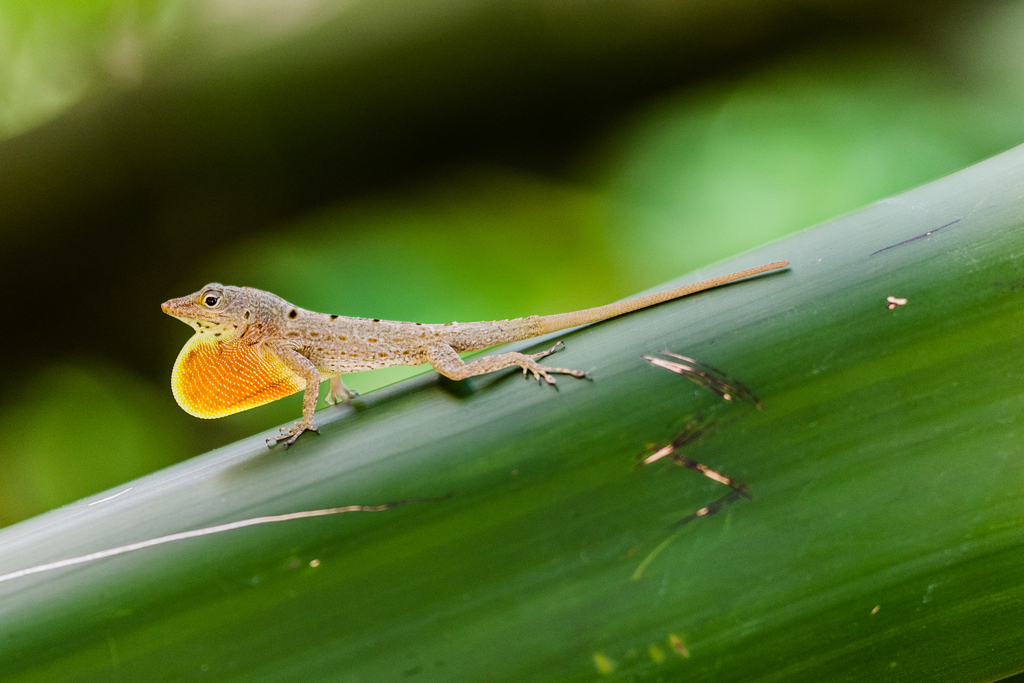
Banded Anole
Anolis stratulus
Anolis stratulus is a moderately-sized species of anole (US: ) (family Dactyloidae) found in Puerto Rico, the United States Virgin Islands and the British Virgin Islands. It is a gray-colored lizard spotted with brown markings. It is arboreal, usually found positioned on tree bark on branches in the canopies of forest trees, where in some areas of Puerto Rico it can be incredibly abundant, with tens of thousands of the lizards being present per hectare.
It is locally known as the lagartijo manchando in Puerto Rico. Names which have been coined for it in English are spotted anole, Puerto Rican spotted anole (in Puerto Rico), banded anole (in Puerto Rico), saddled anole, salmon lizard, barred anole, St. Thomas anole or the somewhat of a misnomer chameleon, because it can change color. It is known as the "spotted anole" because of the black markings on its back; the Spanish word manchado means as much. There are no salmon in Puerto Rico; the name "salmon lizard" may have been invented for tourists in 2007 by Alan Mowbray, 'interpretive media writer' for the website of El Yunque National Forest, referring to the trout-like colour pattern of its flanks or the perhaps his interpretation of the color of the skin. The names "saddled anole" and "barred anole" are likely taken from the 1862 description by Edward Drinker Cope, although it is not really true, Cope believed that the lizards were characteristically saddled with brown transverse bars on their back. The name "banded anole" may also refer to that. "St.
From the article Anolis stratulus on Wikipedia (CC BY-SA), quoted section by section
Description
This species of anole is a small lizard (or moderately-sized for an anole), adults measuring 40 to 44 mm (1.6 to 1.7 in) from snout to vent in males, in females to 46 mm (1.8 in). The male does not have a dorsal crest or tail fin which is common in many of the anole lizards of Puerto Rico. The species' range of color is from gray to brownish gray. It has a pale colored, hour-glass shaped spots from the nape of its neck to its tail, and also has a black, crescent-shaped patch behind the eye. It has distinct black or darker markings running down the nape of its neck and its back, which are more noticeable on males. Its flanks are marked with small dark spots. The throat of this anole has raised brown ridges and the dewlap color is orange with light yellow scales, or "bright orange and yellow toward the margins". The dewlap is rather large. The tail is slightly compressed, with the eight or nine vertical rows of weakly keeled scales being arranged in a clearly whorled or verticillate pattern, and the upper margin (edge) of the tail being strongly toothed. The tail measures 51 to 75 mm (2.0 to 3.0 in) in length. In females the dewlap much smaller than it is in the male, and it is colored gray, with some pale orange in the centre near the throat. Unlike in many other anoles, in this species the juveniles have the same coloration and color patterns as do the adults. …
Range & habitat
This species has one of the widest natural distributions of all the anoles of Puerto Rico and this range includes the many islands surrounding it such a Vieques and Culebra. In Puerto Rico it is commonly found in the Maricao State Forest, the Guánica State Forest, and the Luquillo Mountains. It has been described as "very common" in Los Tres Picachos State Forest where it is more common than the "common anole", Anolis cristatellus. It is the most abundant anole at mid-elevations in Puerto Rico. It is less common in the northwestern part of Puerto Rico. It is also present in Cayo Santiago (Humacao) and Isla Piñeros. On the islet of Cayo Santiago and the nearby southern coastal regions of Puerto Rico, such as the city of Ponce, it is also less common than A. cristatellus. The barred anole is also found, but to a lesser extent, in the coffee plantations of the barrios of Sabana Grande, Vivi Arriba, and Mameye. …
Wikipedia: “Distribution”
What it does
It is oviparous (egg-laying). It can change color. The color pattern of spots and markings makes it well-camouflaged against the lichen-spotted tree bark on which it commonly resides. The lizard prefers smaller branches and individuals have a small range, only venturing around a territory of no more than 6 meters for foraging and mating. This species has a population turnover of 1.4 years. It is diurnal. It is not shy, especially the males, and they let humans come quite close -showing their dewlap as an observer approaches.
Wikipedia: “Behaviour”
In human culture
Cope states that the etymology of the specific epithet, stratulus, which he chose for this lizard in his 1862 description of the species, was derived from the diminutive of the Latin language word stratus, which he states he chose for its meaning of 'saddled' (the word can have many meanings). Cope chooses the descriptive name 'saddled' because according to him the species has four characteristic dark brown transverse bars across its back, and another across its tail. Cope had access to limited specimens, and perhaps those he examined had these markings, but in the description published by Reinhardt and Lütken, they state that this pattern is often not apparent, especially in specimens where the dark brown spots dominate (their description is more like that below, a number of brown, transverse tracks or bands running down the back, paired with a series of brown spots on its flanks).
Wikipedia: “Etymology”
Where it lives
Recorded sightings
—
geo-referenced records in GBIF, from museums, herbaria and field observers.
Drag the globe to turn it. Dots are where records exist, not a range map; darker means more records.
In the stacks
Searching the stacks…
Every page naming Anolis stratulus in the Biodiversity Heritage Library →
This page is assembled live from iNaturalist, GBIF, Wikipedia, the Source Library and the Internet Archive. It is not yet part of the hand-edited codex. iNaturalist taxon 36606.