- Animals
- ›Chordates
- ›Vertebrates
- ›Reptiles
- ›Snakes and Lizards
- ›Lizards
- ›Wall lizards, amphisbaenians, and allies
- ›Wall Lizards
- ›Lacertinae
- ›Podarcis
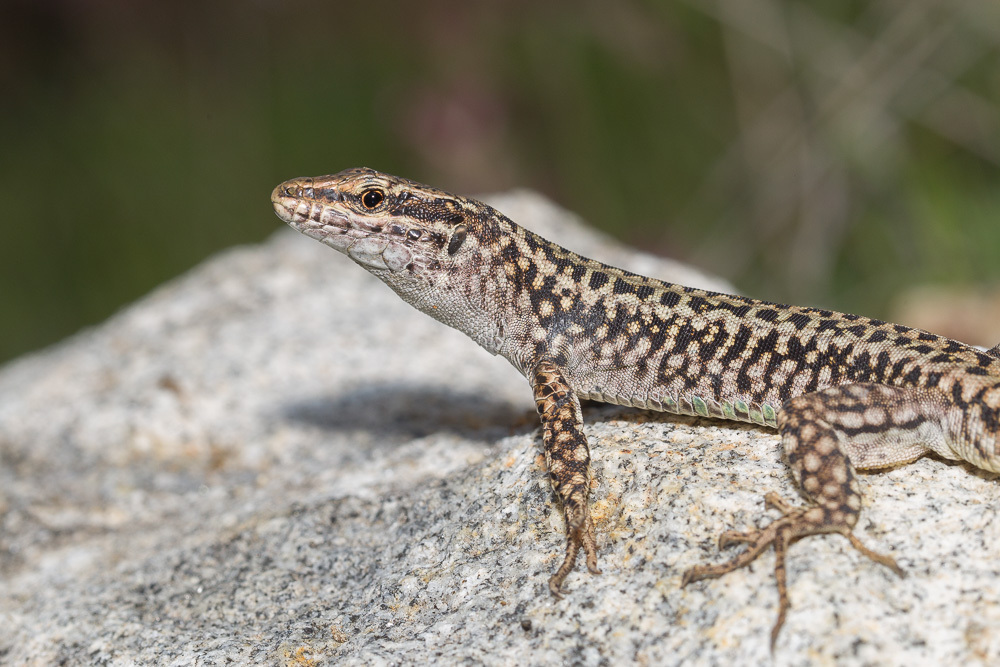
Erhard's Wall Lizard
Podarcis erhardii
Erhard's wall lizard (Podarcis erhardii), also commonly called the Aegean wall lizard, is a species of lizard in the family Lacertidae. The species is endemic to Southeast Europe.
From the article Erhard's wall lizard on Wikipedia (CC BY-SA), quoted section by section
Description
The snout-to-vent length of P. erhardii is about 7 cm (2.8 in), and the tail is twice as long. The head is rather wide, and the skin is smooth. The colour and patterning of this species vary a lot. The main colour is typically grey or brown, sometimes green. Females particularly are often striped. On the edges of the back two white stripes border two dark stripes or spotty lines. In the middle of the back may be a dark line. Some males have net-like patterning, where longitudinal and transverse lines and spots mix. The belly and often throat are white, yellow, orange or red, and in the Aegean Islands also green, blue or grey. The belly is never spotty, but sometimes there are blue spots on the hind legs.
Range & habitat
P. erhardii is found in the Balkan peninsula and the Aegean islands. On the mainland it ranges from Albania, North Macedonia, extreme southern Serbia and southern Bulgaria to the northeastern part of the Peloponnese peninsula in Greece. In the Aegean archipelago it does not occur in Milos or the surrounding islands, where it is replaced by the Milos wall lizard.
Wikipedia: “Geographic range”
What it does
P. erhardii mates in spring, and lays eggs at the beginning of the summer. The young lizards hatch in September, then measuring 3 cm (1.2 in).
Wikipedia: “Reproduction”
In human culture
The specific name, erhardii, is in honor of a certain Dr. D. Erhard (first name unknown), a German naturalist, who was the author of Fauna der Cycladen (1858).
Wikipedia: “Etymology”
Where it lives
Recorded sightings
—
geo-referenced records in GBIF, from museums, herbaria and field observers.
Drag the globe to turn it. Dots are where records exist, not a range map; darker means more records.
In the stacks
Searching the stacks…
Every page naming Podarcis erhardii in the Biodiversity Heritage Library →
This page is assembled live from iNaturalist, GBIF, Wikipedia, the Source Library and the Internet Archive. It is not yet part of the hand-edited codex. iNaturalist taxon 35677.