 NL·0376
Herbarium of the Nature Library
- Name
- Coracias garrulus
- Family
- Coraciidae
- Native to
- Breeds in southern and eastern Europe, North Africa, Turkey, the Middle East and Central Asia to western China and Kashmir; winters in eastern and southern Africa
- Habitat
- Steppe, Farmland, Mediterranean woodland, Savanna
On eBird ↗
European Roller
Live sightings near you, the range map, bar charts of when it is seen, and Macaulay Library photos and recordings.
European roller
Coracias garrulus
Also calledShiqirraq (Arabic) · Sabzqaba (Persian) · Gökkuzgun (Turkish) · Blauracke (German) · Rollier d'Europe (French) · Carraca europea (Spanish)
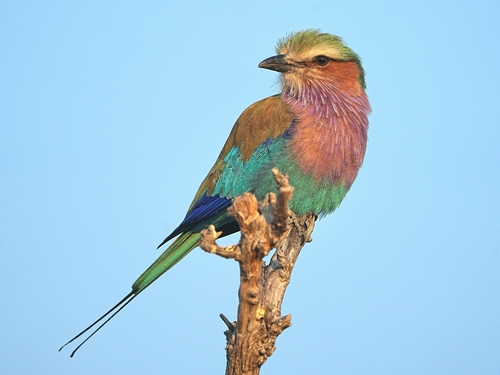
A jay-sized bird of shining turquoise and chestnut that watches for insects from wires and dead trees. It is named for its tumbling, rolling display flight, and it migrates to southern Africa for the winter.
The European roller is the only member of the roller family Coraciidae breeding in Europe. Its range extends into the Maghreb, West Asia and Central Asia. It winters in southern Africa, primarily in dry wooded savanna and bushy plains. It occurs in a wide variety of habitats, but avoids treeless plains. It usually nests in tree holes. Wikipedia
What it can do
- iPerforms a tumbling, rolling display dive in spring
- iiNestlings vomit a foul-smelling orange fluid to deter predators
- iiiNests in tree holes, banks and nest boxes, often old woodpecker holes
- ivMigrates in loops across East Africa and Arabia
In the field
Field marks
- aBright turquoise head and underparts
- bChestnut back
- cDeep violet-blue and black flight feathers flash in flight
- dStout black bill
- Voice
- A harsh, crow-like 'rack-kack' and rattling 'krak-krak-krak' in display.
- Not to be confused with
- Indian roller (Middle East, South Asia) has a rufous-pink breast and purple throat. Blue-cheeked bee-eater is green and slimmer. European bee-eater has a long, curved bill and tail streamers.
- Where to see it
- Extremadura and the Ebro valley (Spain), the Crau and Camargue (France), Hungary, the Balkans, Turkey, Central Asian steppes; passage in East Africa.
- When
- Summer visitor Apr/May–Aug
Listen
Looking for field recordings…
Life & habits
- Diet
- Large insects such as beetles and grasshoppers; lizards and small rodents
- Habitat
- Open country with old trees, steppe, farmland with scattered trees
- Size
- 29–32 cm; wingspan 52–58 cm; 127–160 g
Sits upright on a high perch and drops to the ground to seize prey.
Where it lives
Recorded sightings
—
geo-referenced records in GBIF, from museums, herbaria and field observers.
Native range
Breeds in southern and eastern Europe, North Africa, Turkey, the Middle East and Central Asia to western China and Kashmir; winters in eastern and southern Africa
Drag the globe to turn it. Dots are where records exist, not a range map; darker means more records.
In the old herbals & bestiaries
Woodcuts and engravings matched from the Source Library’s scanned books by name. Plates marked “relative” show a close kin rather than this exact species. Click a plate to read the page it came from, with translation.

History of Animals, Book I: On Viviparous Quadrupeds
Conrad Gessner · 1554 · p.860

Historiae Animalium Liber III: De Avium Natura
Conrad Gesner · 1555 · p.715

Ornithology
Ulisse Aldrovandi · 1599 · p.803

Ornithology: The History of Birds
Ulisse Aldrovandi · 1599 · p.800

Ornithologiae: de avibus historiae libri XII
Ulisse Aldrovandi · 1599 · p.813

Ornithologiae: de avibus historiae libri XII
Ulisse Aldrovandi · 1599 · p.787
In the stacks
Searching the stacks…
Every page naming Coracias garrulus in the Biodiversity Heritage Library →
Marginalia
Its Persian name 'sabzqaba' means 'green robe', and Linnaeus's 'garrulus' (chattering) refers to its harsh calls.
Curiosity
Studies in Spain showed roller chicks' orange vomit discourages predators and may warn parents of danger.
Kinship



Photographs: iNaturalist contributors under the licences shown. Records: GBIF.org. Historical plates: Source Library (CC BY-SA 4.0; originals public domain). Summary text: Nature Library editors and Wikipedia (CC BY-SA). Medicinal and edibility notes are historical and educational, not advice. iNaturalist taxon 2266.