- Animals
- ›Chordates
- ›Vertebrates
- ›Birds
- ›Rollers, Kingfishers, and Allies
- ›Kingfishers
- ›Water Kingfishers
- ›Ceryle
On eBird ↗
Pied Kingfisher
Live sightings near you, the range map, bar charts of when it is seen, and Macaulay Library photos and recordings.
Pied Kingfisher
Ceryle rudis
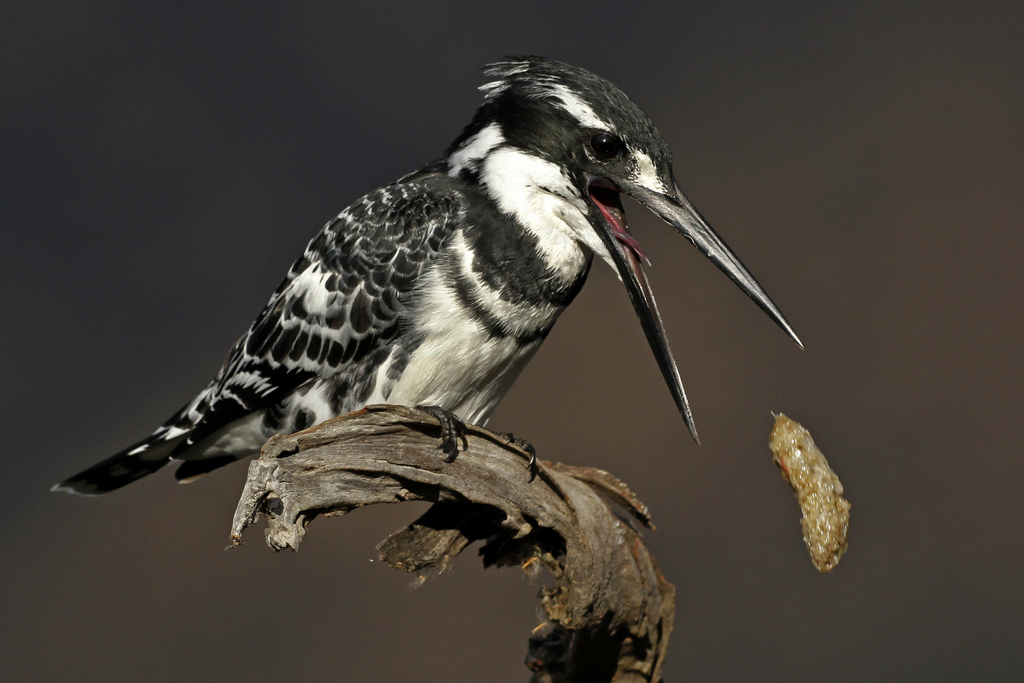
The pied kingfisher (Ceryle rudis) is a species of water kingfisher widely distributed across Africa and Asia. Originally described by Carl Linnaeus in 1758, it has five recognised subspecies, and is the only member of the genus Ceryle. Its black-and white-plumage and crest, as well as its habit of hovering over clear lakes and rivers before diving for fish, make it distinctive. Males have a double band across the breast, while females have a single broken breast band. They are usually found in pairs or small family groups. When perched, they often bob their heads and flick up their tails.
From the article Pied kingfisher on Wikipedia (CC BY-SA), quoted section by section
Description
This is a medium-sized kingfisher, about 25 cm (9.8 in) long with a white and black mask, a white supercilium, and black breast bands. The crest is neat and the upperparts are barred in black. Several subspecies are recognized within the broad distribution. The nominate race is found in sub-Saharan Africa, extending into West Asia. The subspecies C. r. syriacus is a larger, northern bird similar to the nominate subspecies (following Bergmann's rule). Subspecies leucomelanura is found from Afghanistan east into India, Thailand, and Southeast Asia. The subspecies C. r. travancoreensis of the Western Ghats is darker with the white reduced. The subspecies C. r. insignis is found in Hainan and southeastern China and has a much larger bill. Males have a narrow, second breast band, while females have a single broken breast band.
Range & habitat
It is common throughout sub-Saharan Africa and southern Asia from Turkey to India to China. It is resident, and most birds do not migrate, other than short-distance, seasonal movements. In India, it is distributed mainly on the plains and is replaced in the higher hills of the Himalayas by the crested kingfisher (Megaceryle lugubris). The pied kingfisher is estimated to be one of the three most-numerous kingfishers in the world; the other two are the common kingfisher (Alcedo atthis) and collared kingfisher (Todiramphus chloris). It is a noisy bird, making it hard to miss.
Wikipedia: “Distribution”
What it does
When perched, the pied kingfisher often bobs its heads up and down and sometimes raises its tail and flicks it downwards. It calls often with sharp chirruk chirruk notes. Unlike some kingfishers, it is quite gregarious, and forms large roosts at night.
Feeding. This kingfisher feeds mainly on fish, although it takes crustaceans and large aquatic insects such as dragonfly larvae. It usually hunts by hovering over the water to detect prey, before diving vertically, bill-first, to capture fish. When not foraging, it has a straight, rapid flight and have been observed flying at speeds approaching 50 km/h. In Lake Victoria in East Africa, the introduction of the Nile perch reduced the availability of haplochromine cichlids, which were formerly the preferred prey of these birds. It can consume prey without returning to a perch, often manipulating the subject with its bill and swallowing in flight, so can hunt over large water bodies or in estuaries that lack perches required by other kingfishers.
Breeding. The breeding season in India is February to April. Its nest is a hole excavated in a vertical mud bank about 5 feet (1.8 m) above water. The nest tunnel is 4-5 feet deep and ends in a chamber. Several birds may nest in the same vicinity. The usual clutch is three to six white eggs. …
Wikipedia: “Behaviour”
Listen
Looking for field recordings…
Where it lives
Recorded sightings
—
geo-referenced records in GBIF, from museums, herbaria and field observers.
Drag the globe to turn it. Dots are where records exist, not a range map; darker means more records.
In the stacks
Searching the stacks…
Every page naming Ceryle rudis in the Biodiversity Heritage Library →
This page is assembled live from iNaturalist, GBIF, Wikipedia, the Source Library and the Internet Archive. It is not yet part of the hand-edited codex. iNaturalist taxon 2662.