- Animals
- ›Chordates
- ›Vertebrates
- ›Birds
- ›Swifts and Hummingbirds
- ›Hummingbirds
- ›Bee Hummingbirds, Emeralds, Mountain-gems, and Allies
- ›Emerald Hummingbirds and Allies
- ›Chlorostilbon
On eBird ↗
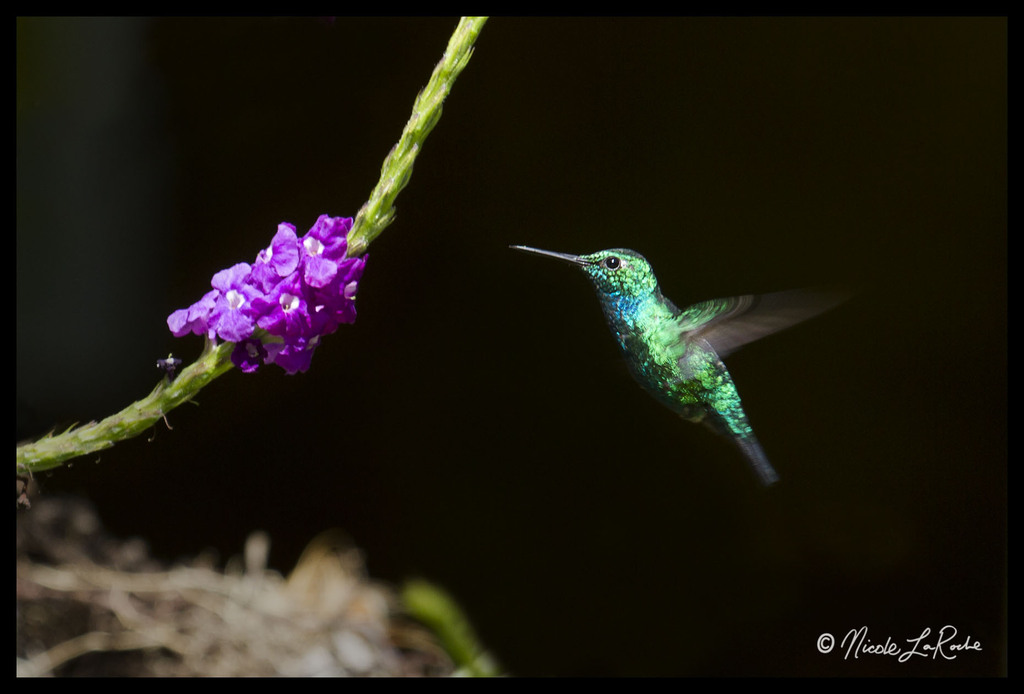
Blue-tailed Emerald
Live sightings near you, the range map, bar charts of when it is seen, and Macaulay Library photos and recordings.
Blue-tailed Emerald
Chlorostilbon mellisugus
The blue-tailed emerald (Chlorostilbon mellisugus) is a hummingbird in the "emeralds", tribe Trochilini of subfamily Trochilinae. It is found in tropical and subtropical South America east of the Andes from Colombia east to the Guianas and Trinidad, and south to northern Bolivia and central Brazil.
From the article Blue-tailed emerald on Wikipedia (CC BY-SA), quoted section by section
Description
Male blue-tailed emeralds are 7.5 to 9.5 cm (3.0 to 3.7 in) long and females 6.5 to 7.5 cm (2.6 to 3.0 in). Males of C. m. caribaeus average about 2.7 g (0.095 oz) and females about 2.5 g (0.088 oz). Males of C. m. phoeopygus average about 2.7 g (0.095 oz) and females about 2.4 g (0.085 oz). Both sexes of all subspecies have a short, straight, black bill. All of the males have a forked tail whose depth varies somewhat among the subspecies. Females are essentially indistinguisable from each other. Males of the nominate subspecies have an iridescent golden green forehead and crown, shining bronze-green upperparts, and a steel blue tail. Their underparts are glittering emerald green that is most iridescent on the breast and bluish on the throat. They have white thighs. The nominate female's forehead and crown are bronzy green. Its face has a blackish "mask" with a pale gray stripe behind the eye. The rest of its upperparts are metallic grass green and the tail blue-black with whitish gray tips. Its underparts are pale gray. Subspecies C. m. caribaeus is very like the nominate but the male has less blue on its throat. Male C. m. duidaes have a bronzy orange head and reddish copper upperparts. Males of C. m. subfurcatus have blue-green on the throat and uppertail coverts and golden green on the crown whose intensities are intermediate between the nominate and caribaeus. C. m. …
Range & habitat
The seven subspecies of blue-tailed emerald recognized by the IOC are distributed thus:
C. m. caribaeus, northern Venezuela, Trinidad, and the "ABC Islands" C. m. duidae, Cerro Duida region of southern Venezuela's Amazonas state C. m. subfurcatus, eastern and southern Venezuela, Guyana, and the Rio Branco region of northwestern Brazil C. m. mellisugus, Suriname, French Guiana, and the lower Amazon basin of northeastern Brazil C. m. phoeopygus, the upper Amazon River and its eastern tributaries in Colombia, Ecuador, and Brazil C. m. napensis, the upper Amazon River in northeastern Peru C. m. peruanus, southeastern Peru, eastern Bolivia, and possibly extreme southwestern Brazil The species occurs in a variety of habitats from the tropical to the temperate zones. It mostly is found in semi-open to open landscapes such as savanna, cerrado, cultivated areas, and gardens. It also occurs in the edges of deciduous woodland and in large clearings within terra firme forest, and commonly in Ecuador, Várzea and floodplain forest. In elevation it ranges between 750 and 2,600 m (2,500 and 8,500 ft) in Ecuador, up to 1,200 m (3,900 ft) in Peru, and from sea level to about 1,850 m (6,100 ft) in Venezuela.
Wikipedia: “Distribution and habitat”
What it does
The blue-tailed emerald forages for nectar mostly by trap-lining, visiting a circuit of flowering plants. However, in some areas it defends patches of flowers. It takes nectar from a very wide variety of low plants, shubs, and trees, and feeds at all levels of the vegetation. In addition to nectar, it captures small insects and other arthropods by hawking from a perch.
Wikipedia: “Feeding”
Listen
Looking for field recordings…
Where it lives
Recorded sightings
—
geo-referenced records in GBIF, from museums, herbaria and field observers.
Drag the globe to turn it. Dots are where records exist, not a range map; darker means more records.
In the stacks
Searching the stacks…
Every page naming Chlorostilbon mellisugus in the Biodiversity Heritage Library →
This page is assembled live from iNaturalist, GBIF, Wikipedia, the Source Library and the Internet Archive. It is not yet part of the hand-edited codex. iNaturalist taxon 6095.