- Animals
- ›Chordates
- ›Vertebrates
- ›Birds
- ›Swifts and Hummingbirds
- ›Hummingbirds
- ›Mango Hummingbirds and Allies
- ›Eulampis
On eBird ↗
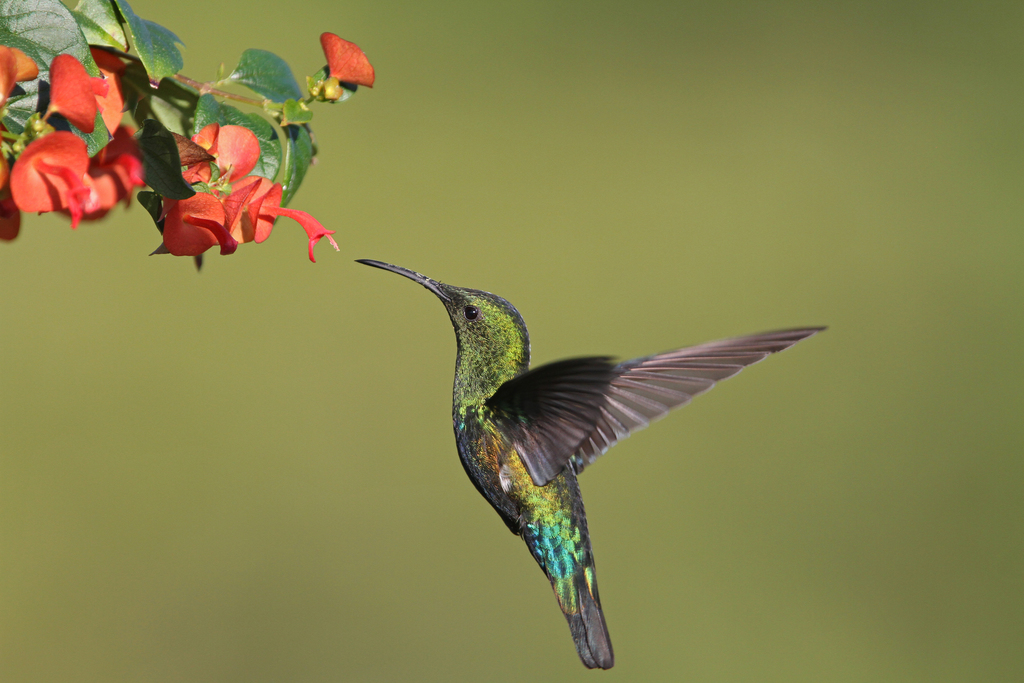
Green-throated Carib
Live sightings near you, the range map, bar charts of when it is seen, and Macaulay Library photos and recordings.
Green-throated Carib
Eulampis holosericeus
The green-throated carib (Eulampis holosericeus) is a species of hummingbird in the genus Eulampis, which contains one other species. It has two subspecies, holosericeus and chlorolaemus, the former occurring in Puerto Rico and the latter in Grenada.
From the article Green-throated carib on Wikipedia (CC BY-SA), quoted section by section
Description
The green-throated carib is a large hummingbird, 10.5 to 12 cm (4.1 to 4.7 in) long. Both sexes have a bright green back, though the female's is duller, and a bright green gorget. The male's gorget has a blue border that is usually not apparent. Males and females have a black belly, a green vent area, and a dark blue tail that appears black in poor light. The underparts of subspecies E. h. chlorolaemus are somewhat darker than those of the nominate. Males have a medium length slightly decurved bill; the female's is longer and more strongly curved. The calls include a sharp chup! or chuwp!. During territorial disputes it sometimes makes rattles and whirs with its wings.
Range & habitat
The green-throated carib is generally sedentary but some are known to move to wetter areas after the breeding season. The nominate subspecies is found from eastern Puerto Rico through the Virgin Islands and the Lesser Antilles chain as far as (but not including) Grenada. E. h. chlorolaemus is endemic to Grenada. The species inhabits a variety of landscapes including wet forest, semi-deciduous forest, cultivated areas, gardens, and parks. On Martinique it is also found in drier habitat. On many islands it is most common near sea level though on Dominica it is found mostly in foothills.
Wikipedia: “Distribution and habitat”
What it does
The green-throated carib feeds on the nectar of a variety of flowering shrubs and trees. Males are believed to defend flowering feeding territories all year but females do so only in the non-breeding season. The species also feeds on small arthropods such as insects and spiders, mostly caught on the wing.
Wikipedia: “Feeding”
Listen
Looking for field recordings…
Where it lives
Recorded sightings
—
geo-referenced records in GBIF, from museums, herbaria and field observers.
Drag the globe to turn it. Dots are where records exist, not a range map; darker means more records.
In the stacks
Searching the stacks…
Every page naming Eulampis holosericeus in the Biodiversity Heritage Library →
This page is assembled live from iNaturalist, GBIF, Wikipedia, the Source Library and the Internet Archive. It is not yet part of the hand-edited codex. iNaturalist taxon 6427.