- Animals
- ›Chordates
- ›Vertebrates
- ›Birds
- ›Swifts and Hummingbirds
- ›Hummingbirds
- ›Mango Hummingbirds and Allies
- ›Anthracothorax
On eBird ↗
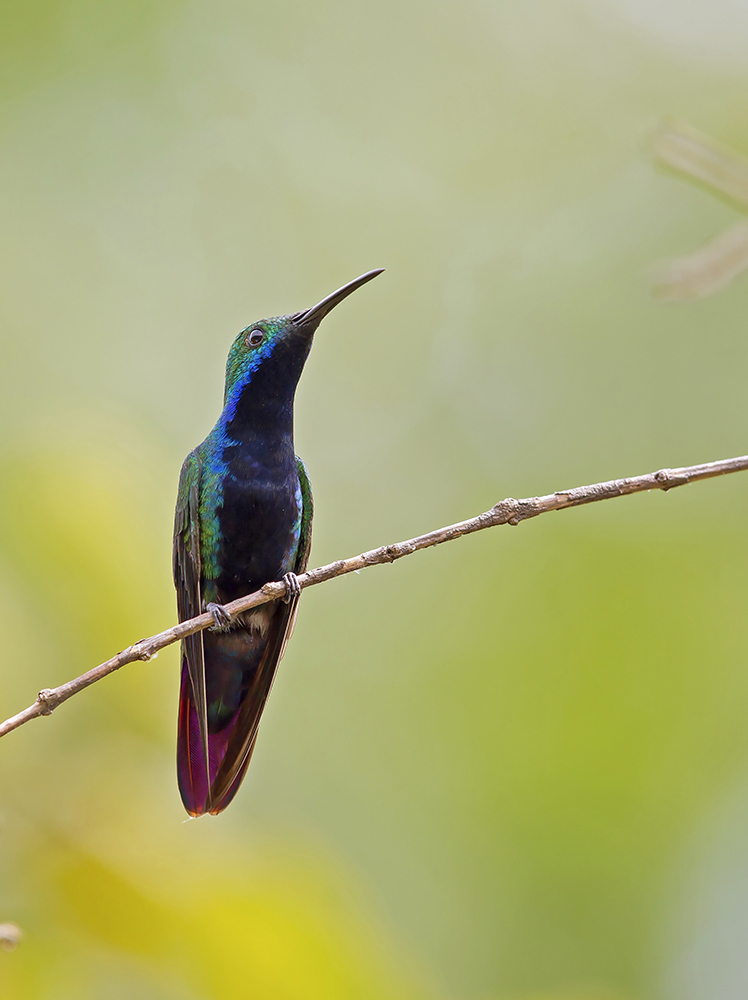
Black-throated Mango
Live sightings near you, the range map, bar charts of when it is seen, and Macaulay Library photos and recordings.
Black-throated Mango
Anthracothorax nigricollis
The black-throated mango (Anthracothorax nigricollis) is a species in subfamily Polytminae of the hummingbird family Trochilidae. It is found in Panama, in every mainland South American country except Chile, and in Trinidad and Tobago.
From the article Black-throated mango on Wikipedia (CC BY-SA), quoted section by section
Description
The black-throated mango is 10.2 to 14 cm (4.0 to 5.5 in) long and weighs 6 to 9 g (0.21 to 0.32 oz). Both sexes of both subspecies have a slightly decurved black bill. Adult males of the nominate subspecies have a metallic bronze-green crown, nape, and upperparts. Their innermost pair of tail feathers are dusky bronze green and the outer four pairs are metallic magenta-rufous with dark blue edges and a violet sheen. Their wings are grayish brown. They have a black chin, throat, and middle of the chest with metallic bluish green beside it and to the vent. Their sides and flanks are bronzy green. Nominate females have metallic green on the crown, nape, and upperparts without the male's bronzy tone. Their innermost pair of tail feathers are dusky bronze green like the male's, but the outer four pairs are rufous with a wide purple base and whitish tips. They have a thin and ragged black chin and throat stripe with a white border. The rest of their underparts are green. Juveniles are somewhat similar to adult females but have a white chin, throat, and breast with a thin black central line. Some brown on the head and back feathers gives a barred appearance. Their lower back and rump feathers have dull cinnamon-buff tips. Juvenile females have some rusty or buff beside the white of the underparts, green undertail coverts, and a mostly dull carmine underside of the tail. …
Range & habitat
The nominate subspecies of the black-throated mango is found from western Panama into much of Colombia and Venezuela, the Guianas, eastern Ecuador and Peru, northern and eastern Bolivia, eastern Paraguay, far northern Argentina, most of Brazil, and on both Trinidad and Tobago. It has also occurred as a vagrant in Uruguay. Subspecies A. n. iridescens is found in extreme southwestern Colombia, western Ecuador, and extreme northwestern Peru. The black-throated mango inhabits a variety of landscapes in the lowland tropics, most of them semi-open to open. These include gallery forests, shade coffee, and cacao plantations, the edges of dense forest, and parks and gardens in populated areas. In general, it is a bird of the lowlands but reaches 1,400 m (4,600 ft) in Venezuela, 1,700 m (5,600 ft) in Colombia, and 2,000 m (6,600 ft) in eastern Brazil.
Wikipedia: “Distribution and habitat”
What it does
The black-throated mango feeds on nectar, favoring the flowers of tall trees. Those of genera Erythrina, Eucalyptus, Mabea, Spirotheca, Tabebuia, and Spathodea are known sources. It also feeds on vines and shrubs of many genera, both native and introduced. Males defend feeding territories in trees but not as vigorously as some other hummingbirds. In addition to nectar, the species feeds on insects by hawking, mostly from a high perch but also much less frequently low down such as along roads or streams. It also gleans insects from foliage but less commonly than taking them by hawking.
Wikipedia: “Feeding”
Listen
Looking for field recordings…
Where it lives
Recorded sightings
—
geo-referenced records in GBIF, from museums, herbaria and field observers.
Drag the globe to turn it. Dots are where records exist, not a range map; darker means more records.
In the stacks
Searching the stacks…
Every page naming Anthracothorax nigricollis in the Biodiversity Heritage Library →
This page is assembled live from iNaturalist, GBIF, Wikipedia, the Source Library and the Internet Archive. It is not yet part of the hand-edited codex. iNaturalist taxon 5807.