- Animals
- ›Chordates
- ›Vertebrates
- ›Birds
- ›Swifts and Hummingbirds
- ›Hummingbirds
- ›Brilliants, Coquettes, and Allies
- ›Coquettes and Allies
- ›Lophornis
On eBird ↗
Tufted Coquette
Live sightings near you, the range map, bar charts of when it is seen, and Macaulay Library photos and recordings.
Tufted Coquette
Lophornis ornatus
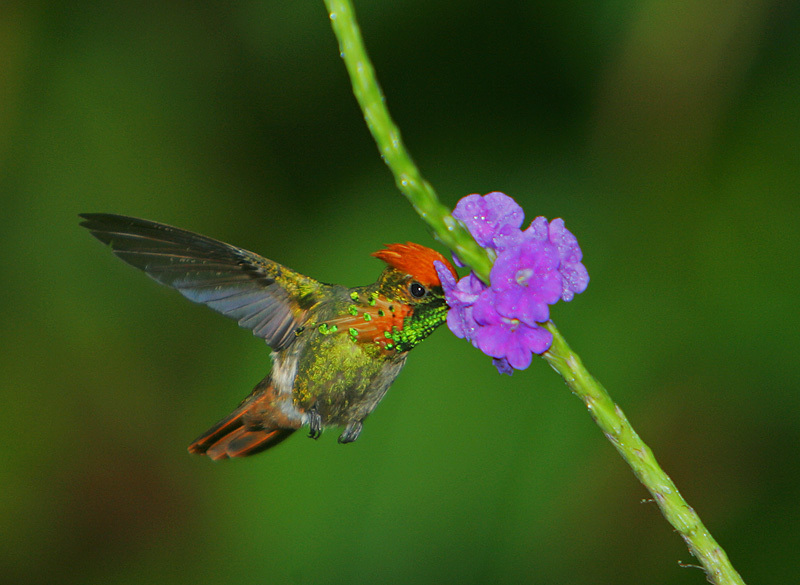
The tufted coquette (Lophornis ornatus) is a tiny hummingbird that breeds in eastern Venezuela, Trinidad, Guiana, and northern Brazil. It is an uncommon but widespread species, and appears to be a local or seasonal migrant, although its movements are not well understood.
This small bird inhabits open country, gardens, and cultivated areas.
From the article Tufted coquette on Wikipedia (CC BY-SA), quoted section by section
Description
The tufted coquette is 6.6 centimetres (2.6 in) long and weighs 2.3 grams (0.081 oz). The black-tipped red bill is short and straight. The male has a rufous head crest and a coppery green back with a whitish rump band that is prominent in flight. The forehead and underparts are green, and black-spotted rufous plumes project from the neck sides. The tail is golden rufous. The female lacks the crest and plumes. She has green upperparts (dorsal), except for the whitish tail band, and rufous underparts (ventral) that become much paler on the belly. The tail is mostly bronze green with a dusky band and whitish tips to the feathers. Immature males resemble the female, but their throats are whitish with fine dark spotting. The female tufted coquette lays two eggs in a small cup nest made of plant down and placed on a branch. Tufted coquettes are tame and approachable. The call of this species while feeding is a light chik. Their food is nectar, taken from a variety of flowers, and some small invertebrates. With their small size and steady flight, these birds often resemble a large bee as it moves from flower to flower.
Listen
Looking for field recordings…
Where it lives
Recorded sightings
—
geo-referenced records in GBIF, from museums, herbaria and field observers.
Drag the globe to turn it. Dots are where records exist, not a range map; darker means more records.
In the old herbals & bestiaries

In the stacks
Searching the stacks…
Every page naming Lophornis ornatus in the Biodiversity Heritage Library →
This page is assembled live from iNaturalist, GBIF, Wikipedia, the Source Library and the Internet Archive. It is not yet part of the hand-edited codex. iNaturalist taxon 6350.