On eBird ↗
Uniform Swiftlet
Live sightings near you, the range map, bar charts of when it is seen, and Macaulay Library photos and recordings.
Uniform Swiftlet
Aerodramus vanikorensis
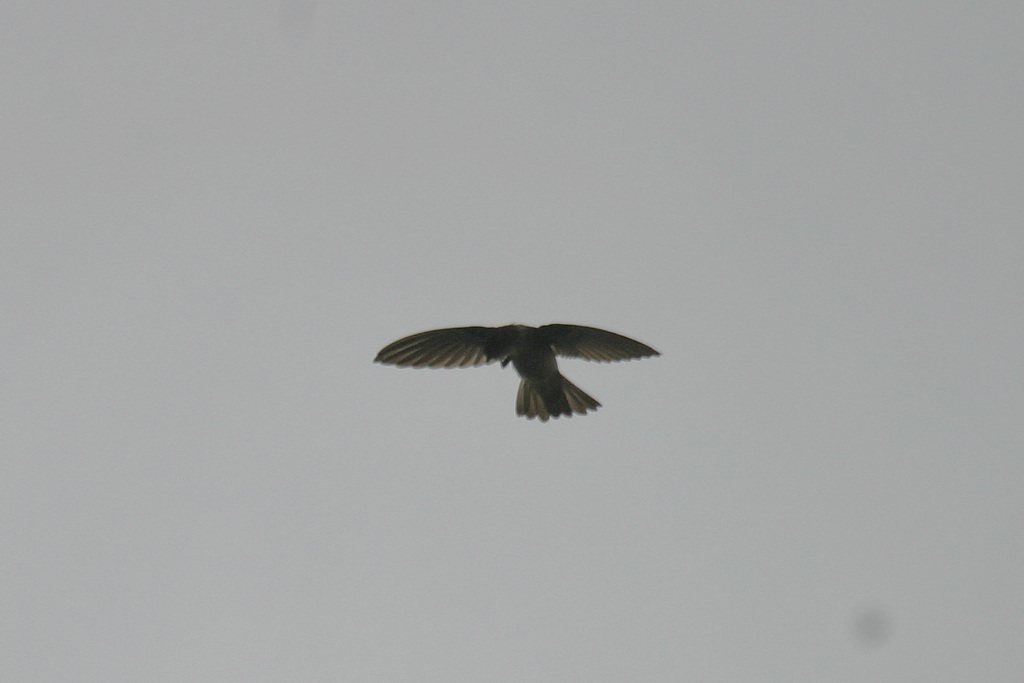
The uniform swiftlet (Aerodramus vanikorensis), also known as the Vanikoro swiftlet or lowland swiftlet, is a gregarious, medium-sized swiftlet with a shallowly forked tail. The colouring is dark grey-brown, darker on the upperparts with somewhat paler underparts, especially on chin and throat. This species is widespread from the Philippines through Wallacea, New Guinea and Melanesia. It forages for flying insects primarily in lowland forests and open areas. It nests in caves where it uses its sense of echolocation, rare in birds, to navigate.
From the article Uniform swiftlet on Wikipedia (CC BY-SA), quoted section by section
Description
The uniform swiftlet is a gregarious, medium-sized swiftlet with a shallowly forked tail. It is about 13 cm long with a wingspan averaging around 27 cm. It weighs about 11 grams. The colouring is dark grey-brown, darker on the upperparts with paler underparts, especially on chin and throat. It is similar to, and most likely to be confused with, the white-rumped swiftlet or mountain swiftlet.
Range & habitat
This species is widespread from the Philippines through Wallacea, New Guinea and Melanesia. It has been recorded as a rare vagrant to Australia, from Cape York Peninsula and islands in Torres Strait. The uniform swiftlet forages over lowland forests and open areas. It roosts in caves and sinkholes, mostly in limestone areas. The caves may be as little as 10 m (33 ft) long but are usually much larger. Sometimes man-made tunnels or structures are used.
Wikipedia: “Distribution and habitat”
Listen
Looking for field recordings…
Where it lives
Recorded sightings
—
geo-referenced records in GBIF, from museums, herbaria and field observers.
Drag the globe to turn it. Dots are where records exist, not a range map; darker means more records.
In the stacks
Searching the stacks…
Every page naming Aerodramus vanikorensis in the Biodiversity Heritage Library →
This page is assembled live from iNaturalist, GBIF, Wikipedia, the Source Library and the Internet Archive. It is not yet part of the hand-edited codex. iNaturalist taxon 144622.