On eBird ↗
American Oystercatcher
Live sightings near you, the range map, bar charts of when it is seen, and Macaulay Library photos and recordings.
American Oystercatcher
Haematopus palliatus
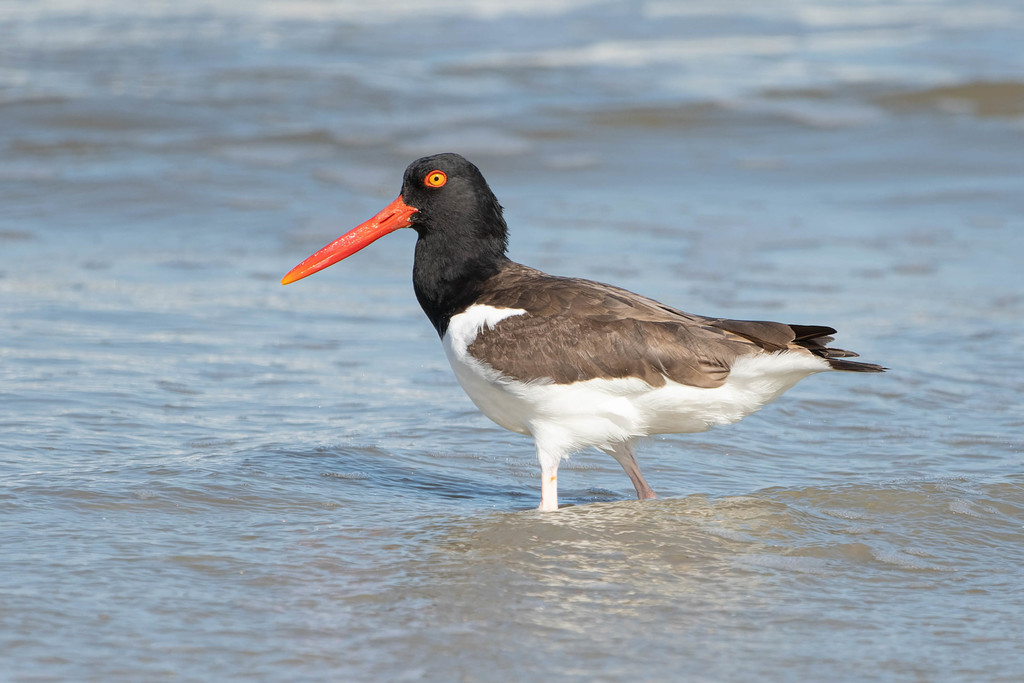
The American oystercatcher (Haematopus palliatus), occasionally called the American pied oystercatcher, is a member of family Haematopodidae. Originally called the "sea pie", it was renamed in 1731 when naturalist Mark Catesby claimed that he had observed the bird eating oysters. The current population of American oystercatchers is estimated to be 50,000 – 99,999 mature individuals. There are estimated to be 1,500 breeding pairs along the Atlantic and Gulf Coasts of the US. The bird is marked by its black and white body and a long, thick orange beak.
From the article American oystercatcher on Wikipedia (CC BY-SA), quoted section by section
Description
The American oystercatcher has distinctive black and white plumage and a long, bright orange beak. The head and breast are black and the back, wings and tail greyish-black. The underparts are white, as are feathers on the inner part of the wing which become visible during flight. The irises are yellow and the eyes have orange orbital rings. The legs are pink. Adults are between 42–52 cm (17–20 in) in length.
Range & habitat
The American oystercatcher is found on the Atlantic coast of North America from coastal Massachusetts to northern Florida, where it is also found on the Gulf coast, the Caribbean, and south to Brazil, Uruguay and Argentina. It is found also in the Pacific coast of California, Mexico, Central America, Peru, and Chile. In the 19th century they became locally extinct in the lower northeastern United States due to market hunting and egg collecting. After receiving protection under the Migratory Bird Treaty Act, their range extended northward to re-occupy historical habitat in the coastal Northeast. During the breeding season, these birds are found along the Atlantic and Gulf Coasts and from Massachusetts south to Argentina and Chile. In winter, they are found in flocks along the coast from central New Jersey to the Gulf of Mexico.
Wikipedia: “Distribution”
What it does
Oystercatchers are closely tied to coastal habitats. They nest on beaches on coastal islands and feed on marine invertebrates. The large, heavy beak is used to pry open bivalve mollusks. Oystercatchers raise a clutch of two or three eggs.
Feeding. The American oystercatcher feeds almost exclusively on shellfish and other marine invertebrates. Oysters are a staple of their diet, as their name suggests, but they also eat mussels, clams, limpets, sea urchins, starfish, crabs, and worms. In general, they use their bills to catch shellfish. As they walk across a shellfish bed, they look for a mollusk with a partially opened shell. When they find one, they jab their bill into the shell and sever the muscle that causes the shell to clamp shut. This can be dangerous, however, as they are sometimes drowned when they don't completely sever this muscle and the shell clamps down on their bill. A strong, tightly rooted mollusk can hold the bird in place until the tide comes in. They also feed by carrying loose shellfish out of the water and hammering at the shell or by probing the sand for soft-shell or razor clams.
Mating. American oystercatchers first breed at an age of 3–4 years. When courting, the birds will walk together and make a single piping note. This progresses to leaning towards each other, extending and lowering the neck, and running alongside each other while calling. …
Wikipedia: “Behavior”
Listen
Looking for field recordings…
Where it lives
Recorded sightings
—
geo-referenced records in GBIF, from museums, herbaria and field observers.
Drag the globe to turn it. Dots are where records exist, not a range map; darker means more records.
In the old herbals & bestiaries

In the stacks
Searching the stacks…
Every page naming Haematopus palliatus in the Biodiversity Heritage Library →
This page is assembled live from iNaturalist, GBIF, Wikipedia, the Source Library and the Internet Archive. It is not yet part of the hand-edited codex. iNaturalist taxon 4840.