- Animals
- ›Chordates
- ›Vertebrates
- ›Birds
- ›Hawks, Eagles, Kites, and Allies
- ›Hawks, Eagles, and Kites
- ›Bearded, Egyptian, and Palm-nut Vultures
- ›Gypohierax
On eBird ↗
Palm-nut Vulture
Live sightings near you, the range map, bar charts of when it is seen, and Macaulay Library photos and recordings.
Palm-nut Vulture
Gypohierax angolensis
The palm-nut vulture (Gypohierax angolensis) or vulturine fish eagle, is a large bird of prey in the family Accipitridae (which also includes many other diurnal raptors such as kites, buzzards and harriers, vultures, and eagles). It is the only member of the genus Gypohierax. Unusual for birds of prey, it feeds mainly on the fruit of the oil palm, though it also feeds on crabs, molluscs, locusts, and fish, and has been known to occasionally attack...
From the article Palm-nut vulture on Wikipedia (CC BY-SA), quoted section by section
Description
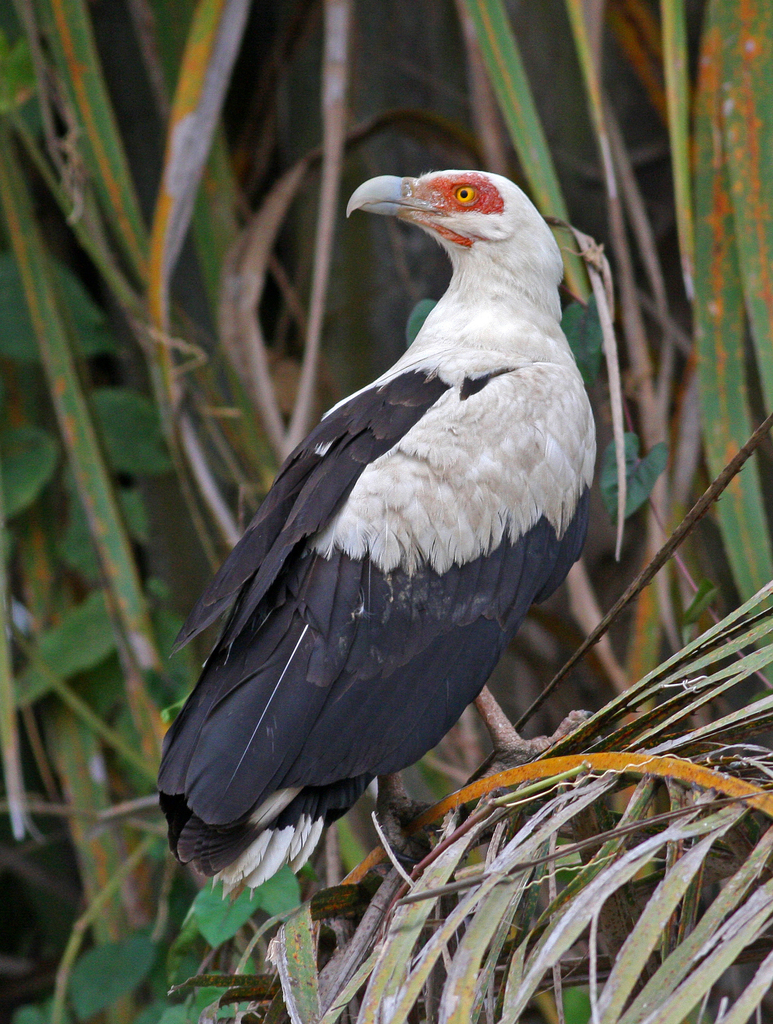
This is a nearly unmistakable bird as an adult. At 1.3–1.7 kg (2.9–3.7 lb) in weight, 60 cm (2.0 ft) in length and with a wingspan of 1.50 m (4.9 ft), this is the smallest Old World vulture. Its plumage is all white except for black areas in its wings and tail. It has a red patch around each eye. The juvenile, which takes 3–4 years to mature, is brown with yellow eye-patches. In flight, this species resembles an eagle more than a typical vulture, and it can sustain flapping flight, so it does not depend on thermals. With its extensive white plumage, and black wing- and tail-feathers, the adult palm-nut vulture can be crudely mistaken for both the African fish-eagle and the Egyptian vulture, but clearly lacks the chestnut body of the former and the white tail of the latter. The sexes are identical in appearance, with the female being the same size as the male. Juveniles on the other hand are predominately brown with partially black wings and take a lengthy three to four years to make the transition into the adult plumage.
Range & habitat
Palm-nut vultures are found throughout most of the coastal areas of the African continent from The Gambia to Kenya and as far South as South Africa. The total African population is estimated to be 80,000 pairs. There are approximately 40 birds in South Africa. The only Southern African subregions to have resident breeding pairs of palm-nut vultures are South Africa and Mozambique. The breeding distribution of the palm-nut vulture during the 1970s census period was centred on the Raffia palm groves of the Kosi Bay system and Mtunzini. Its distribution is linked to the presence of the Raffia palm Raphia australis at all permanently occupied sites, and the existence of this species at Mtunzini is entirely due to the artificial cultivation of Raffia palms. Currently there are 7 known nesting sites in South Africa and a total of 40 individual birds. As the name suggests, the distribution of the palm-nut vulture closely tracks that of oil (Elaeis guineensis) or raffia (Raphia sp.) palms. Consequently, it is most common in coastal forests and mangrove swamps below 1,500 m (4,900 ft), but also occurs in wet savannas.
Wikipedia: “Distribution and habitat”
What it does
Unusual for birds of prey, the palm-nut vulture feeds mainly on the fleshy fruit-husks of the oil palm and on the palm-fruits of Raffia palms, as well as wild dates, oranges, other fruits, some grains and acacia seeds. These fruits make up over 60% of the adult bird's diet and over 90% of the juvenile bird's diet. It has also been recorded to feed on crabs (both freshwater and marine), molluscs, frogs, tadpoles, fish, dung beetles, termites, alate ants, alate termites, locusts, small mammals, birds and their nestlings, snakes, other reptiles, even reptiles’ eggs and hatchlings, and it has been known to occasionally attack domestic poultry and feed on carrion.
Wikipedia: “Food and feeding”
Listen
Looking for field recordings…
Where it lives
Recorded sightings
—
geo-referenced records in GBIF, from museums, herbaria and field observers.
Drag the globe to turn it. Dots are where records exist, not a range map; darker means more records.
In the stacks
Searching the stacks…
Every page naming Gypohierax angolensis in the Biodiversity Heritage Library →
This page is assembled live from iNaturalist, GBIF, Wikipedia, the Source Library and the Internet Archive. It is not yet part of the hand-edited codex. iNaturalist taxon 5418.