- Animals
- ›Chordates
- ›Vertebrates
- ›Birds
- ›Pelicans, Herons, Ibises, and Allies
- ›Ibises and Spoonbills
- ›Plegadis
On eBird ↗
Glossy Ibis
Live sightings near you, the range map, bar charts of when it is seen, and Macaulay Library photos and recordings.
Glossy Ibis
Plegadis falcinellus
The glossy ibis (Plegadis falcinellus) is a water bird in the order Pelecaniformes and the ibis and spoonbill family Threskiornithidae. The scientific name derives from Ancient Greek plegados and Latin, falcis, both meaning "sickle" and referring to the distinctive shape of the bill.
The historical name black curlew was used for the glossy ibis in Norfolk at least until the early 19th century, and this name also appears in Anglo-Saxon literature. Yalden and Albarella do not mention this species as occurring in medieval England.
From the article Glossy ibis on Wikipedia (CC BY-SA), quoted section by section
Description
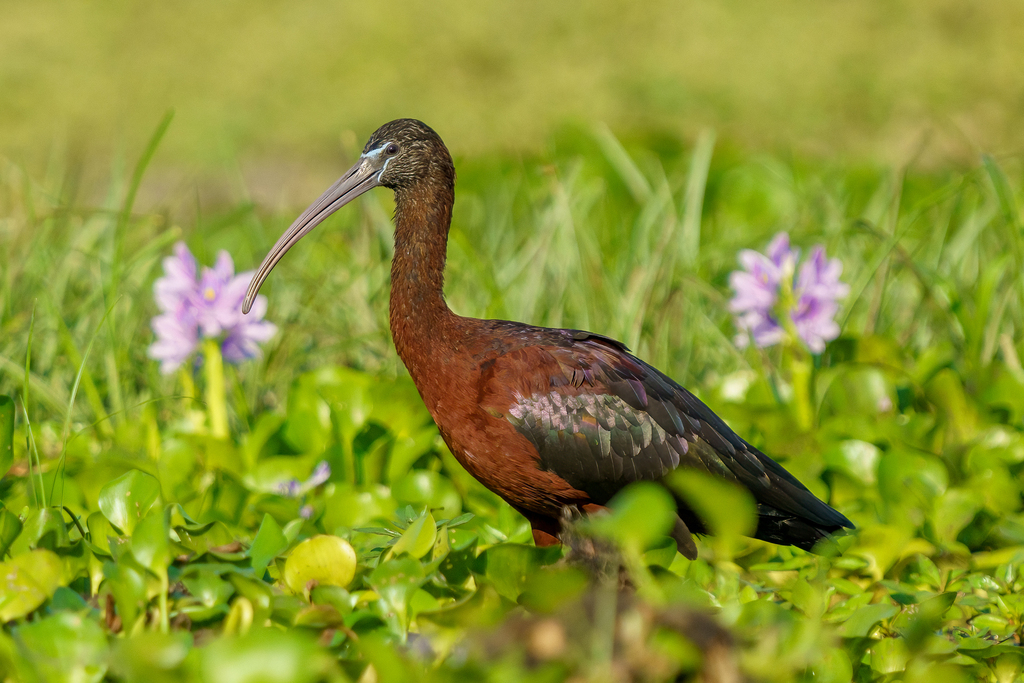
This species is a mid-sized ibis. It is 48–66 cm (19–26 in) long, averaging around 59.4 cm (23.4 in) with an 80–105 cm (31–41 in) wingspan. The culmen measures 9.7 to 14.4 cm (3.8 to 5.7 in) in length, each wing measures 24.8–30.6 cm (9.8–12.0 in), the tail is 9–11.2 cm (3.5–4.4 in) and the tarsus measures 6.8–11.3 cm (2.7–4.4 in). The weight can range from 485 to 970 g (1.069 to 2.138 lb). Breeding adults have reddish-brown bodies and strongly iridescent wing feathers, bottle-green to bronzed or purple depending on the light angle. Adult breeding birds have a narrow white facial band above and below the bill, much less obvious than in the closely related and otherwise very similar white-faced ibis. Non-breeders and juveniles have duller bodies, with the dark brown head and neck finely streaked with white. It has a brownish bill, dark facial skin bordered above and below in blue-grey (non-breeding) to cobalt blue (breeding), and red-brown legs. Unlike herons, ibises fly with necks outstretched, their flight being graceful and often in V formation. Sounds made by this rather quiet ibis include a variety of croaks and grunts, including a hoarse grrrr made when breeding.
Range & habitat
This is the most widespread ibis species, breeding in scattered sites in warm regions of Europe, Asia, Africa, Australia, and the Atlantic and Caribbean regions of the Americas. It is thought to have originated in the Old World and spread naturally from Africa to northern South America in the 19th century, from where it spread to North America. The glossy ibis was first documented in the New World in 1817 (New Jersey). Audubon saw the species just once in Florida in 1832. It expanded its range substantially northwards in the 1940s and to the west in the 1980s. This species is migratory; most European birds winter in Africa, and in North America birds from north of the Carolinas winter farther south. Though generally suspected to be a migratory species in India, the glossy ibis is resident in western India. Birds from other populations may disperse widely outside the breeding season. It is increasing in Europe, after earlier major declines in the 19th and early 20th centuries due to uncontrolled heavy hunting pressure and habitat loss. Birds which arrived in Great Britain and Ireland were routinely shot as trophies until the 1920s, when attitudes started to change. It disappeared as a regular breeding bird in Spain in the early 20th century, but with legal protection re-established itself in 1993 and has since rapidly increased with thousands of pairs in several colonies. …
Wikipedia: “Distribution”
What it does
Glossy ibises undertake dispersal movements after breeding and are highly nomadic. The more northerly populations are fully migratory and travel on a broad front, for example across the Sahara Desert. Glossy ibis ringed in the Black Sea seem to prefer the Sahel and West Africa to winter, those ringed in the Caspian Sea have been found to move to East Africa, the Arabian peninsula and as far east as Pakistan and India. Numbers of glossy ibis in western India varied dramatically seasonally with the highest numbers being seen in the winter and summers, and drastically declining in the monsoon likely indicating local movements to a suitable area to breed. Populations in temperate regions breed during the local spring, while tropical populations nest to coincide with the rainy season. Nesting is often in mixed-species colonies. When not nesting, flocks of over 100 individuals may occur on migration, and during the winter or dry seasons the species is usually found foraging in small flocks. Glossy ibises often roost communally at night in large flocks, with other species, occasionally in trees which can be some distance from wetland feeding areas.
Wikipedia: “Behaviour”
Listen
Looking for field recordings…
Where it lives
Recorded sightings
—
geo-referenced records in GBIF, from museums, herbaria and field observers.
Drag the globe to turn it. Dots are where records exist, not a range map; darker means more records.
In the stacks
Searching the stacks…
Every page naming Plegadis falcinellus in the Biodiversity Heritage Library →
This page is assembled live from iNaturalist, GBIF, Wikipedia, the Source Library and the Internet Archive. It is not yet part of the hand-edited codex. iNaturalist taxon 3756.