- Animals
- ›Chordates
- ›Vertebrates
- ›Birds
- ›Pelicans, Herons, Ibises, and Allies
- ›Ibises and Spoonbills
- ›Phimosus
On eBird ↗
Bare-faced Ibis
Live sightings near you, the range map, bar charts of when it is seen, and Macaulay Library photos and recordings.
Bare-faced Ibis
Phimosus infuscatus
The bare-faced ibis (Phimosus infuscatus), also known as the whispering ibis, is a species of bird in the family Threskiornithidae, in the monotypic genus Phimosus.
From the article Bare-faced ibis on Wikipedia (CC BY-SA), quoted section by section
Description
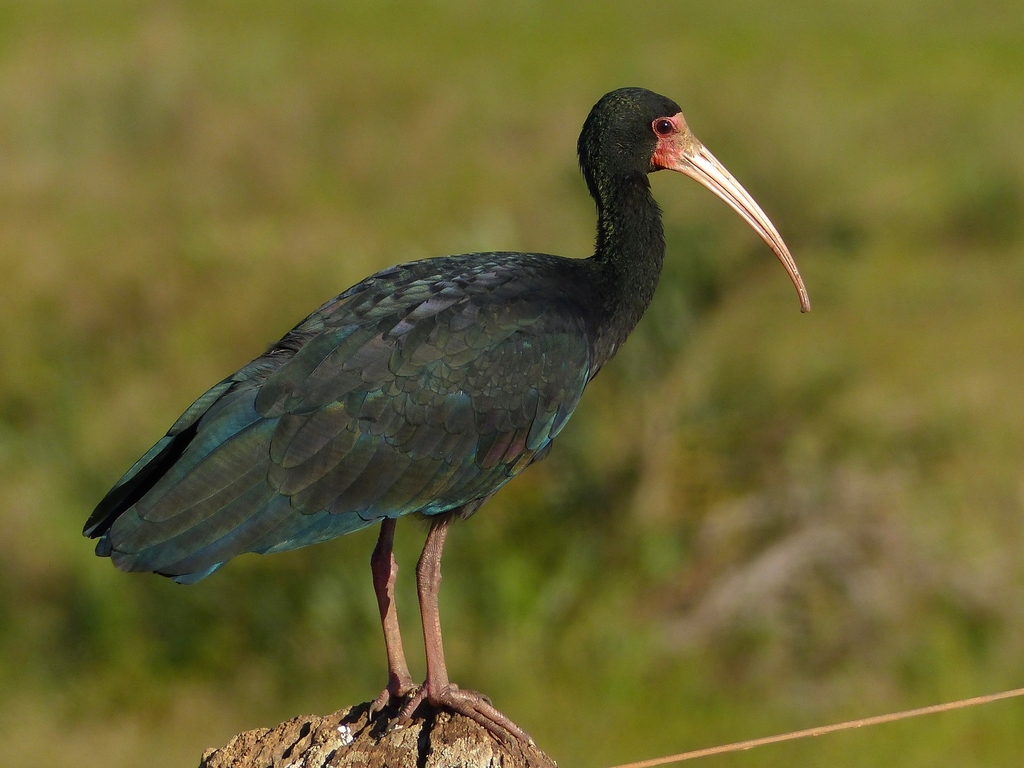
The bare-faced ibis is either dark brown or a blackish color. It is called the bare-faced ibis because it does not have any feathers on its face. It has a long decurved bill with a pinkish to reddish brown colour. The skin on its face is usually a reddish color, and it also has long orange colored beak with pink legs. The total length of the ibis ranges between 45 and 50 cm.
Range & habitat
It is found in Argentina, Bolivia, Brazil, Colombia, Ecuador, Guyana, Paraguay, Suriname, Uruguay, and Venezuela.
Wikipedia: “Distribution”
What it does
Bare-faced ibises are usually seen in large flocks of their own species or with other species of ibis, sometimes even found with domestic animals. They live in close range neighboring amongst other flocks of ibis, typically known for the closest living habitats that range from being 100 meters away from the nearest neighbor. They are not very territorial towards other ibis birds, and are rarely found alone, but most of the time their aggression is limited to food robbery from another ibis or animal. Regarding nesting behavior, it is less aggressive when compared to other species of ibis. The males have a larger bill than the females relative to their body sizes, and sexual selection is not as intense as it is in other species. They share nests with other species as well.
Wikipedia: “Behavior”
At the table
The bare-faced ibis forages in most soil and along the edges of standing water. Its diet consists of insects, worms, clams, and other small invertebrates.
Wikipedia: “Food”
Listen
Looking for field recordings…
Where it lives
Recorded sightings
—
geo-referenced records in GBIF, from museums, herbaria and field observers.
Drag the globe to turn it. Dots are where records exist, not a range map; darker means more records.
In the stacks
Searching the stacks…
Every page naming Phimosus infuscatus in the Biodiversity Heritage Library →
This page is assembled live from iNaturalist, GBIF, Wikipedia, the Source Library and the Internet Archive. It is not yet part of the hand-edited codex. iNaturalist taxon 3736.