On eBird ↗
Great Black-backed Gull
Live sightings near you, the range map, bar charts of when it is seen, and Macaulay Library photos and recordings.
Great Black-backed Gull
Larus marinus
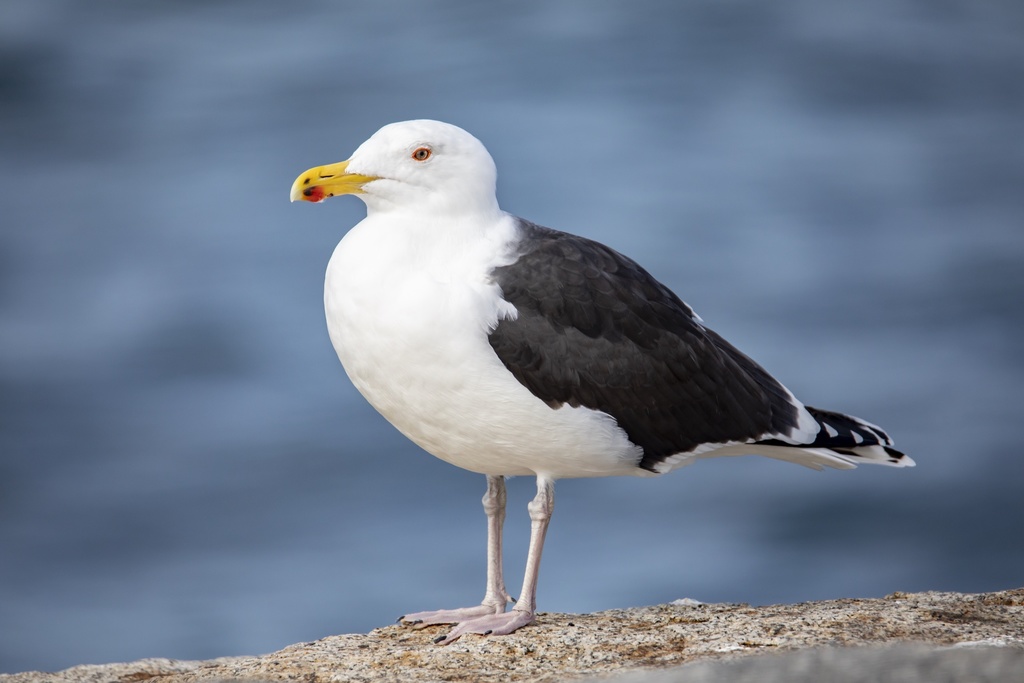
The great black-backed gull (Larus marinus) is the largest member of the gull and tern family Laridae. It is a very aggressive hunter, pirate and scavenger which breeds on the North Atlantic coasts and islands of northern Europe and northeastern North America. Southern populations are generally sedentary, while those breeding in the far north (northern Norway, northwest Russia) migrate farther south in winter. A few also move inland to large lakes and reservoirs. The adult has a white head, neck and underparts, dark blackish-grey wings and back, pink legs and the bill yellow with a red spot.
From the article Great black-backed gull on Wikipedia (CC BY-SA), quoted section by section
Description
This is the largest gull in the world, considerably larger than a herring gull (Larus argentatus); only two other gulls, glaucous gull (Larus hyperboreus) and Pallas's gull (Ichthyaetus ichthyaetus), come close to matching this species in size. It is 64–79 cm (25–31 in) long with a 1.5–1.7 m (4 ft 11 in – 5 ft 7 in) wingspan and a body weight of 0.75–2.3 kg (1 lb 10 oz – 5 lb 1 oz). In a sample of 2009 adults from the North Atlantic, males were on average 1,830 g (4 lb 1⁄2 oz) and females were on average 1,488 g (3 lb 4+1⁄2 oz). Some adult gulls with access to fisheries in the North Sea can weigh up to roughly 2.5 kg (5+1⁄2 lb) and averaged 1.96 kg (4 lb 5 oz). An exceptionally large glaucous gull was found to outweigh any known great black-backed gull, although usually that species is slightly smaller. The great black-backed gull is bulky and imposing in appearance with a large, powerful bill. The standard measurements are: the bill is 5.4 to 7.25 cm (2+1⁄8 to 2+7⁄8 in), the wing chord is 44.5 to 53 cm (17+1⁄2 to 20+3⁄4 in) and the tarsus is 6.6 to 8.8 cm (2+5⁄8 to 3+1⁄2 in).
The adult great black-backed gull is fairly distinctive, as no other very large gull with black on its upper-wings generally occurs in the North Atlantic. In other white-headed North Atlantic gulls, the mantle is generally a lighter grey and, in some species, it is a light powdery grey or even pinkish. …
Range & habitat
This species can be found breeding in coastal areas from the extreme northwest portion of Russia, through much of coastal Scandinavia, on the Baltic Sea coasts, to the coasts of northwestern France, the United Kingdom and Ireland. Across the northern portion of the Atlantic, this gull is distributed in Iceland, the Faroe Islands, southern Greenland and on the Atlantic coasts of Canada and the United States. Though formerly mainly just a non-breeding visitor south of Canada in North America, the species has spread to include several colonies in the New England states and now breeds as far south as North Carolina. Individuals breeding in harsher environments will migrate south, wintering on northern coasts of Europe from the Baltic Sea to southern Portugal, and regularly down to coastal Florida in North America. During the winter in the Baltic Sea, the bird usually stays close to the ice boundary. North of the Åland islands, the sea often freezes all the way from Sweden to Finland, and then the bird migrates to open waters. Exceptionally, the species can range as far south as the Caribbean and off the coast of northern South America. The great black-backed gull is found in a variety of coastal habitats, including rocky and sandy coasts and estuaries, as well as inland wetland habitats, such as lakes, ponds, rivers, wet fields and moorland. …
Wikipedia: “Distribution and habitat”
What it does
Great black-backed gulls are opportunistic feeders, apex predators of the oceanic sky, and are very curious. They will investigate any small organism they encounter and will readily eat almost anything that they can swallow. They get much of their dietary energy from scavenging, with refuse, most provided directly by humans, locally constituting more than half of their diet. The proliferation of garbage or refuse dumps has become a major attractant to this and all other non-specialised gull species in its range. A study to investigate how much time they spend foraging at refuse dumps in Massachusetts found great black-backed gulls were only observed actively foraging 19% of their time there, eating less garbage than other common gulls, and spent most of their time roosting or loafing. Like most gulls, great black-backed gulls regularly capture fish, and any fish smaller than themselves found close to the surface of the water are potential prey. Stomach contents of great black-backed gulls usually show fish to be the primary food. On Sable Island in Nova Scotia, 25% of the stomach contents consisted of fish, but 96% of the regurgitations given to young consisted of fish. Similarly, on Great Island in Newfoundland, 25% of the stomach contents were fish but 68% of regurgitants were fish. …
Wikipedia: “Diet”
Listen
Looking for field recordings…
Where it lives
Recorded sightings
—
geo-referenced records in GBIF, from museums, herbaria and field observers.
Drag the globe to turn it. Dots are where records exist, not a range map; darker means more records.
In the stacks
Searching the stacks…
Every page naming Larus marinus in the Biodiversity Heritage Library →
This page is assembled live from iNaturalist, GBIF, Wikipedia, the Source Library and the Internet Archive. It is not yet part of the hand-edited codex. iNaturalist taxon 4368.