On eBird ↗
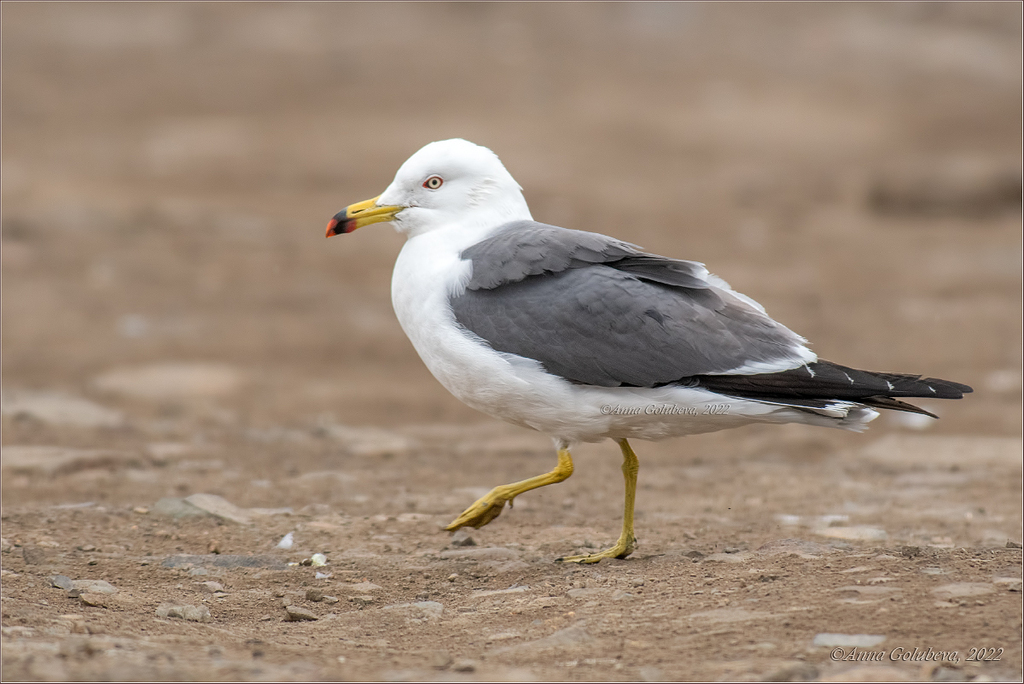
Black-tailed Gull
Live sightings near you, the range map, bar charts of when it is seen, and Macaulay Library photos and recordings.
Black-tailed Gull
Larus crassirostris
The black-tailed gull (Larus crassirostris) is a gull native to shorelines of East Asia.
From the article Black-tailed gull on Wikipedia (CC BY-SA), quoted section by section
Description
The black-tailed gull is medium-sized (46 cm or 18.1 in), with a wingspan of 126–128 cm (49.6–50.4 in). It has yellow legs and a red and black spot at the end of the bill. Males and females have identical plumage and features, although males are larger in size than females. This gull takes four years to reach full adult plumage. As the name suggests, it has a black tail. The bird has a cat-like call, giving it its Japanese name — umineko (海猫, 'sea cat'), and Korean name — gwaeng-yi gull, which means 'cat' gull. In Hachinohe their calls are one of the 100 Soundscapes of Japan.
Range & habitat
The species is resident to coastlines of the East China Sea, Japan, Manchuria and the Kuril Islands. It is a vagrant to Alaska and North America and has been found in the Philippines.
In Japan. The bird is common in Japan, nesting from Hokkaido to Western Kyushu. It has caused flights to be delayed at Haneda Airport in Tokyo.
An enormous gathering of black-tailed gulls can be found at Kabushima, a peninsula (formerly an island) in Hachinohe, Aomori, Japan. A Shinto shrine was raised by fishermen in 1269 (and has been rebuilt several times since) at which the black-tailed gull is seen as a messenger of the goddess of the fishery. For over 700 years, the species has enjoyed reverence, feeding and protection from the local population. As a result, every summer, over 40,000 black-tailed gulls nest and raise their young in the grounds of the shrine and the surrounding island, which has been designated a National Natural Monument by the government of Japan. The gulls are very tame and are a popular tourist attraction. Around 5,000 birds also nest at Fumi-shima in Shimane Prefecture near Izumo Shrine, and there is a large colony at Teuri Island in Hokkaido.
In Korea. The species is common on the shoreline of Korea and on various islands. There are over 20,000 black-tailed gulls on Liancourt Rocks, and numbers are increasing due to the absence of predators. …
Wikipedia: “Distribution and habitat”
What it does
The black-tailed gull feeds mainly on small fish, molluscs, crustaceans scraps and carrion. A study analyzing the identifiable parts of gull excreta in Korea found that 19.1% consisted of the remains of fish, 3.3% of crustaceans, and 3.3% of land insects. The species often follows ships and commercial fishing fleets. It also steals food from other seabirds. It is a colonial nester, with colonies forming in mid-April. 2–3 eggs are laid by early June. Incubation lasts approximately 24 days. Black-tailed gulls use a variety of voice signals and are known to use more than 10 different sounds for communication. Young can recognize their parents from their voice and visual stimulation between 10 and 15 days after hatching, and can also distinguish between siblings and non-siblings. Alarm calls are alert signals that warn of predators or danger. Aggressive calls accompany attacks on predators. Contact calls are signals used for intra-specific communication. The most commonly heard cat-like sound ("mew call") is a part of the contact call, and is frequently used, such as when returning to the nest after taking food, alternating the role of the mating and nesting, taking care of the young, collective flight, etc. The sound of a young gull begging for food and the sound of a female during mating are also included in the contact call.
Wikipedia: “Ecology”
Listen
Looking for field recordings…
Where it lives
Recorded sightings
—
geo-referenced records in GBIF, from museums, herbaria and field observers.
Drag the globe to turn it. Dots are where records exist, not a range map; darker means more records.
In the stacks
Searching the stacks…
Every page naming Larus crassirostris in the Biodiversity Heritage Library →
This page is assembled live from iNaturalist, GBIF, Wikipedia, the Source Library and the Internet Archive. It is not yet part of the hand-edited codex. iNaturalist taxon 4370.