 NL·0418
Herbarium of the Nature Library
- Name
- Thalassarche melanophris
- Family
- Diomedeidae
- Native to
- Breeds on sub-Antarctic islands (Falklands, South Georgia, Chile); ranges over the Southern Ocean
- Habitat
- Marine, Sub-Antarctic island
On eBird ↗
Black-browed Albatross
Live sightings near you, the range map, bar charts of when it is seen, and Macaulay Library photos and recordings.
Black-browed albatross
Thalassarche melanophris
Also calledAlbatros ceja negra (Spanish) · Albatros à sourcils noirs (French) · Malmok (Afrikaans, albatross) · Toroa (Māori, albatross)
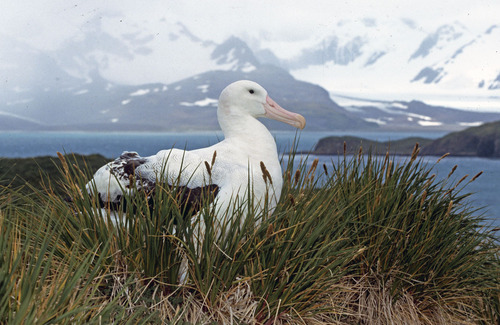
The most widespread and numerous albatross, with a dark 'eyebrow' giving it a stern expression. About two-thirds of the world population breeds in the Falkland Islands.
The black-browed albatross, also known as the black-browed mollymawk, is a large seabird of the albatross family Diomedeidae; it is the most widespread and common member of its family. Wikipedia
What it can do
- iDynamic soaring lets it travel thousands of kilometres with little flapping
- iiLocks its wings in place with a shoulder tendon
- iiiNests in vast colonies on cliffs and slopes
In the field
Field marks
- aDark eyebrow stripe
- bBright orange-yellow bill with reddish tip
- cDark upperwings and back, white body
- dBroad dark margins to the white underwing
- Voice
- Braying and groaning calls at colonies; silent at sea.
- Not to be confused with
- Campbell albatross (New Zealand) has a pale yellow eye. Shy albatross has a pale grey-green bill and narrow underwing margins.
- Where to see it
- Steeple Jason, Saunders and New Islands (Falklands); off Cape Horn
- When
- Breeds Sept–April; disperses north in winter
Listen
Looking for field recordings…
Life & habits
- Diet
- Fish, squid, crustaceans and fishery discards
- Habitat
- Open ocean; nests on sub-Antarctic islands
- Size
- 80–95 cm; wingspan 2.1–2.5 m
Pairs reunite every year with elaborate dances of bill-fencing and sky-pointing.
Where it lives
Recorded sightings
—
geo-referenced records in GBIF, from museums, herbaria and field observers.
Native range
Breeds on sub-Antarctic islands (Falklands, South Georgia, Chile); ranges over the Southern Ocean
Drag the globe to turn it. Dots are where records exist, not a range map; darker means more records.
In the old herbals & bestiaries
No plate in the Source Library names this exact species, so these show its closest relatives as the old naturalists drew them: same genus, or the same kind of animal. Click a plate to read the page it came from, with translation.

In the stacks
Searching the stacks…
Every page naming Thalassarche melanophris in the Biodiversity Heritage Library →
Marginalia
The species was downlisted from Endangered to Near Threatened in 2013 and to Least Concern in 2017, following reductions in seabird bycatch.
Curiosity
Steeple Jason Island in the Falklands holds well over 100,000 breeding pairs, among the largest albatross colonies anywhere.
Kinship



Fact-checked: 1 correction made to this sheet. Photographs: iNaturalist contributors under the licences shown. Records: GBIF.org. Historical plates: Source Library (CC BY-SA 4.0; originals public domain). Summary text: Nature Library editors and Wikipedia (CC BY-SA). Medicinal and edibility notes are historical and educational, not advice. iNaturalist taxon 144433.