On eBird ↗
Pintado Petrel
Live sightings near you, the range map, bar charts of when it is seen, and Macaulay Library photos and recordings.
Pintado Petrel
Daption capense
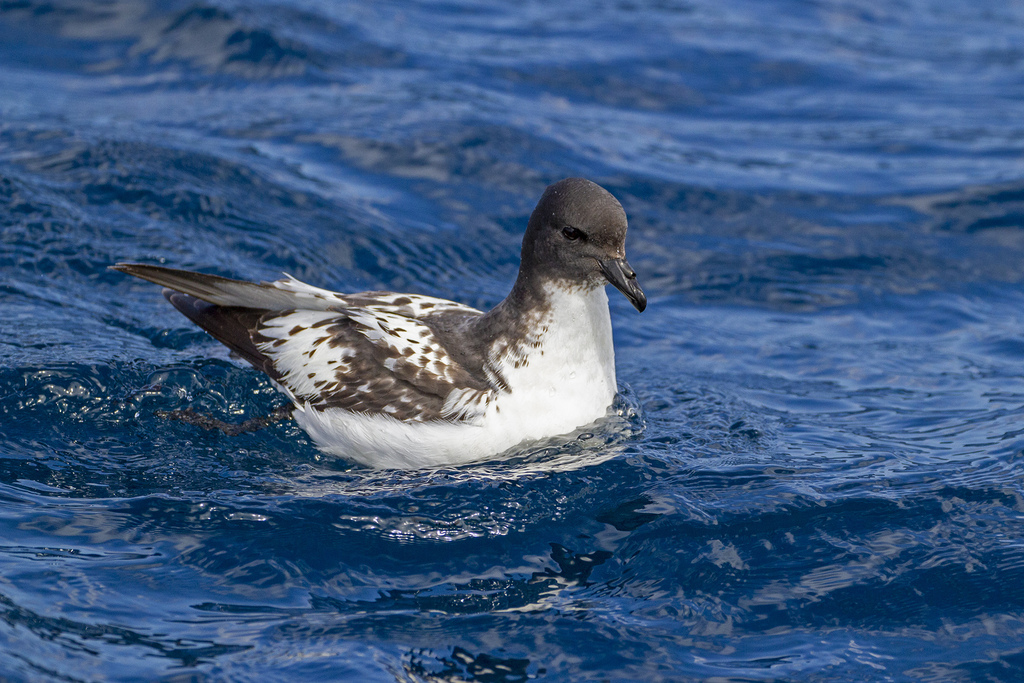
The Cape petrel (Daption capense), also called the Cape pigeon, pintado petrel, or Cape fulmar, is a common seabird of the Southern Ocean from the family Procellariidae. It is the only member of the genus Daption, and is allied to the fulmarine petrels, and the giant petrels. They are extremely common seabirds with an estimated population of around 2 million.
From the article Pintado petrel on Wikipedia (CC BY-SA), quoted section by section
Description
The pintado petrel has a black head and neck, and a white belly, breast, and its underwing is white with a black border. Its back, and upperwings are black and white speckled, as is its tail which also has a band of black. It is 35–40 cm (14–16 in) long and the wingspan 80–90 cm (31–35 in). Two subspecies are recognised, though intermediates occur:
D. c. capense (Linnaeus, 1758) – breeds on circumpolar subantarctic islands, winters at sea north to around the Tropic of Capricorn and locally further north in cold currents (to the Equator around the Galapagos Islands). Larger; back white with black spots. D. c. australe Mathews, 1913 – breeds on subantarctic islands around and south of New Zealand, extends northwest to southeastern Australian waters outside of the breeding season. Smaller; back solid blackish-brown down to the top of rump.
Range & habitat
During breeding season, pintado petrels feed at sea around Antarctica, and during the winter they range further north, as far as Angola and the Galapagos Islands. They breed on many islands of Antarctica and the subantarctic islands, some as far north as the Auckland Islands, the Chatham Islands, Campbell Island. Their main breeding grounds are on the Antarctic Peninsula, South Georgia, the Balleny Islands, the Kerguelen Islands, as well as islands in the Scotia Sea. Birds have been reported from Northern Hemisphere waters, but are of unknown origin, probably captured by sailors and released in northern waters.
Wikipedia: “Distribution and habitat”
What it does
The diet is 80% crustaceans, as well as fish and squid. Krill is their favoured crustacean, which they obtain by surface seizing as well as diving under water and filtering them out. They are also well known for following ships and eating edible waste and carcasses thrown overboard. They are aggressive while feeding and will spit their stomach oil at competitors, even their own species.
Wikipedia: “Diet”
Listen
Looking for field recordings…
Where it lives
Recorded sightings
—
geo-referenced records in GBIF, from museums, herbaria and field observers.
Drag the globe to turn it. Dots are where records exist, not a range map; darker means more records.
In the stacks
Searching the stacks…
Every page naming Daption capense in the Biodiversity Heritage Library →
This page is assembled live from iNaturalist, GBIF, Wikipedia, the Source Library and the Internet Archive. It is not yet part of the hand-edited codex. iNaturalist taxon 4168.