On eBird ↗
Snow Petrel
Live sightings near you, the range map, bar charts of when it is seen, and Macaulay Library photos and recordings.
Snow Petrel
Pagodroma nivea
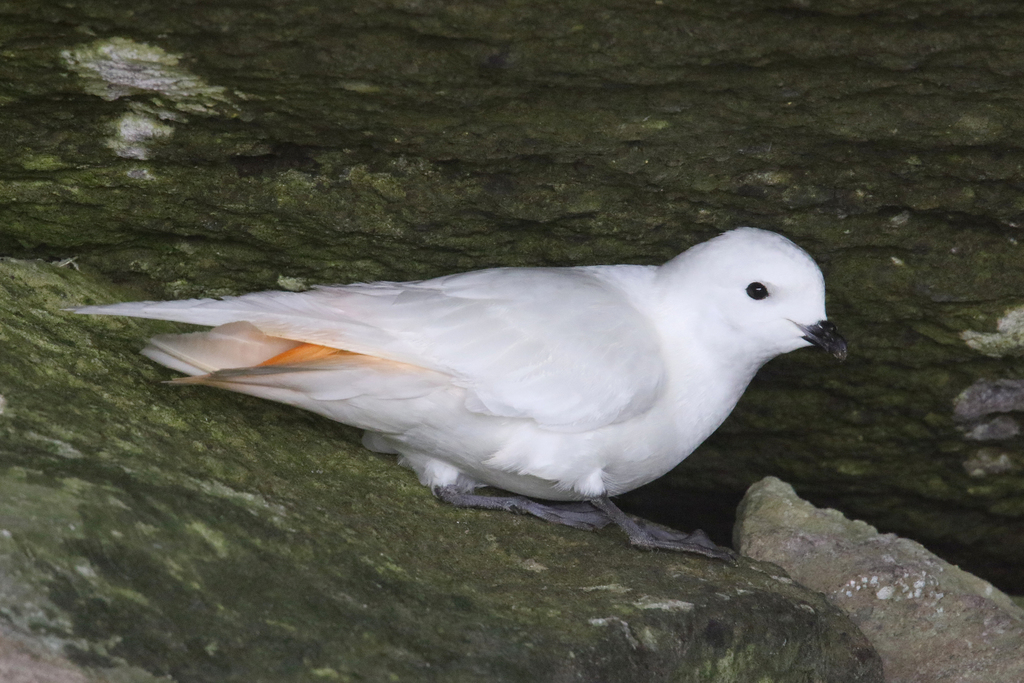
The snow petrel (Pagodroma nivea) is the only member of the genus Pagodroma. It is one of only three birds that have been seen at the Geographic South Pole, along with the Antarctic petrel and the south polar skua, and it has the most southerly breeding sites of any bird, inland in Antarctica.
From the article Snow petrel on Wikipedia (CC BY-SA), quoted section by section
Description
The snow petrel is a small, pure white fulmarine petrel with coal-black eyes, a small black bill and bluish gray feet. Body length is 30–40 cm (12–16 in) and the wingspan is 75–95 cm (30–37 in). Flight is erratic with frequent changes of direction.
What it does
Snow petrels are almost entirely restricted to cold Antarctic waters. Flocks are characteristically seen sitting on icebergs.
Breeding. Breeding occurs in colonies on the Antarctic continent and on various Antarctic islands. Nesting is colonial in small to large colonies on exposed rocks, usually near the sea, but also on inland mountain ranges more than 400 km (250 mi) from the open sea. Some birds remain at the colony all year, but the main influx at colonies is from the mid-September until early November. Nests are simple pebble-lined scrapes usually in a deep rock crevices with overhanging protection. Nests are abandoned if concealed by heavy snowfall; egg mortality is 50%, and chick mortality is 10–15%. One white egg is laid between late November and mid-December. The egg is incubated 41 to 49 days and the chick is brooded for 8 days. They fledge 7 weeks later in late February to mid-May. Colonies are also the sites of cleaning areas where snow petrels, far from the sea, bathe in snow. Snow petrel partners are faithful for life (around 20 years).
Feeding. Snow petrels feed mainly on fish, some cephalopods, mollusks, and krill, as well as carrion in the form of seal placentas, dead/stillborn seals, whale carcasses, and dead penguin chicks. During the winter, they disperse to the pack ice, ice floes, and the open sea. Flocks are characteristically seen sitting on icebergs. …
Wikipedia: “Behavior”
Listen
Looking for field recordings…
Where it lives
Recorded sightings
—
geo-referenced records in GBIF, from museums, herbaria and field observers.
Drag the globe to turn it. Dots are where records exist, not a range map; darker means more records.
In the stacks
Searching the stacks…
Every page naming Pagodroma nivea in the Biodiversity Heritage Library →
This page is assembled live from iNaturalist, GBIF, Wikipedia, the Source Library and the Internet Archive. It is not yet part of the hand-edited codex. iNaturalist taxon 4195.