On eBird ↗
Parasitic Jaeger
Live sightings near you, the range map, bar charts of when it is seen, and Macaulay Library photos and recordings.
Parasitic Jaeger
Stercorarius parasiticus
The parasitic jaeger or arctic skua (Stercorarius parasiticus), also known as the parasitic skua or arctic jaeger, is a seabird in the skua family Stercorariidae. It is a migratory species breeding in Northern Fennoscandia, Scotland, Iceland, Greenland, Northern Canada, Alaska, and Siberia and wintering across the southern hemisphere. Kleptoparasitism is a major source of food for this species during migration and winter, and is where the name is derived from.
From the article Parasitic jaeger on Wikipedia (CC BY-SA), quoted section by section
Description
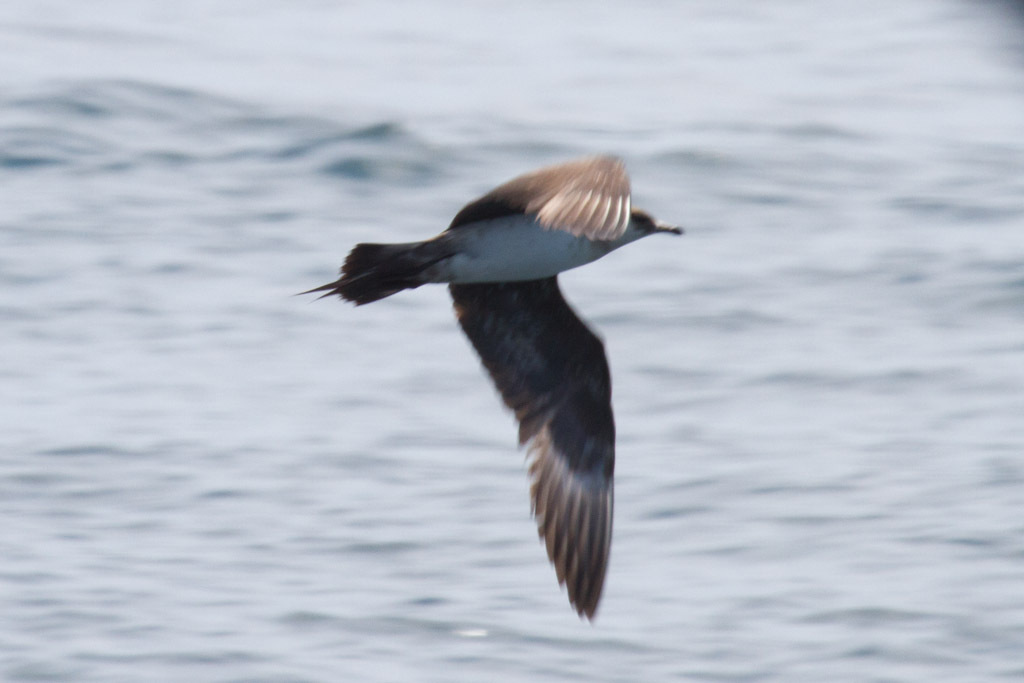
Identification is complicated by similarities to long-tailed jaeger and pomarine jaeger, and the existence of three colour morphs. Small for a skua, the parasitic jaeger measures 41–48 cm (16–19 in) in length, 107–125 cm (42–49 in) in wingspan and weighs 300–650 g (11 oz – 1 lb 7 oz). The tail streamer of the breeding adult accounts for about 7 cm (3 in) of their length. Light-morph adults have a brown back, mainly white underparts and dark primary wing feathers with a white "flash". The head and neck are yellowish-white with a black cap and there is a pointed central tail projection. Dark-morph adults are dark brown, and intermediate-phase birds are dark with somewhat paler underparts, head and neck. All morphs have the white wing flash. Identification of juveniles is even more problematic, and it is difficult to separate parasitic jaegers from long-tailed jaegers. Parasitic jaegers are bulkier, shorter-winged, and less tern-like than long-tailed jaegers. They are usually warmer toned, with browner shades, rather than grey. However, they show the same wide range of plumage variation. The flight is more falcon-like. The parasitic jaeger is the most common of the three jaeger species seen from shore. The typical call of these birds is a nasal mewing sound, repeated a few times in display. Their alarm call is a shorter sound.
Range & habitat
This species breeds in the north of Eurasia and North America, with significant populations as far south as northern Scotland, in Shetland and Orkney, the Outer Hebrides, Sutherland, Caithness, and some islands in Argyll. Birds in North America breed in Alaska, Yukon, the Northwest Territories, Nunavut, the Hudson Bay coast, and parts of Northern Quebec and Nunatsiavut. The parasitic jaeger is a migrant, wintering at sea in the tropics and southern oceans. While much of the migration is over sea, overland spring migration occurs in the Canning River Valley, Alaska, and overland fall migration occurs from northern Russia to the Persian Gulf among Eurasian populations, and over the Great Lakes (particularly Lake Ontario) among American populations.
Wikipedia: “Distribution and habitat”
What it does
This bird will feed on rodents, insects, eggs, chicks and small birds in the breeding season, but the majority of its diet (especially in winter and on migration) is made up of food that it acquires by robbing other birds (primarily gulls and terns) of their catches in an act called kleptoparasitism.
Wikipedia: “Feeding”
Listen
Looking for field recordings…
Where it lives
Recorded sightings
—
geo-referenced records in GBIF, from museums, herbaria and field observers.
Drag the globe to turn it. Dots are where records exist, not a range map; darker means more records.
In the stacks
Searching the stacks…
Every page naming Stercorarius parasiticus in the Biodiversity Heritage Library →
This page is assembled live from iNaturalist, GBIF, Wikipedia, the Source Library and the Internet Archive. It is not yet part of the hand-edited codex. iNaturalist taxon 4489.