 NL·0464
Herbarium of the Nature Library
- Name
- Gavia immer
- Family
- Gaviidae
- Native to
- Breeds across Alaska, Canada, the northern US, Greenland and Iceland; winters on Atlantic and Pacific coasts of North America and western Europe
- Habitat
- Boreal lakes, Coastal seas (winter)
On eBird ↗
Common Loon
Live sightings near you, the range map, bar charts of when it is seen, and Macaulay Library photos and recordings.
Common loon
Gavia immer
Also calledMaang (Ojibwe) · Huard à collier (French) · Colimbo mayor (Spanish) · Great northern diver (British English)
A heavy, dagger-billed diving bird of northern lakes whose wailing and yodelling calls are the signature sound of the North Woods. Its legs are set so far back that it can barely walk on land.
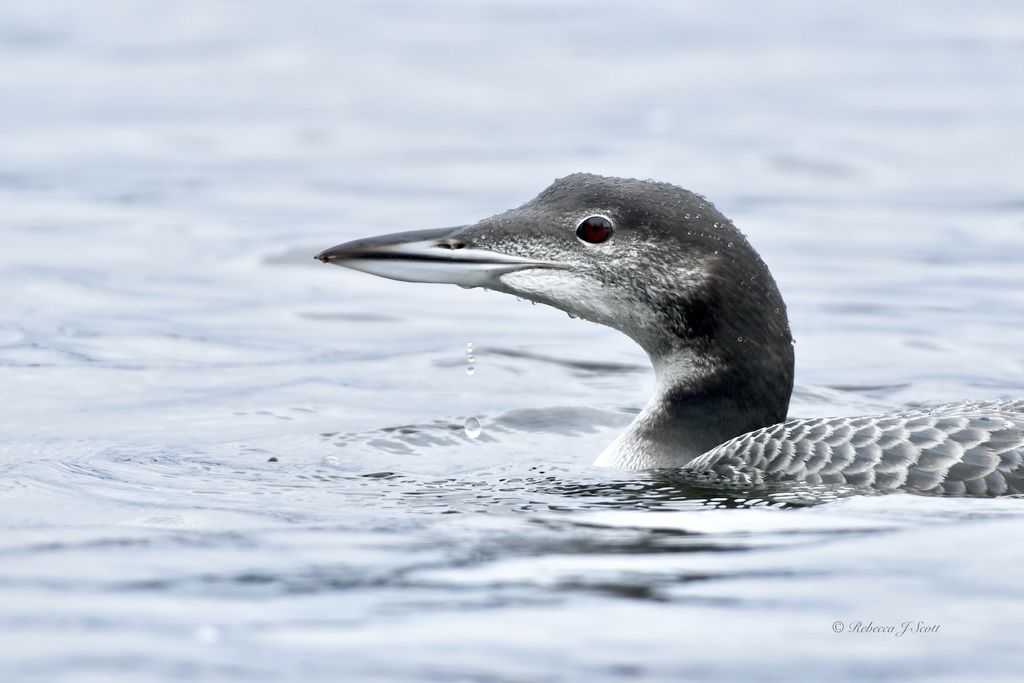
The common loon or great northern diver is a large member of the loon, or diver, family of birds. Breeding adults have a plumage that includes a broad black head and neck with a greenish, purplish, or bluish sheen, blackish or blackish-grey upperparts, and pure white underparts except some black on the undertail coverts and vent. Non-breeding adults are brownish with a dark neck and head marked with dark grey-brown. Their upperparts are dark brownish-grey with an unclear pattern of squares on the shoulders, and the underparts, lower face, chin, and throat are whitish. The sexes look alike, though males are significantly heavier than females. During the breeding season, loons live on lakes and other waterways in Canada, the northern United States, and southern parts of Greenland and Iceland. Small numbers breed on Svalbard and sporadically elsewhere in Arctic Eurasia. Common loons winter on both coasts of North America as far north as Newfoundland and Alaska, and as far south as Mexico, as well as on the Atlantic coast of Europe. Wikipedia
What it can do
- iDives to about 60 m and stays under for up to a minute or more
- iiHas dense, mostly solid bones that reduce buoyancy
- iiiNeeds a runway of 30 m to several hundred metres of water to take off
- ivEach male has a distinctive yodel that changes if he moves to a new territory
In the field
Field marks
- aBreeding: black head with green gloss, red eye and dagger-like black bill
- bBreeding: white-striped necklace and checkerboard black-and-white back
- cWinter: grey-brown above, white throat, pale bill
- dSits low in the water; in flight shows hunched back and feet trailing past the tail
- Voice
- A haunting wail, a quavering tremolo ('crazy laughter'), the male's rising yodel, and a soft hoot.
- Not to be confused with
- Yellow-billed Loon has a pale, upturned bill. Pacific Loon is smaller with a grey nape and rounded head. Double-crested Cormorant has a hooked bill and swims with head tilted up.
- Where to see it
- Lakes of Minnesota (Boundary Waters), Maine, the Adirondacks, Ontario's Algonquin Park; Atlantic and Pacific coasts in winter.
- When
- On breeding lakes Apr–Oct; on coasts Nov–Apr
Listen
Looking for field recordings…
Life & habits
- Diet
- Fish such as perch and suckers; crayfish and other invertebrates
- Habitat
- Clear northern lakes with fish and islands for nesting; ocean bays in winter
- Size
- 66–91 cm; wingspan 104–131 cm; 2.2–7.6 kg
- Lifespan
- Often 20–30 years
Chicks ride on their parents' backs for their first weeks.
Where it lives
Recorded sightings
—
geo-referenced records in GBIF, from museums, herbaria and field observers.
Native range
Breeds across Alaska, Canada, the northern US, Greenland and Iceland; winters on Atlantic and Pacific coasts of North America and western Europe
Drag the globe to turn it. Dots are where records exist, not a range map; darker means more records.
In the old herbals & bestiaries
Woodcuts and engravings matched from the Source Library’s scanned books by name. Plates marked “relative” show a close kin rather than this exact species. Click a plate to read the page it came from, with translation.

In the stacks
Searching the stacks…
Every page naming Gavia immer in the Biodiversity Heritage Library →
Marginalia
Canada's one-dollar coin, introduced in 1987, carries a loon and is universally called the 'loonie'; in Ojibwe tradition the loon (maang) is a leadership clan, and it is Minnesota's state bird.
Curiosity
Loons have been shown to change their yodel when they move territories, apparently to sound unlike the previous owner.
Kinship

Photographs: iNaturalist contributors under the licences shown. Records: GBIF.org. Historical plates: Source Library (CC BY-SA 4.0; originals public domain). Summary text: Nature Library editors and Wikipedia (CC BY-SA). Medicinal and edibility notes are historical and educational, not advice. iNaturalist taxon 4626.