On eBird ↗
Fan-tailed Raven
Live sightings near you, the range map, bar charts of when it is seen, and Macaulay Library photos and recordings.
Fan-tailed Raven
Corvus rhipidurus
The fan-tailed raven (Corvus rhipidurus) is a passerine bird of the crow family native to Eastern Africa and the Arabian Peninsula. Like the Forest raven, Little raven, Australian raven and Chihuahuan raven, it is one of the smaller raven species. The larger species of raven are the Common raven, Thick-billed raven, White-necked raven and Brown-necked raven with the Common and Thick-billed ravens being the world's largest raven species and the Little and Fan-tailed ravens being the...
From the article Fan-tailed raven on Wikipedia (CC BY-SA), quoted section by section
Description
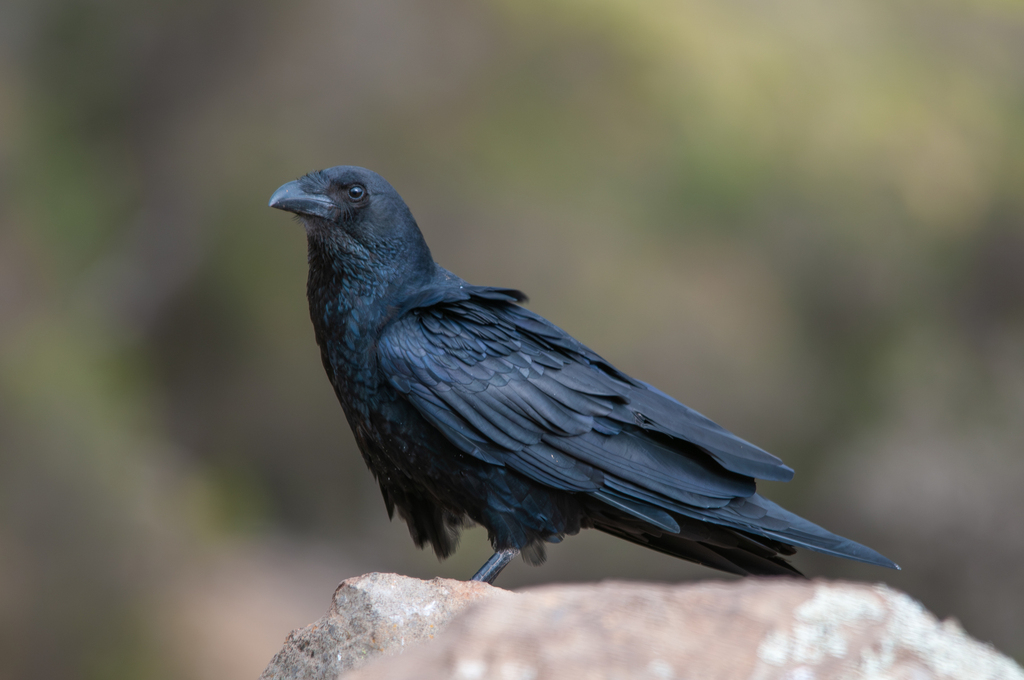
The fan-tailed raven is completely black including bill, legs and feet and the plumage has a purplish-blue gloss in good light. Worn plumage is slightly coppery-brown. The base of the feathers on the upper neck are white and only seen if the bird is inspected or a strong gust blows them the wrong way. The throat hackles are shorter than in most other ravens. One of the smaller raven species, it is about the same size or slightly larger than the carrion crow, at 47–51 cm, but with a much thicker bill, shorter tail and much larger wings. The voice is described as guttural croaks mixed with the sound of frog-call. Like all corvids, the fan-tailed raven is capable of vocal mimicry; however, this behavior is mostly recorded in captivity and, very rarely, in the wild.
Range & habitat
It occurs in the Middle East, North Africa, Arabia, and south to Sudan and Kenya. It also ranges across the Aïr Massif in the southern Sahara. It lives in desert or open dry country that includes crags for nesting. It is one of the most aerial of birds traveling huge distances in search of food, its large wings being adapted to gliding on thermals in a rather vulture-like way.
Wikipedia: “Distribution and habitat”
What it does
Food is invariably taken on the ground and includes all manner of insects and other invertebrates, grain taken from animal dung, carrion and scraps of human food. It has also been seen taking skin parasites from camels and, where not persecuted, scavenges around rubbish dumps and camp sites. Fruits of all types are eaten readily. It soars and plays in thermals even more so than other raven species and often associates with the brown-necked raven roosting in the same tree as it.
Wikipedia: “Diet”
Listen
Looking for field recordings…
Where it lives
Recorded sightings
—
geo-referenced records in GBIF, from museums, herbaria and field observers.
Drag the globe to turn it. Dots are where records exist, not a range map; darker means more records.
In the stacks
Searching the stacks…
Every page naming Corvus rhipidurus in the Biodiversity Heritage Library →
This page is assembled live from iNaturalist, GBIF, Wikipedia, the Source Library and the Internet Archive. It is not yet part of the hand-edited codex. iNaturalist taxon 8046.