On eBird ↗
Cuban Crow
Live sightings near you, the range map, bar charts of when it is seen, and Macaulay Library photos and recordings.
Cuban Crow
Corvus nasicus
The Cuban crow (Corvus nasicus) is one of four species of crow that occur on a few key islands in the Caribbean. It is closely related to the white-necked crow (C. leucognaphalis) and Jamaican crow (C. jamaicensis), with which it shares similar features. The fourth Caribbean crow, the palm crow (C. palmarum), is a later arrival in evolutionary terms and shows characteristics more akin to North American species such as the fish crow (C. ossifragus), which...
From the article Cuban crow on Wikipedia (CC BY-SA), quoted section by section
Description
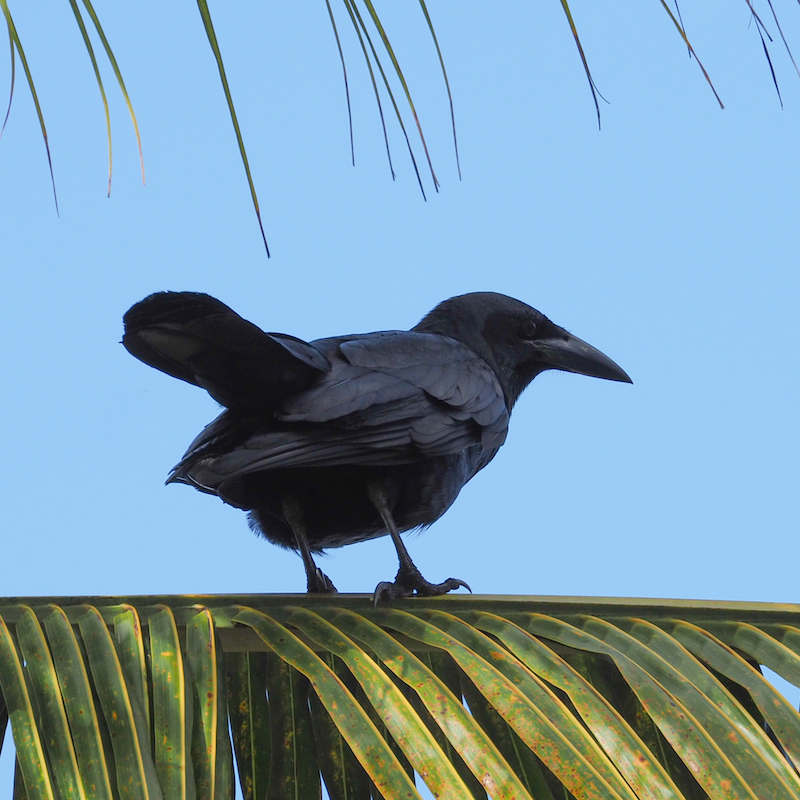
A stocky, medium-sized (40–42 centimetres or 16–17 inches in length) forest crow, the bill of this species is long and deep with a gentle curve towards the tip giving a large headed profile. The nasal bristles sweep forward then upward and frequently reveal the nostrils which are hidden in almost all other members of the genus Corvus. There is a patch of dark grey bare skin behind the browinsh-red eye and at the base of the lower mandible. The black plumage has a bluish-purple gloss in good light. The bill, legs and feet are black.
Range & habitat
It can be found quite commonly over most of the island of Cuba and on the nearby Isla de la Juventud, as well as the Turks and Caicos Islands, in woodland and areas that have been cleared for agriculture. It is frequently found around farms and villages where it seems to have adapted quite well to living in relatively close contact with human settlements.
Wikipedia: “Distribution and habitat”
What it does
Food consists of fruit and insects though it does appear to take human food readily and will scavenge for scraps where the opportunity arises. Large noisy flocks can be seen feeding in trees and it will also readily feed on the ground especially where grain and other seeds have been spilt or left unprotected on the surface of a field.
Wikipedia: “Diet”
Listen
Looking for field recordings…
Where it lives
Recorded sightings
—
geo-referenced records in GBIF, from museums, herbaria and field observers.
Drag the globe to turn it. Dots are where records exist, not a range map; darker means more records.
In the stacks
Searching the stacks…
Every page naming Corvus nasicus in the Biodiversity Heritage Library →
This page is assembled live from iNaturalist, GBIF, Wikipedia, the Source Library and the Internet Archive. It is not yet part of the hand-edited codex. iNaturalist taxon 8019.