On eBird ↗
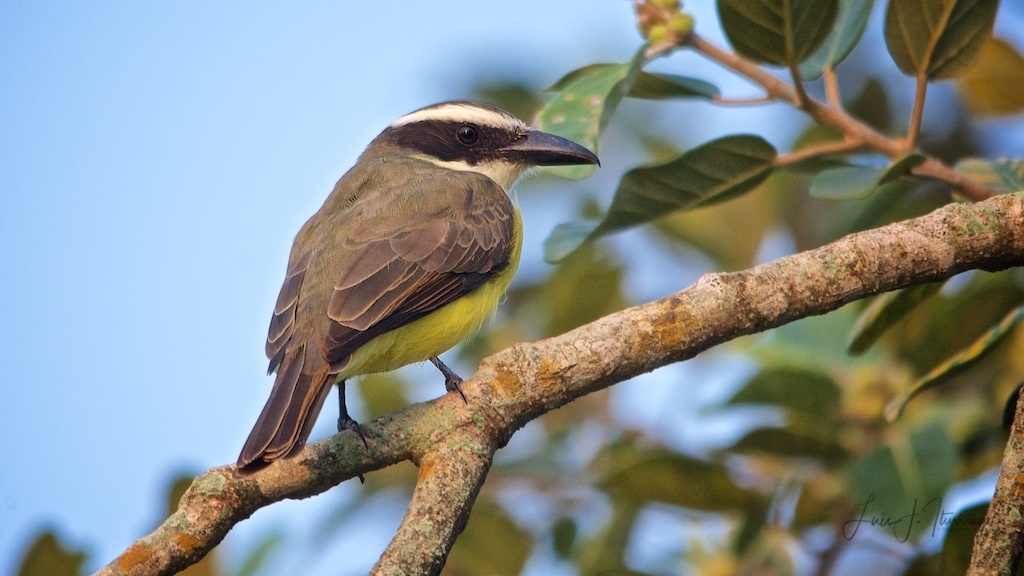
Boat-billed Flycatcher
Live sightings near you, the range map, bar charts of when it is seen, and Macaulay Library photos and recordings.
Boat-billed Flycatcher
Megarynchus pitangua
The boat-billed flycatcher (Megarynchus pitangua) is a large member of the family Tyrannidae, the tyrant flycatchers. It is found in Mexico, in every Central American country, on Trinidad, and in every mainland South American country though only as a vagrant in Chile.
From the article Boat-billed flycatcher on Wikipedia (CC BY-SA), quoted section by section
Description
The boat-billed flycatcher is 21.5 to 24 cm (8.5 to 9.4 in) long and weighs 53 to 70 g (1.9 to 2.5 oz). The sexes have the same plumage. Adults of the nominate subspecies M. p. pitangua have a blackish brown or sooty crown with a mostly hidden yellow to orange-rufous patch in the center. They have a wide white supercilium that begins at the forehead and wraps almost all the way around the nape, a wide black band from the lores to the ear coverts, and white cheeks. They have olive to dull brownish olive upperparts. Their wings are dusky brownish, usually with thin pale cinnamon or rufous edges on the flight feathers. Their tail is dusky brownish with thin pale cinnamon or rufous outer feather edges. Their throat is white and their underparts bright yellow. Juveniles lack the crown patch, have a yellow tinge on the supercilium, and have darker and more brownish upperparts and wider cinnamon edges on the flight feathers than adults. The other subspecies of the boat-billed flycatcher differ from the nominate and each other thus:
M. p. mexicanus: brighter, more greenish olive upperparts and no rufous on the tail feathers M. p. caniceps: grayer crown and more grayish olive upperparts than mexicanus M. p. tardiusculus: similar to mexicanus and caniceps M. p. deserticola: similar to mexicanus and caniceps M. p. …
Range & habitat
The subspecies of the boat-billed flycatcher are found thus:
M. p. tardiusculus: western Mexico from southwestern Sinaloa south into western Nayarit M. p. caniceps: southwestern Jalisco in western Mexico M. p. mexicanus: from southern Tamaulipas in eastern and Guerrero in western Mexico south through Central America including some offshore islands into northwestern Colombia's Chocó Department M. p. deserticola: valley of the Negro River in central Guatemala M. p. pitangua: Trinidad; northern, central, and eastern Colombia; most of Venezuela; the Guianas; eastern Ecuador and Peru, all of Brazil south to Rio Grande do Sul; northern and eastern Bolivia; Paraguay, extreme northern Uruguay; and northeastern Argentina south into Corrientes Province M. p. chrysogaster: disjunctly west of the Andes from western Esmeraldas Province in northwestern Ecuador south into far northern Peru's Tumbes and northern Piura departments The boat-billed flycatcher has also been recorded as a vagrant in Chile. The boat-billed flycatcher inhabits a wide variety of wooded and forested landscapes in the tropical and subtropical zones. Most are somewhat open, like savanna and clearings with scattered trees, plantations, the edges of continuous forest, and gallery forest. In the Amazon Basin it is most often found in the canopy of várzea and the edges of lakes and rivers. …
Wikipedia: “Distribution and habitat”
What it does
The boat-billed flycatcher feeds mostly on invertebrates, especially very large insects like cicadas. It also includes fruits of figs (Ficus), berries, seeds, and small vertebrates in its diet. It primarily forages in pairs or small family groups and occasionally joins mixed-species feeding flocks. It mostly forages from the forest's mid-level to the canopy and often within dense canopy. It does frequently perch in the open atop or at the edge of a large tree. It takes insect prey mostly by snatching it from foliage after a short sally; it also will take it while briefly hovering. It seldom takes insects in mid-air. It takes fruits and seeds by gleaning while perched and with short sallies.
Wikipedia: “Feeding”
Listen
Looking for field recordings…
Where it lives
Recorded sightings
—
geo-referenced records in GBIF, from museums, herbaria and field observers.
Drag the globe to turn it. Dots are where records exist, not a range map; darker means more records.
In the stacks
Searching the stacks…
Every page naming Megarynchus pitangua in the Biodiversity Heritage Library →
This page is assembled live from iNaturalist, GBIF, Wikipedia, the Source Library and the Internet Archive. It is not yet part of the hand-edited codex. iNaturalist taxon 16737.