On eBird ↗
Eastern Phoebe
Live sightings near you, the range map, bar charts of when it is seen, and Macaulay Library photos and recordings.
Eastern Phoebe
Sayornis phoebe
The eastern phoebe (Sayornis phoebe) is a small passerine bird. The genus name Sayornis is constructed from the specific part of Charles Lucien Bonaparte's name for Say's phoebe, Muscicapa saya, and Ancient Greek ornis, "bird". Phoebe is an alternative name for the Roman moon-goddess Diana, but it may also have been chosen to imitate the bird's call.
From the article Eastern phoebe on Wikipedia (CC BY-SA), quoted section by section
Description
Measurements:
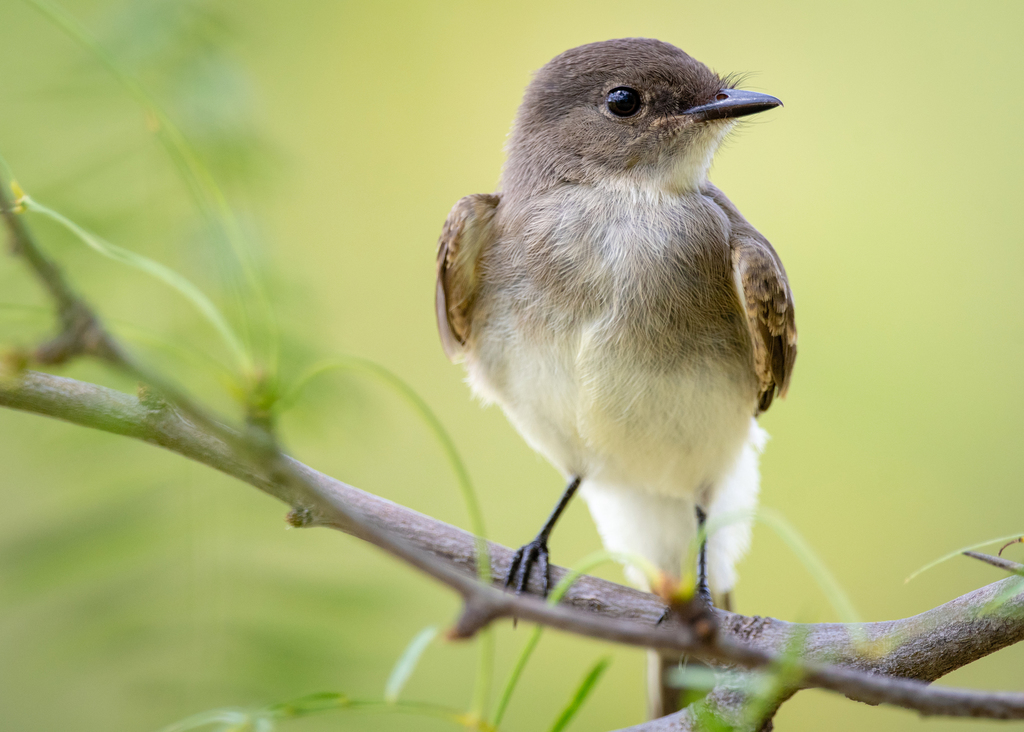
Length: 5.5–6.7 in (14–17 cm) Weight: 0.6–0.7 oz (16–21 g) Wingspan: 10.2–11.0 in (26–28 cm) This species appears remarkably big-headed, especially if it puffs up the small crest. Its plumage is gray-brown above. It has a white throat, dirty gray breast, and buffish underparts which become whiter during the breeding season. Two indistinct buff bars are present on each wing. Its all-dark bill and lack of an eye ring and wingbars distinguish it from other North American tyrant flycatchers, and it pumps its tail up and down like other phoebes when perching on a branch. The eastern phoebe's call is a sharp chip, and the song, from which it may get its name, is fee-bee. The eastern wood pewee (Contopus virens) is extremely similar in appearance. It lacks the buff hue usually present on the lighter parts of the eastern phoebe's plumage, and thus has always clearly defined and contrasting wing-bars. It also does not bob its tail habitually, and appears on the breeding grounds much later, although it leaves for winter quarters at about the same time as the eastern phoebe. The eastern phoebe often nests on human structures such as bridges and buildings. Nesting activity may start as early as the first days of April. The nest is an open cup with a mud base and lined with moss and grass, built in a crevice in a rock or man-made site; two to six eggs are laid. …
Range & habitat
Eastern phoebes are highly adaptable to urban environments. They are primarily found in wooded areas, particularly streamsides, and farmlands. Eastern phoebes tend to avoid open areas and choose spots beneath trees, brushy areas, or overhangs. However, during migration in winters or in breeding season they are frequently seen around the edges of woods and other areas where water sources are abundant.
Wikipedia: “Habitat”
What it does
Insects make up a great majority of its summer diet; included are many small wasps, bees, beetles, flies, true bugs, and grasshoppers. It also eats some spiders, ticks, and millipedes. Small fruits and berries are eaten often during the cooler months.
Wikipedia: “Diet”
Listen
Looking for field recordings…
Where it lives
Recorded sightings
—
geo-referenced records in GBIF, from museums, herbaria and field observers.
Drag the globe to turn it. Dots are where records exist, not a range map; darker means more records.
In the stacks
Searching the stacks…
Every page naming Sayornis phoebe in the Biodiversity Heritage Library →
This page is assembled live from iNaturalist, GBIF, Wikipedia, the Source Library and the Internet Archive. It is not yet part of the hand-edited codex. iNaturalist taxon 17008.