On eBird ↗
Common Grackle
Live sightings near you, the range map, bar charts of when it is seen, and Macaulay Library photos and recordings.
Common Grackle
Quiscalus quiscula
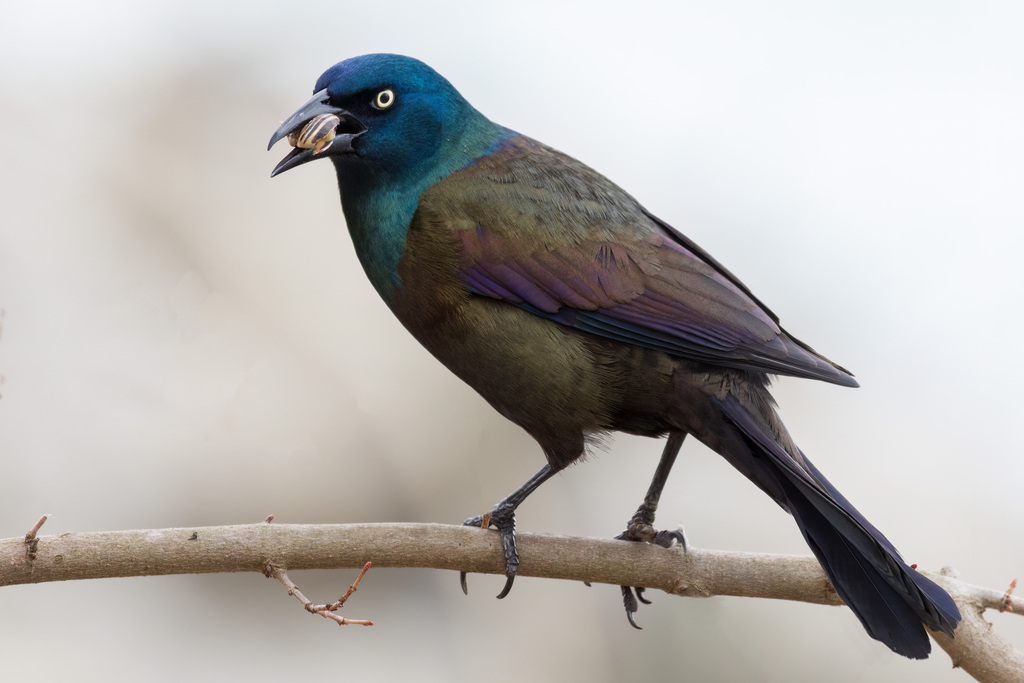
The common grackle (Quiscalus quiscula) is an icterid bird found in large numbers through much of North America. It was first described in 1758 by Carl Linnaeus and has three officially recognized subspecies. Adult common grackles have a long and dark bill, pale yellow eyes, and a long tail. Adults often have a bluish iridescent appearance on their head, this feature being more pronounced on males. Common grackles can be found widely across North America east of the Rocky Mountains and are highly adaptable to their environment.
From the article Common grackle on Wikipedia (CC BY-SA), quoted section by section
Description
Adult common grackles measure from 28 to 34 cm (11 to 13 in) in length, span 36–46 cm (14–18 in) across the wings, and weigh 74–142 g (2.6–5.0 oz). Common grackles are less sexually dimorphic than larger grackle species, but the differences between the sexes can still be noticeable. The male, which averages 122 g (4.3 oz), is larger than the female, at an average of 94 g (3.3 oz). Adults have a long, dark bill, pale yellowish eyes, and a long tail; their feathers appear black with purple, green, or blue iridescence on the head, and primarily bronze sheen in the body plumage. Adult females, beyond being smaller, are usually less iridescent; their tails in particular are shorter, and unlike the males, do not keel (display a longitudinal ridge) in flight and are brown with no purple or blue gloss. Juveniles are brown with dark brown eyes. When grackles are in a group, they are referred to as a "plague".
Range & habitat
The breeding habitat is open and semiopen areas across North America east of the Rocky Mountains. The nest is a well-concealed cup in dense trees (particularly pine) or shrubs, usually near water; sometimes, the common grackle nests in cavities or in man-made structures. It often nests in colonies, some being quite large. Bird houses are also a suitable nesting site. Four to seven eggs are in a clutch. This bird is a permanent resident in much of its range. Northern birds migrate in flocks to the Southeastern United States. The distribution of the common grackle is largely explained by annual mean temperature, and the species has expanded its range by greater than three-fold since the last glacial maximum, approximately 22,000 years ago.
Wikipedia: “Distribution and habitat”
What it does
The common grackle forages on the ground, in shallow water, or in shrubs; it may steal food from other birds. It is omnivorous, eating insects, minnows, frogs, eggs, berries, seeds, grain, and even small birds and rodents. Grackles at outdoor eating areas often wait eagerly until someone drops some food. They rush forward and try to grab it, often snatching food out of the beak of another bird. Grackles prefer to eat from the ground at bird feeders, making scattered seed an excellent choice of food for them. Grackles can be regularly seen foraging for insects, especially after a lawn trimming. Grackles have a unique adaptation in the keel within their bill which allows them to crack and cut hard nuts or kernels. The keel projects downward from the horny palate and is sharper and more abrupt anterior. It extends below the level of the tomium and is used in a sawing motion to score open acorns or dried kernels. Larger adductor muscles within their jaw compared to those of other icterids make this adaptation even more useful for opening hard seeds and acorns. Along with some other species of grackles, the common grackle is known to practice "anting", rubbing insects on its feathers possibly to apply liquids such as formic acid secreted by the insects.
Wikipedia: “Foraging and diet”
Listen
Looking for field recordings…
Where it lives
Recorded sightings
—
geo-referenced records in GBIF, from museums, herbaria and field observers.
Drag the globe to turn it. Dots are where records exist, not a range map; darker means more records.
In the old herbals & bestiaries

In the stacks
Searching the stacks…
Every page naming Quiscalus quiscula in the Biodiversity Heritage Library →
This page is assembled live from iNaturalist, GBIF, Wikipedia, the Source Library and the Internet Archive. It is not yet part of the hand-edited codex. iNaturalist taxon 9602.