On eBird ↗
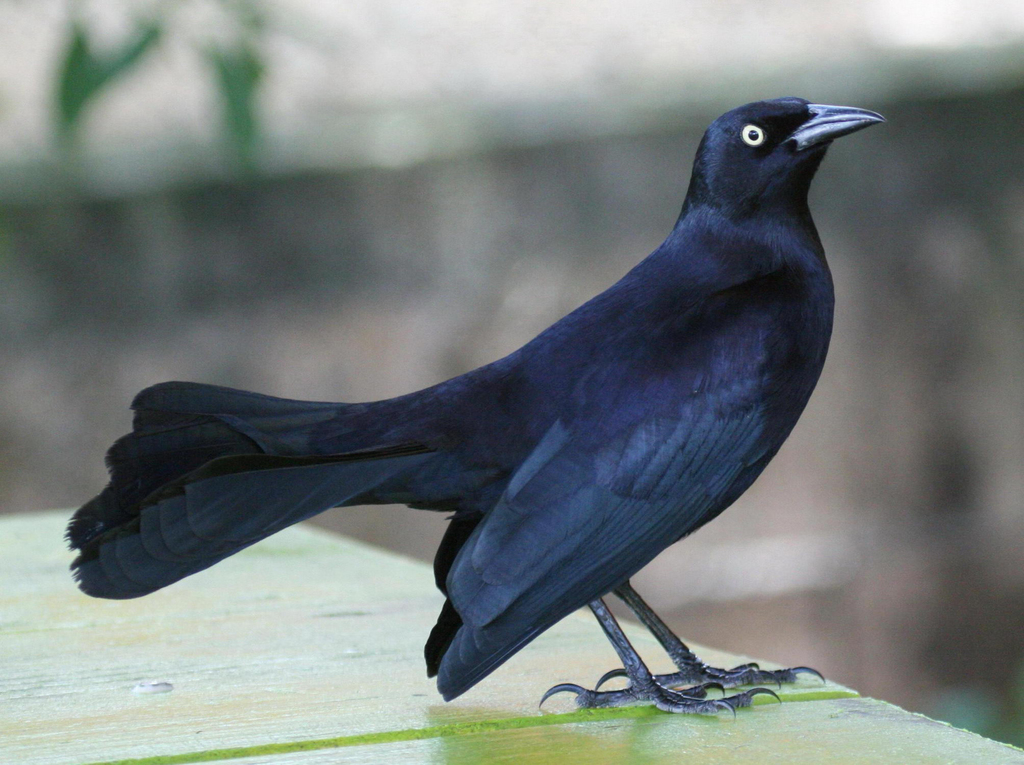
Greater Antillean Grackle
Live sightings near you, the range map, bar charts of when it is seen, and Macaulay Library photos and recordings.
Greater Antillean Grackle
Quiscalus niger
The Greater Antillean grackle (Quiscalus niger) is a species of bird in the family Icteridae, the oropendolas, New World orioles, and New World blackbirds. It is found in the Greater Antilles from Cuba to Puerto Rico and in the Cayman Islands southwest of Cuba.
From the article Greater Antillean grackle on Wikipedia (CC BY-SA), quoted section by section
Description
The Greater Antillean grackle is 25 to 30 cm (9.8 to 12 in) long. Males weigh about 67 to 100 g (2.4 to 3.5 oz) except those of Q. n. crassirostris which average 112 g (4.0 oz). Females weigh about 50 to 72 g (1.8 to 2.5 oz) except those of Q. n. crassirostris which average 79 g (2.8 oz). Males have a long graduated tail which it holds in a "V" shape; females' tails are shorter and held flat. Adults of both sexes of all subspecies are entirely black; males are glossy and most females are less so. The nominate subspecies Q. n. niger is the smallest. Nominate males have a purple gloss on their head and upperparts and a greenish gloss on their flight feathers and tail. The other subspecies of the Greater Antillean grackle differ from the nominate and each other thus:
Q. n. caribaeus: males have a bluish gloss Q. n. gundlachii: both sexes have a violaceous gloss Q. n. caymanensis: males have purplish-blue gloss on the head and upperparts, greenish blue gloss on the uppertail coverts, and bronze-green gloss on the wings Q. n. crassirostris: males have violet gloss on head and upperparts, blue gloss on upper- and undertail coverts, and greenish bronze gloss on upperwing coverts Q. n. bangsi: males have bluer gloss than crassirostris; females are brownish Q. n. …
Range & habitat
The subspecies of the Greater Antillean grackle are found thus:
Q. n. caribaeus: Pinar del Río Province in far western Cuba, on Isla de Juventud (Isle of Pines), and nearby cays Q. n. gundlachii: Cuba except Pinar del Río Province, Jardines de la Reina off the southern coast, and cays off the northern coast Q. n. caymanensis: Grand Cayman Q. n. bangsi: Little Cayman; extirpated from Cayman Brac Q. n. crassirostris: Jamaica Q. n. niger: Hispaniola (shared by Haiti and the Dominican Republic) Q. n. brachypterus: Puerto Rico including Vieques The Greater Antillean grackle inhabits a variety of landscapes, most of which are open. These include savanna, pastures and cultivated areas, light woodlands, scrublands, marshes, mangroves, and parks and gardens in human-inhabited areas. It "often roosts in towns and cities" and several thousand may roost together. Sources differ on its elevational range. One simply says "lowlands". Another says it ranges from sea level to 1,800 m (5,900 ft). A third says that the nominate subspecies is mostly below 1,000 m (3,300 ft) but as high as 2,200 m (7,200 ft) while Q. n. crassirostris is mostly in the lowlands; the source does not address the other subspecies.
Wikipedia: “Distribution and habitat”
What it does
The Greater Antillean grackle is omnivorous. Common foods include insects and other arthropods, wild and domestic fruits and seeds, small vertebrates like lizards, and the eggs and chicks of small birds. It regularly forages in flocks.
Wikipedia: “Feeding”
Listen
Looking for field recordings…
Where it lives
Recorded sightings
—
geo-referenced records in GBIF, from museums, herbaria and field observers.
Drag the globe to turn it. Dots are where records exist, not a range map; darker means more records.
In the stacks
Searching the stacks…
Every page naming Quiscalus niger in the Biodiversity Heritage Library →
This page is assembled live from iNaturalist, GBIF, Wikipedia, the Source Library and the Internet Archive. It is not yet part of the hand-edited codex. iNaturalist taxon 9609.