- Animals
- ›Chordates
- ›Vertebrates
- ›Birds
- ›Perching Birds
- ›Ovenbirds and Woodcreepers
- ›Typical Ovenbirds
- ›Pseudoseisura
On eBird ↗
Brown Cacholote
Live sightings near you, the range map, bar charts of when it is seen, and Macaulay Library photos and recordings.
Brown Cacholote
Pseudoseisura lophotes
The brown cacholote (Pseudoseisura lophotes) is a medium-sized bird of the ovenbird family Furnariidae. It was described by Ludwig Reichenbach in 1853, with its subspecies, argentina, described in 1960 by Kenneth Carroll Parkes. It is nonmigratory, and is found in the forests and parks of Argentina, Bolivia, Brazil, Paraguay, and Uruguay. Unlike many other birds, the brown cacholote builds large, pitcher-like nests year-round, each weighing many times more than the bird itself. Breeding begins in mid-November, with both parents sharing the responsibility for taking care of the nest equally. Incubation takes 17–20 days, and nestlings fledge at 19 days. They are omnivorous, primarily eating various arthropods, along with the eggs of other birds, fruits, and grain. The causes of death in adults is not well researched; however, nestlings are subject to parasitism from various insects. Egg success rate is 59%. They are a least-concern species.
From the article Brown cacholote on Wikipedia (CC BY-SA), quoted section by section
Description
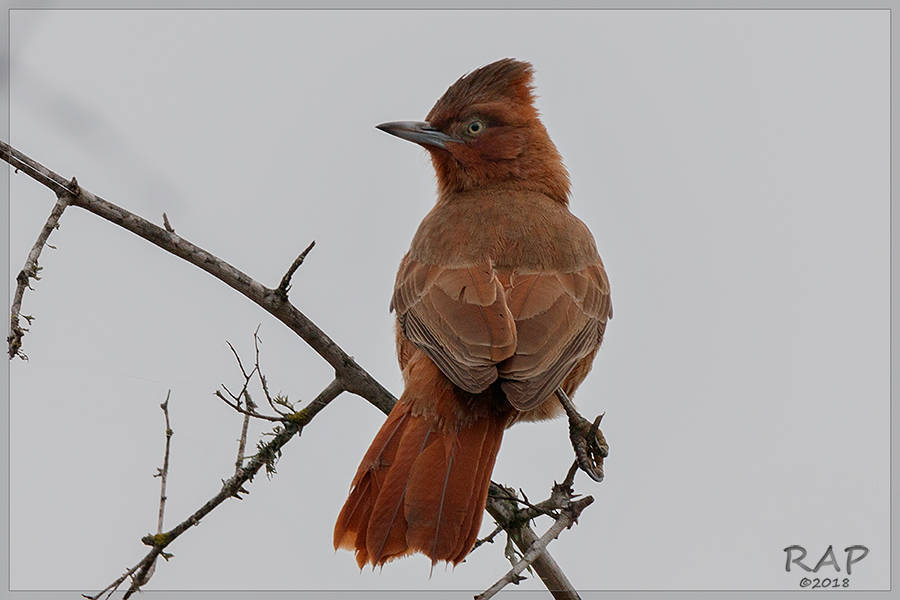
The brown cacholote ranges from 24 to 26 cm (9.4 to 10 in) in length and weighs 63 to 79 g (2.2 to 2.8 oz), making it one of the largest furnariids. The entire bird is rufous, with varying shades in different areas. The area between the eye and nostrils is slightly darker, alongside the bottom of the tail feathers. The breast is lighter in color compared to the throat, which is especially vibrant. The feathers on the top of the head (the crest) resembles that of a jay and is especially dark, along with the primary and secondary flight feathers. The iris is yellow, the bill is black, and the legs are grayish-olive to dull greenish, with nestlings having more monotone feet, greener irises, and greyer bill, with yellow gape flanges. Both sexes have the same plumage, and males are slightly larger. Wings are 123 or 128.7 mm (4.84 or 5.07 in), tails are 109.4 or 111.5 mm (4.31 or 4.39 in), and bills are 26.4 or 27 mm (1.04 or 1.06 in) in length, for males and females respectively. They are very distinct in their habitat, and are easily identifiable. The brown cacholote performs its songs in a duet, usually on the tops of trees with fanned tails and spread wings. Songs are composed of variably noisy and coarse notes, fading toward the end. Songs can last at least 25 seconds, with around 2 notes per second. Its call is a loud "krok" or "cluck".
Range & habitat
The brown cacholote can be found in the more humid regions of the Gran Chaco and Argentine Espinal north of Rio Colorado; however, its subspecies are allopatric and occupy their own range. The nominate subspecies of the brown cacholote is found in southern Bolivia and western Paraguay, and subspecies P. l. argentina is found in northern and central Argentina, far southern Brazil, and Uruguay; however, vagrants have been spotted as south as Chubut Province. The species inhabits tropical deciduous forest, the edges of gallery forest, chaco woodlands and scrublands, as well as parks and gardens in urban areas. In elevation it ranges from near sea level to 900 m (3,000 ft). The brown cacholote is a year-round resident throughout its range.
Wikipedia: “Distribution and habitat”
What it does
The brown cacholote is monogamous, meaning it remains mated to the same partner for life. If a partner dies, a new one is found promptly.
Breeding. Male brown cacholotes court nearly exclusively inside or near the nest. Once both the male and the female are close enough to the nest, both begin repeatedly singing in a duet. The male brings its body horizontal to the ground, sags his wings low, and fans his tail feathers while chittering. The male then enters the nest and the female follows, spinning around 2–3 times, before pausing for 15 seconds. The female then lowers her feathers, and they copulate. After copulating, the pair sing a duet inside the nest. Nest-building occurs year-round, although nests are more frequently built in the winter months (July–October). Nests usually took 15–37 days to build, with 62 days between new nests on average. Nests are used for both roosting and breeding; however, each nest is only used for 42 days. New nests are always built from scratch, and old nests are never reused, perhaps because of concern for parasites. Old nests are often destroyed or reused as materials for new nests, or destroyed with the foundation intact for reuse in a later nest. Sometimes a pair immediately start building a new nest after they finished their previous one. …
Wikipedia: “Behavior”
Listen
Looking for field recordings…
Where it lives
Recorded sightings
—
geo-referenced records in GBIF, from museums, herbaria and field observers.
Drag the globe to turn it. Dots are where records exist, not a range map; darker means more records.
In the stacks
Searching the stacks…
Every page naming Pseudoseisura lophotes in the Biodiversity Heritage Library →
This page is assembled live from iNaturalist, GBIF, Wikipedia, the Source Library and the Internet Archive. It is not yet part of the hand-edited codex. iNaturalist taxon 11719.