On eBird ↗
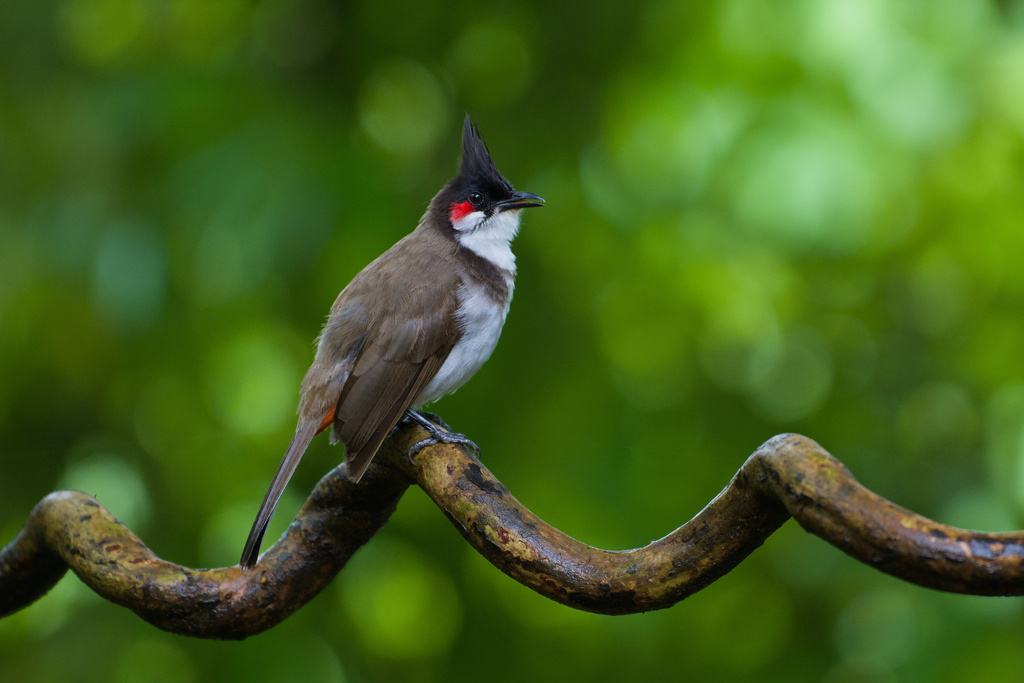
Red-whiskered Bulbul
Live sightings near you, the range map, bar charts of when it is seen, and Macaulay Library photos and recordings.
Red-whiskered Bulbul
Pycnonotus jocosus
The red-whiskered bulbul (Pycnonotus jocosus), or crested bulbul, is a passerine bird native to Asia. It is a member of the bulbul family. It is a resident frugivore found mainly in tropical Asia. It has been introduced in many tropical areas of the world where populations have established themselves. It has a loud three or four note call, feeds on fruits and small insects and perches conspicuously on trees. It is common in hill forests and urban gardens.
From the article Red-whiskered bulbul on Wikipedia (CC BY-SA), quoted section by section
Description
The red-whiskered bulbul is about 20 cm (7.9 in) in length. It has brown upper-parts and whitish underparts with buff flanks and a dark spur running onto the breast at shoulder level. It has a tall pointed black crest, red face patch and thin black moustachial line. The tail is long and brown with white terminal feather tips, but the vent area is red. Juveniles lack the red patch behind the eye, and the vent area is rufous-orange. An albino red-whiskered bulbul has also been recorded. The red-whiskered bulbul's loud and evocative call is a sharp kink-a-joo, also transcribed as pettigrew or kick-pettigrew or pleased to meet you. Its song is a scolding chatter, more often heard than seen; it but often perches conspicuously especially in the mornings when it calls from the tops of trees.
Range & habitat
This is a bird of lightly wooded areas, more open country with bushes and shrubs, and farmland. Irruptions have been noted from early times with Thomas C. Jerdon noting that they were "periodically visiting Madras and other wooded towns in large flocks". It has established itself in Australia and in Los Angeles, Hawaii, and Florida in the United States, as well as in Mauritius, on Assumption Island and Mascarene Islands. In Florida, it is only found in a small area, and its population could be extirpated easily. It was eradicated from Assumption Island in 2013–2015 to prevent colonisation of nearby Aldabra, the largest introduced bird-free tropical island. The red-whiskered bulbul was introduced by the Zoological and Acclimatization Society in 1880 to Sydney, became well established across the suburbs by 1920, and continued to spread slowly to around 100 km away. It is now also found in suburban Melbourne and Adelaide, although it is unclear how they got there.
Wikipedia: “Distribution and habitat”
What it does
On the island of Réunion, this species established itself and also aided the spread of alien plant species such as Rubus alceifolius. In Florida they feed on fruits and berries of as many as 24 exotic plants including loquat (Eriobotrya japonica), Lantana spp., Brazilian pepper (Schinus terebinthifolius) and figs (Ficus). In Mauritius they aid the dispersal of Ligustrum robustum and Clidemia hirta. Seeds that pass through their gut germinate better. Populations of the red-whiskered bulbul on the island of Réunion have diversified in the course of thirty years and show visible variations in bill morphology according to the food resources that they have adapted to utilize.
Breeding. The red-whiskered bulbul's breeding season is spread out and peaks from December to May in southern India and March to October in northern India. Breeding may occur once or twice a year. The courtship display of the male involves head bowing, spreading the tail and drooping wings. The nest is cup-shaped, and is built on bushes, thatched walls or small trees. It is woven of fine twigs, roots, and grasses, and embellished with large objects such as bark strips, paper, or plastic bags. Clutches typically contain two or three eggs. Adults feign injury to distract potential predators away from the nest. The eggs have a pale mauve ground colour with speckles becoming blotches towards the broad end. …
Wikipedia: “Behaviour and ecology”
In human culture
Captive hybrids have been bred with the red-vented, white-eared, white-spectacled, black-capped and Himalayan bulbuls.
Wikipedia: “In culture”
Listen
Looking for field recordings…
Where it lives
Recorded sightings
—
geo-referenced records in GBIF, from museums, herbaria and field observers.
Drag the globe to turn it. Dots are where records exist, not a range map; darker means more records.
In the stacks
Searching the stacks…
Every page naming Pycnonotus jocosus in the Biodiversity Heritage Library →
This page is assembled live from iNaturalist, GBIF, Wikipedia, the Source Library and the Internet Archive. It is not yet part of the hand-edited codex. iNaturalist taxon 14591.