On eBird ↗
Marsh Tit
Live sightings near you, the range map, bar charts of when it is seen, and Macaulay Library photos and recordings.
Marsh Tit
Poecile palustris
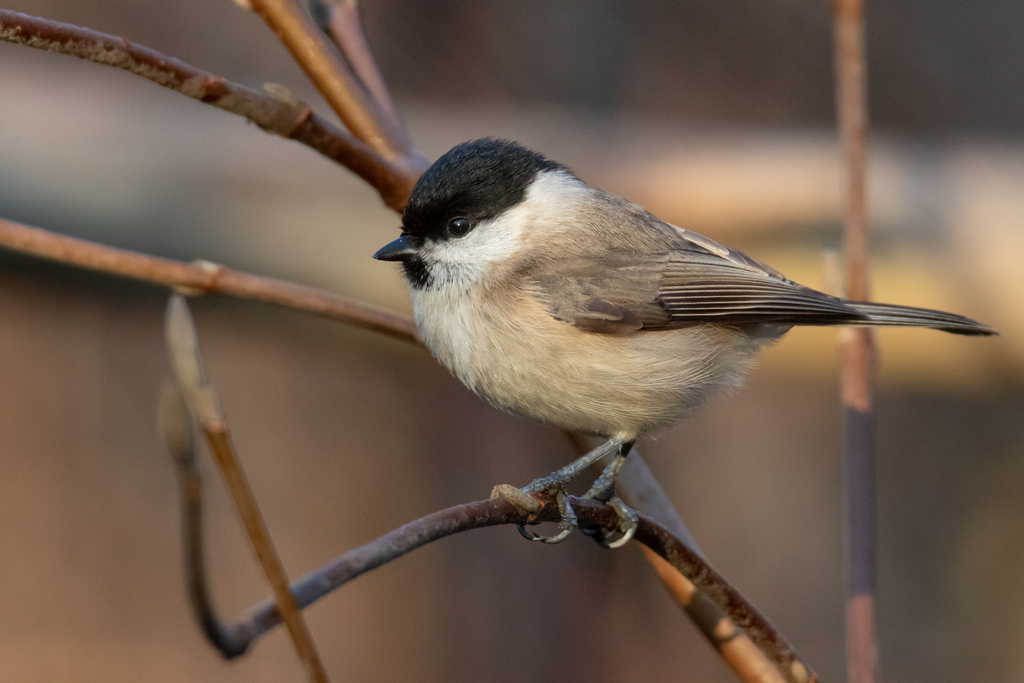
The marsh tit (Poecile palustris) is a Eurasian passerine bird in the tit family Paridae and genus Poecile, closely related to the willow tit, Père David's and Songar tits. It is a small bird, around 12 cm (4.7 in) long and weighing 12 g (0.42 oz), with a black crown and nape, pale cheeks, brown back and greyish-brown wings and tail. Between 8 and 11 subspecies are recognised. Its close resemblance to the willow tit can cause identification problems, especially in the United Kingdom where the local subspecies of the two are very similar; they were not recognised as separate species until 1897.
Globally, the marsh tit is classified as Least Concern, although there is evidence of a decline in numbers (in the UK, numbers have dropped by more than 50% since the 1970s, for example). It can be found throughout temperate Europe and northern Asia and, despite its name, it occurs in a range of habitats including dry woodland. The marsh tit is omnivorous; its food includes caterpillars, spiders and seeds. It nests in tree holes, choosing existing hollows to enlarge, rather than excavating its own. A clutch of 5–9 eggs is laid.
From the article Marsh tit on Wikipedia (CC BY-SA), quoted section by section
Description
The nominate subspecies has a black cap and nape with a blue sheen visible at close quarters. The black 'bib' below the bill is rather small; the cheeks are white, turning dusky brown on the ear coverts. The upperparts, tail and wings are greyish-brown, with slightly paler fringes to the tertials. The underparts are off-white with a buff or brown tinge strongest on the flanks and undertail coverts. The bill is black and the legs dark grey. Juveniles are very similar to adults, but with a duller black cap and bib, more greyish upperparts and paler underparts; they moult into adult plumage by September. The marsh tit weighs 12 g (0.42 oz), has a length of 11.5 to 12 cm (4.5 to 4.7 in) (from bill to tail) and a wingspan of 19 cm (7.5 in). The wing length ranges from 60–70 mm (2.4–2.8 in). The oldest recorded marsh tit in Europe reached the age of 11 years, 11 months. Like other tits it has a large range of call notes; most typical is the explosive "pitchou" note, given when agitated, often leading into "pitchou-bee-bee-bee", which can sound like willow tit when not heard clearly. Unlike many other tits, however, the marsh tit has a well-defined song and a wide song repertoire. Individual birds can have more than five songs, which they use interchangeably. …
Range & habitat
The marsh tit has a worldwide Extent of Occurrence of around 10 million square kilometres. The global population includes between 6.1 million and 12 million birds in Europe alone. The species is classified as Least Concern, though there is some evidence of a decline in numbers. For example, between the 1970s and 2007, marsh tit numbers declined in the United Kingdom by more than 50% and consequently it is on the Red List of species compiled by the UK's Joint Nature Conservation Committee. Research suggests that the cause may be low survival rates from year to year, though the nest failure rate has fallen during the decline. Other studies have shown that reduced diversity of woodland structure and plant species, partly because of the impact of deer browsing, is the cause of the bird's decline. Data from 157 woodlands covered by the RSPB/BTO Repeat Woodland Bird Survey showed that the abundance of marsh tits in 2003–2004 corresponded with the vegetation present 2–4 metres above the ground, the shrub layer. Data from the 1980s did not show the same results, but marsh tit numbers had increased by 2003–2004 in woods with the most shrub cover. The study concluded that damage to the shrub layer, caused by overgrazing by deer, for example, may make woodland less suitable for marsh tits. It is a widespread and common resident breeder throughout temperate Europe and northern Asia. …
Wikipedia: “Distribution and habitat”
What it does
In mixed winter tit flocks, seldom more than one or two marsh tits are present, and parties of this species alone are infrequent. Its performances in the bushes and branches are just as neat and agile as those of other tits; it often hangs upside down by one leg.
Breeding. Marsh tits are monogamous and often pair for life; one pair stayed together for six years. In Europe, hybridisation with the willow tit has been recorded twice. The nest site is in a hole, usually in a tree but sometimes in a wall or in the ground. Nestboxes may be used. Old willow tit holes may be used and enlarged further. Marsh tits do not usually excavate their own nest holes, though they may enlarge the hollow, carrying the chips to a distance before dropping them. The hole may be within a centimetres or two of the ground or high as 10 m (33 ft). Inside the hole, a nest of moss is made and lined with hair and sometimes a few feathers; 20 cm (7.9 in) of moss is used in damp holes, but much less in dry ones.
Between five and nine white and red-speckled eggs are laid late in April or in May, measuring 16 mm × 12 mm (0.63 in × 0.47 in) and weighing 1.2 g (0.042 oz) each, of which 6% is shell. The eggs are incubated by the female for 14–16 days; incubation begins before the clutch is complete, meaning that the chicks hatch over a period of around two days. …
Wikipedia: “Behaviour and ecology”
Listen
Looking for field recordings…
Where it lives
Recorded sightings
—
geo-referenced records in GBIF, from museums, herbaria and field observers.
Drag the globe to turn it. Dots are where records exist, not a range map; darker means more records.
In the stacks
Searching the stacks…
Every page naming Poecile palustris in the Biodiversity Heritage Library →
This page is assembled live from iNaturalist, GBIF, Wikipedia, the Source Library and the Internet Archive. It is not yet part of the hand-edited codex. iNaturalist taxon 144809.