On eBird ↗
Carolina Chickadee
Live sightings near you, the range map, bar charts of when it is seen, and Macaulay Library photos and recordings.
Carolina Chickadee
Poecile carolinensis
The Carolina chickadee (Poecile carolinensis) is a small passerine bird in the tit family Paridae. It is often placed in the genus Parus with most other tits, but mtDNA cytochrome b sequence data and morphology suggest that separating Poecile more adequately expresses these birds' relationships (Gill et al., 2005). The American Ornithologists' Union has been treating Poecile as distinct genus for some time already.
From the article Carolina chickadee on Wikipedia (CC BY-SA), quoted section by section
Description
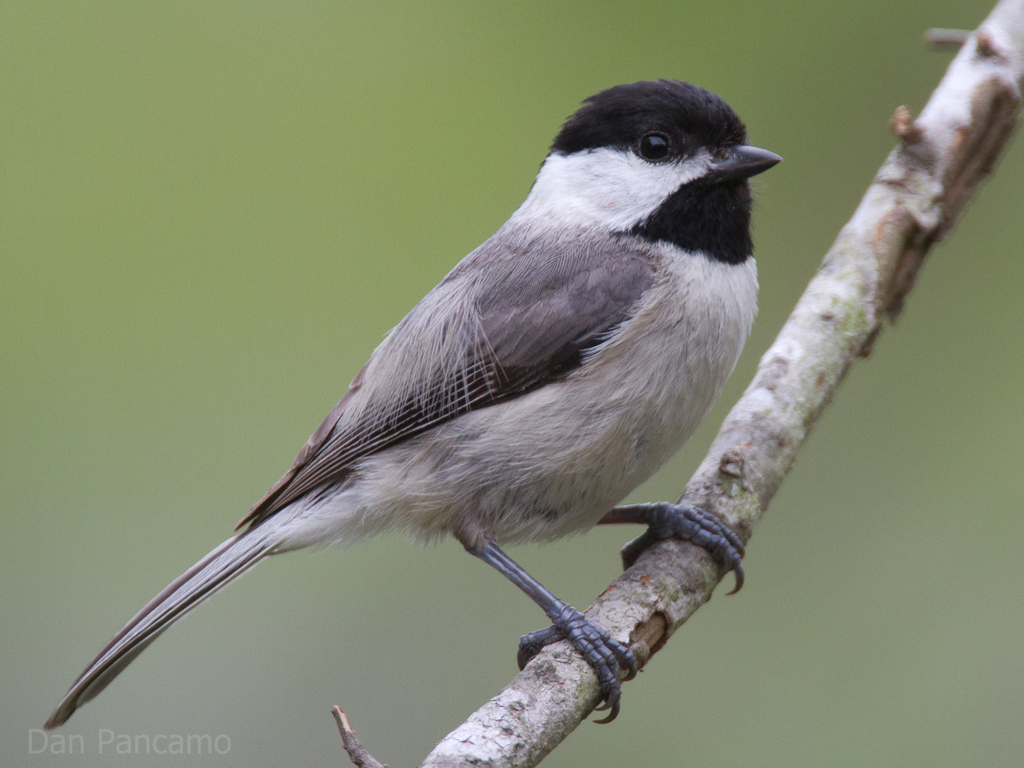
Adults are 10–12 cm (3.9–4.7 in) long with a weight of 8–12 g (0.28–0.42 oz) and a wingspan of 15–20 cm (5.9–7.9 in), and have a black cap and bib with white sides to the face. Their underparts are white with rusty brown on the flanks; their back is gray. They have a short dark bill, short wings and a moderately long tail. Very similar to the black-capped chickadee, the Carolina chickadee is distinguished by the slightly browner wing with the greater coverts brown (not whitish fringed) and the white fringing on the secondary feathers slightly less conspicuous; the tail is also slightly shorter and more square-ended. Without calls, visual distinction between the two species is very difficult even with an excellent view. Eggs are about 1.5 cm (0.6 in) long and 1.1 cm (0.4 in) wide. Eggs are white with areas of reddish-brown ranging from dots to small blotches.
Vocalization. The calls and song between the Carolina chickadee and the black-capped chickadee differ subtly to an experienced ear: the Carolina chickadee's chick-a-dee call is faster and higher-pitched than that of the black-capped chickadee, and the Carolina chickadee has a four-note see-dee-see-dee song, whereas the black-capped chickadee has a two- or three-note song. In areas where the habitat of the Carolina chickadee and black-capped chickadee overlap, they can mimic each other's songs. …
Range & habitat
Their breeding habitat is mixed or deciduous forests in the United States from New Jersey and Pennsylvania west to southern Kansas and south to Florida and Texas; there is a gap in the range at high altitudes in the Appalachian Mountains where they are replaced by their otherwise more northern relative, the black-capped chickadee. They are permanent residents, not usually moving south even in severe winter weather.
Wikipedia: “Distribution and habitat”
What it does
During the winter, chickadees often flock together. Each of the birds in a flock has a rank and in the spring, highly ranked birds will remain on the flock's territory for breeding, while lower-ranked birds must find new breeding territory. Many other species of birds, including titmice, nuthatches, and warblers can often be found foraging in these flocks. Mixed flocks occur about 50% of the time. Mixed flocks stay together because the chickadees call out whenever they find a good source of food. This calling out forms cohesion for the group, allowing the other birds to find food more efficiently. Carolina chickadees actively defend individual spaces of 2–5 ft (0.6–1.5 m) apart; if another bird encroaches on these spaces, the dominant bird may make gargle calls. At feeders, these birds will usually take a seed and fly to a branch isolated from other birds to eat it. A 2022 study found that in high-quality foraging habitats, Carolina chickadees exhibit higher rates of gargle calls compared to low-quality foraging habitats. These birds usually sleep in cavities, though they may sleep in branches. Different members of a flock will sleep in the same cavity from night to night. While females usually sleep in the nest cavity, males will normally sleep on a nearby branch.
Breeding. …
Wikipedia: “Behavior and ecology”
In human culture
The Carolina chickadee is recognized in Native American oral traditions as a news bringer and truth teller. Its presence and song appear in many stories as a harbinger of reconnection with an absent friend, or of impending trouble from a covert adversary. The Carolina chickadee is especially venerated in Cherokee tradition for its role in the defeat of "U`tlûñ'ta, The Spearfinger," a monster and witch whose food was human livers.
Wikipedia: “In culture”
Listen
Looking for field recordings…
Where it lives
Recorded sightings
—
geo-referenced records in GBIF, from museums, herbaria and field observers.
Drag the globe to turn it. Dots are where records exist, not a range map; darker means more records.
In the stacks
Searching the stacks…
Every page naming Poecile carolinensis in the Biodiversity Heritage Library →
This page is assembled live from iNaturalist, GBIF, Wikipedia, the Source Library and the Internet Archive. It is not yet part of the hand-edited codex. iNaturalist taxon 144814.