On eBird ↗
Willow Tit
Live sightings near you, the range map, bar charts of when it is seen, and Macaulay Library photos and recordings.
Willow Tit
Poecile montanus
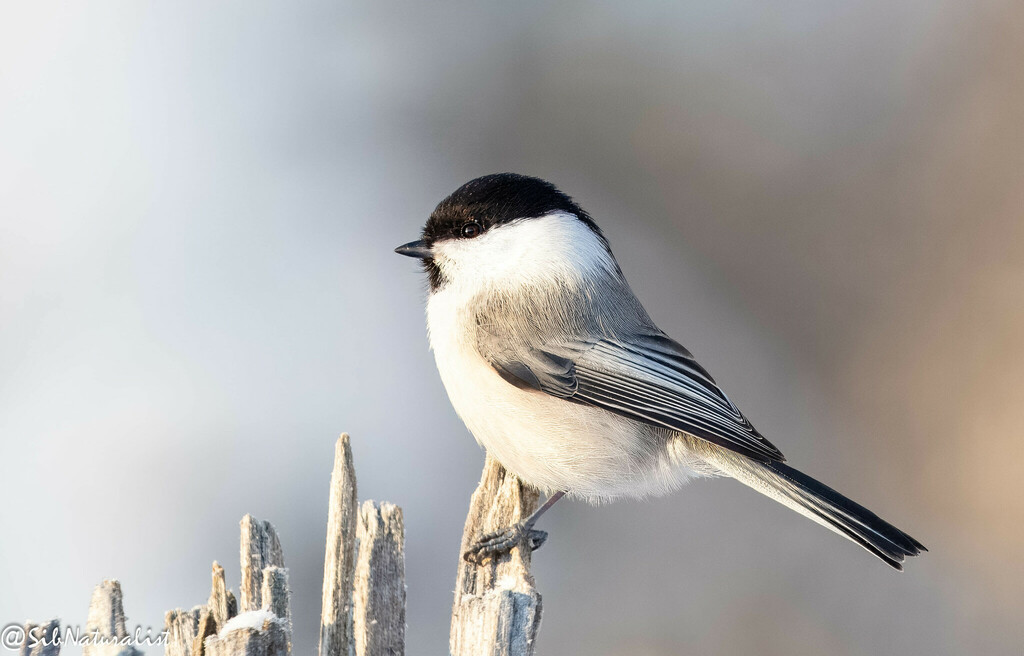
The willow tit (Poecile montanus) is a passerine bird in the tit family, Paridae. It is a widespread and common resident breeder throughout temperate and subarctic Europe and across the Palearctic. The plumage is grey-brown and off-white with a black cap and bib. It is more of a conifer specialist than the closely related marsh tit, which explains its breeding much farther north. It is resident, and most birds do not migrate.
From the article Willow tit on Wikipedia (CC BY-SA), quoted section by section
Description
The willow tit is 11.5 cm (4.5 in) in length, has a wingspan of 17–20.5 cm (6.7–8.1 in) and weighs around 11 g (0.39 oz). It has a large head, a thin bill, a long dull black cap that descends to the mantle and a black bib. The sides of the face are white, the back is grey-brown and the underparts are buff. The sexes are similar in appearance. In the east of its range it is much paler than marsh tit, but as one goes west the various races become increasingly similar, so much so that it was not recognised as a breeding bird in Great Britain until the end of the 19th century, despite being widespread. The willow tit is distinguished from the marsh tit by a sooty brown instead of a glossy blue black cap; the general colour is otherwise similar, though the under parts are more buff and the flanks distinctly more rufous; the pale buff edgings to the secondaries form a light patch on the closed wing. The feathers of the crown and the black bib under the bill are longer, but this is not an easily noticed character. The commonest call is a nasal zee, zee, zee, but the notes of the bird evidently vary considerably. Occasionally a double note, ipsee, ipsee, is repeated four or five times.
What it does
Birds feed on insects, caterpillars, and seeds, much like other tits. This species is parasitised by the moorhen flea, Dasypsyllus gallinulae.
Wikipedia: “Food and feeding”
Listen
Looking for field recordings…
Where it lives
Recorded sightings
—
geo-referenced records in GBIF, from museums, herbaria and field observers.
Drag the globe to turn it. Dots are where records exist, not a range map; darker means more records.
In the stacks
Searching the stacks…
Every page naming Poecile montanus in the Biodiversity Heritage Library →
This page is assembled live from iNaturalist, GBIF, Wikipedia, the Source Library and the Internet Archive. It is not yet part of the hand-edited codex. iNaturalist taxon 144812.