On eBird ↗
Silvereye
Live sightings near you, the range map, bar charts of when it is seen, and Macaulay Library photos and recordings.
Silvereye
Zosterops lateralis
The silvereye or wax-eye (Zosterops lateralis), also known by its Māori name tauhou, is a very small omnivorous passerine bird of the south-west Pacific. In Australia and New Zealand its common name is sometimes white-eye, but this name is more commonly used to refer to all members of the genus Zosterops, or the entire family Zosteropidae.
In New Zealand, the silvereye was first recorded in 1832. It arrived in greater numbers in 1856, and it is assumed that a migrating flock was swept eastwards by a storm. As an apparently self-introduced bird it is protected as a native New Zealand species. Its Māori name, tauhou, means "stranger" or more literally, "new arrival".
From the article Silvereye on Wikipedia (CC BY-SA), quoted section by section
Description
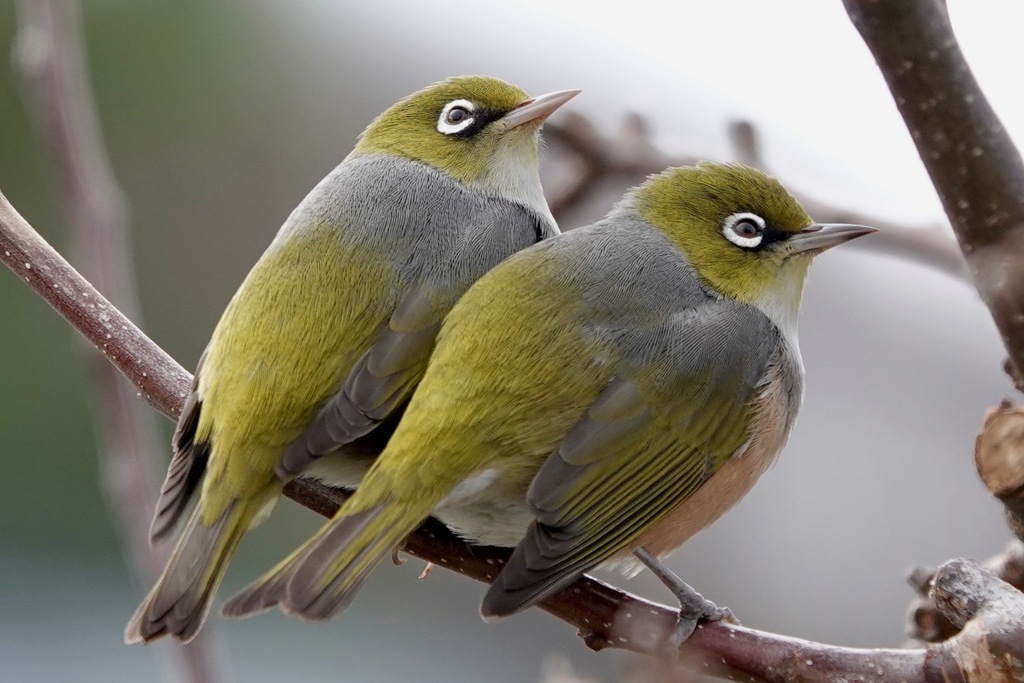
A small bird 11 to 13 cm in length and around 10 g in weight, it has a conspicuous ring of white feathers around its eye. There are a number of plumage variations depending on the sub-species. Generally it has olive-green wings and either a grey or olive-green back, a lighter coloured throat - yellow or grey, flanks that range from chestnut to pale buff, and an undertail that may be white or yellow. Within Australia there are seasonal migrations and the ranges of the sub-species overlap. The other islands within its range tend to host only a single sub-species each so only one plumage variant is seen. The sperm of Zosterops lateralis exhibits a head measuring 13.01 μm, a midpiece of 52.75 μm, a flagellum extending to 56.69 μm, resulting in a total length of 69.71 μm.
Range & habitat
The silvereye is native to Australia, New Zealand and the south-west Pacific islands of Lord Howe, New Caledonia, Loyalty Islands, Vanuatu, and Fiji. It is common to abundant throughout the relatively fertile south-west and south-east parts of Australia (including Tasmania and the Bass Strait islands), and through the well-watered coastal zone of tropical Queensland, including Cape York Peninsula The silvereye is liable to be found in any vegetated area, apart from open grasslands, within its distribution range, including forest, scrub, horticultural blocks and urban gardens.
Wikipedia: “Distribution and habitat”
What it does
Silvereyes feed on small insects and spiders and large amounts of fruit and nectar, making them occasional pests of commercial orchards.
Wikipedia: “Feeding”
How it is grown
They perform a valuable service in gardens and orchards, eating insects harmful to produce, including aphids, scale insects, and the diamondback moth. However, some orchardists, grape growers and home gardeners regard them as a serious pest particularly as, being so small, they simply ignore bird nets, popping in and out through the netting at will. They are attracted to a wide range of fruit species, including apples, citrus, feijoas, figs, grapes, pears and persimmons.
Wikipedia: “Horticulture”
Listen
Looking for field recordings…
Where it lives
Recorded sightings
—
geo-referenced records in GBIF, from museums, herbaria and field observers.
Drag the globe to turn it. Dots are where records exist, not a range map; darker means more records.
In the stacks
Searching the stacks…
Every page naming Zosterops lateralis in the Biodiversity Heritage Library →
This page is assembled live from iNaturalist, GBIF, Wikipedia, the Source Library and the Internet Archive. It is not yet part of the hand-edited codex. iNaturalist taxon 202505.