On eBird ↗
Whistling Warbler
Live sightings near you, the range map, bar charts of when it is seen, and Macaulay Library photos and recordings.
Whistling Warbler
Catharopeza bishopi
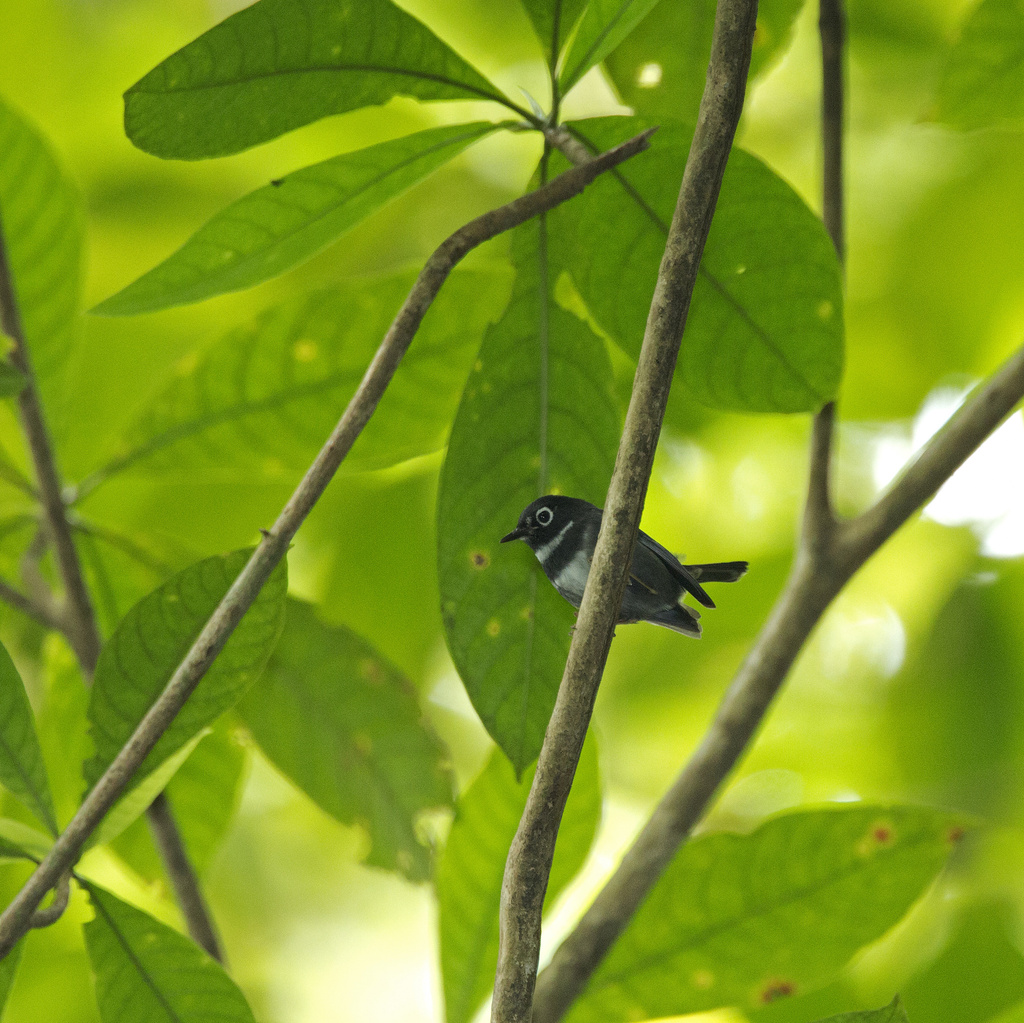
The whistling warbler (Catharopeza bishopi) is a species of bird in the New World warbler family. It is monotypic within the genus Catharopeza. It has a dark back that fades into a lighter gradient going towards the chest. It also has a dark head, a dark strip on the breast, and a light orbital. Both male and female have the same plumage. It is endemic to the island of Saint Vincent in the Lesser Antilles. Its natural habitats are subtropical or tropical moist lowland forest and subtropical or tropical moist montane forest. It is threatened by habitat loss. This habitat loss is due to volcanic activity and deforestation. Whistling warblers have cup-shaped nests, and spotted eggs. Their diet primarily consists of insects.
From the article Whistling warbler on Wikipedia (CC BY-SA), quoted section by section
Description
The whistling warbler is often compared to a wren in appearance. It has a dusty-black plumage, with a dark head and bill. Some interpretations of the whistling warbler have stated that they have a medium-brown plumage. A bright white ring surrounds the eye, with a hazel iris. There is also an off-white color on a minor portion of the chin and on the ends of feathers on the upper throat. The breast has a black and white striped-like pattern, with the black between two white bands. The underside of the tail goes from a blackish ash gray to an off-white. The tail's two distal feathers have a white triangle at the end of them. The tarsus and toes are a light orange color, and they also have a small manubrium-sternum bridge. Females have the same plumage. The whistling warbler's length ranges from 5 ½ inches to 5 ¾ inches. Their wings are around 2 ¾" long, the tail is about 2 ½ in", the tarsus is ~7/8 inches, and their wingspan is approximately 8 ½ inches in length. The immature whistling warbler has black feathers emerging on the crown and has the same appearance of the tail's feather tips as the adult, with the overall tail feather color being black. There is a dark greenish brown color on the top, and lighter color on the bottom. In place of the white marks in an adult, a light reddish-brown is present. …
Range & habitat
Whistling warblers inhabit the hills and mountains of St. Vincent island, including Richmond Peak, and Grand Bonhomme. St. Vincent is 18 miles in length and is located 13 degrees 10' north latitude, and 60 degrees 57' west longitude. There are also active and inactive volcanoes present on the island. There is no dry season on the hilltops and they are considered rainforests due to their 3800 mm of rain annually. These rainforests range from 300 m to 500 m in elevation. Whistling warbler distribution has changed over time. Before a volcanic eruption in 1902, whistling warblers were usually found around 300 m above sea level, but they are now found in areas 300 m to 600 m above sea level, with more of them found at lower elevations. This higher density of whistling warblers at lower altitudes is due to there being more ravines, gorges, and valleys in those areas and more wet slopes at higher altitudes.
Wikipedia: “Distribution and habitat”
What it does
Whistling warblers forage at low heights usually from the ground to 4 m, and at most 15 m. They can be found foraging on large rocks along streams, boulders, and decayed logs. They feed on insects, herbaceous plants, and occasionally lizards. While foraging they hop from branch to branch with a "cocked tail". The whistling warbler often flicks this "cocked tail" swiftly when observed foraging.
Wikipedia: “Diet and foraging”
Listen
Looking for field recordings…
Where it lives
Recorded sightings
—
geo-referenced records in GBIF, from museums, herbaria and field observers.
Drag the globe to turn it. Dots are where records exist, not a range map; darker means more records.
In the stacks
Searching the stacks…
Every page naming Catharopeza bishopi in the Biodiversity Heritage Library →
This page is assembled live from iNaturalist, GBIF, Wikipedia, the Source Library and the Internet Archive. It is not yet part of the hand-edited codex. iNaturalist taxon 10574.