On eBird ↗
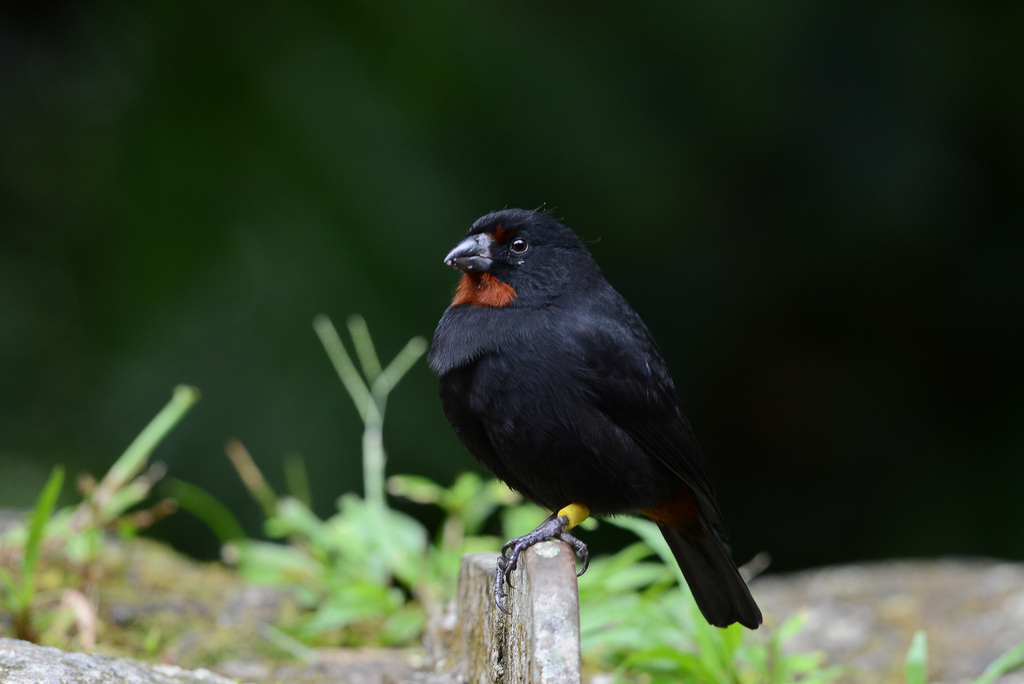
Lesser Antillean Bullfinch
Live sightings near you, the range map, bar charts of when it is seen, and Macaulay Library photos and recordings.
Lesser Antillean Bullfinch
Loxigilla noctis
The Lesser Antillean bullfinch (Loxigilla noctis) is a species of bird in the family Thraupidae. It is found in Saint Barth, Saint Martin, Anguilla, Antigua and Barbuda, Dominica, Grenada, Guadeloupe, Martinique, Montserrat, Netherlands Antilles, Saint Kitts and Nevis, Saint Lucia, Saint Vincent and the Grenadines, the British Virgin Islands, and the U.S. Virgin Islands.
From the article Lesser Antillean bullfinch on Wikipedia (CC BY-SA), quoted section by section
Description
The Lesser Antillean bullfinch is 14 to 15.5 cm (5.5 to 6.1 in) long and weighs 13.1 to 23.4 g (0.46 to 0.83 oz). The species is sexually dimorphic. Adult males of the nominate subspecies L. n. noctis are mostly black with a short red supercilium and an orangish red throat. Adult females have a warm brown head with some rusty on the lores. Their upperparts and tail are also warm brown. Their wings are mostly warm brown with bright rusty edges on the greater coverts. Their underparts are mostly warm gray with rusty undertail coverts. The other subspecies of the Lesser Antillean bullfinch differ from the nominate and each other thus:
L. n. crissalis: male has larger rufous throat patch and rufous-chestnut undertail coverts L. n. grenadensis: male similar to crisalis with smaller throat patch and some black in the undertail coverts L. n. desiradensis: male similar to grenadensis but larger and duller black overall L. n. dominicana: male similar to grenadensis but larger and duller black overall L. n. ridgwayi: smaller than dominicana; males have grayish black upperparts and slate gray underparts L. n. coryi: slightly darker than ridgwayi L. n. sclateri: smaller than nominate with shorter red supercilium Both sexes of all subspecies have a dark brown iris and dark grayish, brown, or black legs and feet. …
Range & habitat
The Lesser Antillean bullfinch is found on most of the main islands and several smaller ones along the Lesser Antilles. The subspecies are found thus:
L. n. coryi: northwestern islands of Saba, Sint Eustatius, Saint Kitts and Nevis, and Montserrat L. n. ridgwayi: Vieques, Puerto Rico in the Greater Antilles, United States Virgin Islands, British Virgin Islands, and northern Lesser Antilles islands of Anguilla, Antigua and Barbuda, and Saint Martin L. n. desiradensis: La Désirade off Grande-Terre, Guadeloupe L. n. dominicana: Dominica and Guadeloupe islands of Îles des Saintes, Marie-Galante, Grande-Terre, and Basse-Terre L. n. noctis: Martinique L. n. sclateri: Saint Lucia L. n. crissalis: Saint Vincent but see below L. n. grenadensis: Grenada Most sources say that the species is not found in the Grenadines but there are eBird records on several of them beginning in 1996. Because the Grenadines are between Saint Vincent and Grenada, it is not clear whether these individuals are L. n. crissalis or L. n. grenadensis. The Lesser Antillean bullfinch's habitat is briefly described as "shrubbery, gardens, thickets, and forest understory at all elevations". Habitats differ along the island chain but overall encompass "[t]ropical evergreen forest, deciduous woodlands, second growth, gardens, and forest understory; sometimes in dry areas and mangrove swamps".
Wikipedia: “Distribution and habitat”
What it does
The Lesser Antillean bullfinch feeds primarily on fruits and insects, and also eats seeds, flowers, and nectar. It is found in pairs, small flocks, and as members of mixed-species feeding flocks. It forages mostly in trees; in one study its average height above the ground was 6.6 m (22 ft).
Wikipedia: “Feeding”
Listen
Looking for field recordings…
Where it lives
Recorded sightings
—
geo-referenced records in GBIF, from museums, herbaria and field observers.
Drag the globe to turn it. Dots are where records exist, not a range map; darker means more records.
In the stacks
Searching the stacks…
Every page naming Loxigilla noctis in the Biodiversity Heritage Library →
This page is assembled live from iNaturalist, GBIF, Wikipedia, the Source Library and the Internet Archive. It is not yet part of the hand-edited codex. iNaturalist taxon 10019.