On eBird ↗
White-browed Sparrow-Weaver
Live sightings near you, the range map, bar charts of when it is seen, and Macaulay Library photos and recordings.
White-browed Sparrow-Weaver
Plocepasser mahali
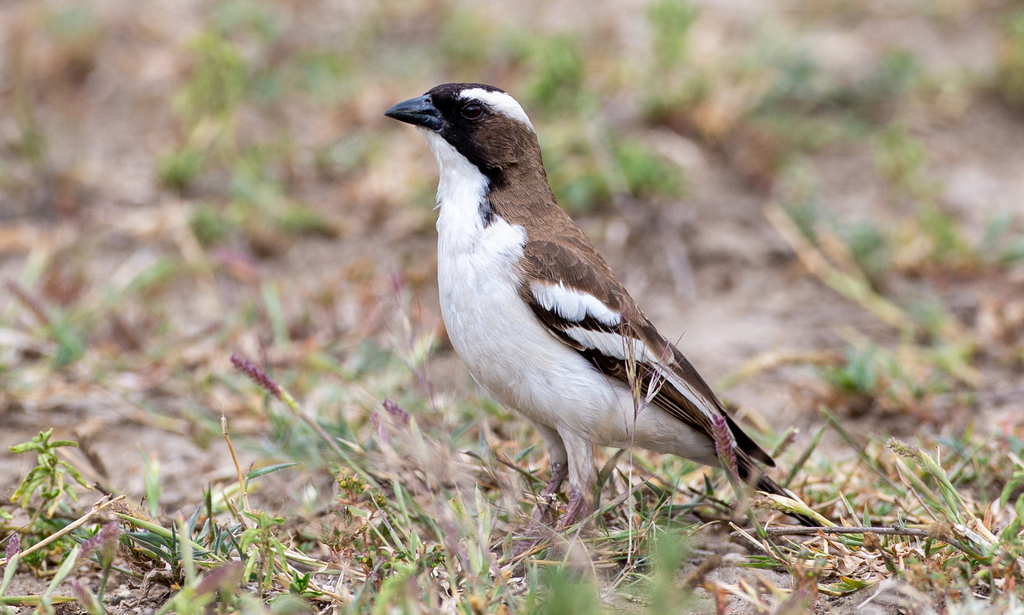
The white-browed sparrow-weaver (Plocepasser mahali) is a predominantly brown, sparrow-sized bird found throughout central and north-central southern Africa. It is found in groups of two to eleven individuals consisting of one breeding pair and other non-reproductive individuals.
From the article White-browed sparrow-weaver on Wikipedia (CC BY-SA), quoted section by section
Description
It ranges from 17 to 19 cm (6.7 to 7.5 in) in length and is characterized by a broad, white eyebrow stripe and white rump visible in flight. While the male white-browed sparrow-weaver sports a black bill, the female's bill is horn-colored (light gray); that of the juvenile is pinkish-brown. In Zimbabwe, the white-browed sparrow-weaver shows faint brown spotting across its white breast.
Voice. The white-browed sparrow-weaver may emit either a brief chik-chick or a loud, fluid, cheoop-preeoo-chop whistle.
Similar species. The yellow-throated petronia has a pinkish brown (not black) bill, a buff (not white) eyebrow stripe, black (not pink) feet, and yellow shading at the bottom of a white throat. Additionally, the white-browed sparrow-weaver is larger than the yellow-throated petronia. Unlike the white-browed sparrow-weaver, the yellow-throated petronia may be found in broad-leaved woodland.
Range & habitat
The white-browed sparrow-weaver is found in greatest numbers in north-central southern Africa. While this species most densely populates dry regions with woodland or wooded grassland at northern South Africa, its range includes Botswana, northern and central Namibia, and western Zimbabwe. It is seen very often in South Luangwa National Park, Zambia and southern Malawi. Populations may be found as far north as Ethiopia. Populations are sedentary. This species nests in colonies along thornveld and scrubby, dry riverbanks.
Wikipedia: “Distribution and habitat”
In human culture
Smith did not provide an explanation for the species epithet mahali, but is clear it is not a Latin name. Probably it is derived from the vernacular name for the bird in Setswana mogale or from the Sesotho word mohale, a brave or fierce person, which suggests the bird's name may refer to its angry scolding.
Wikipedia: “Etymology”
Listen
Looking for field recordings…
Where it lives
Recorded sightings
—
geo-referenced records in GBIF, from museums, herbaria and field observers.
Drag the globe to turn it. Dots are where records exist, not a range map; darker means more records.
In the stacks
Searching the stacks…
Every page naming Plocepasser mahali in the Biodiversity Heritage Library →
This page is assembled live from iNaturalist, GBIF, Wikipedia, the Source Library and the Internet Archive. It is not yet part of the hand-edited codex. iNaturalist taxon 14115.