On eBird ↗
Masked Shrike
Live sightings near you, the range map, bar charts of when it is seen, and Macaulay Library photos and recordings.
Masked Shrike
Lanius nubicus
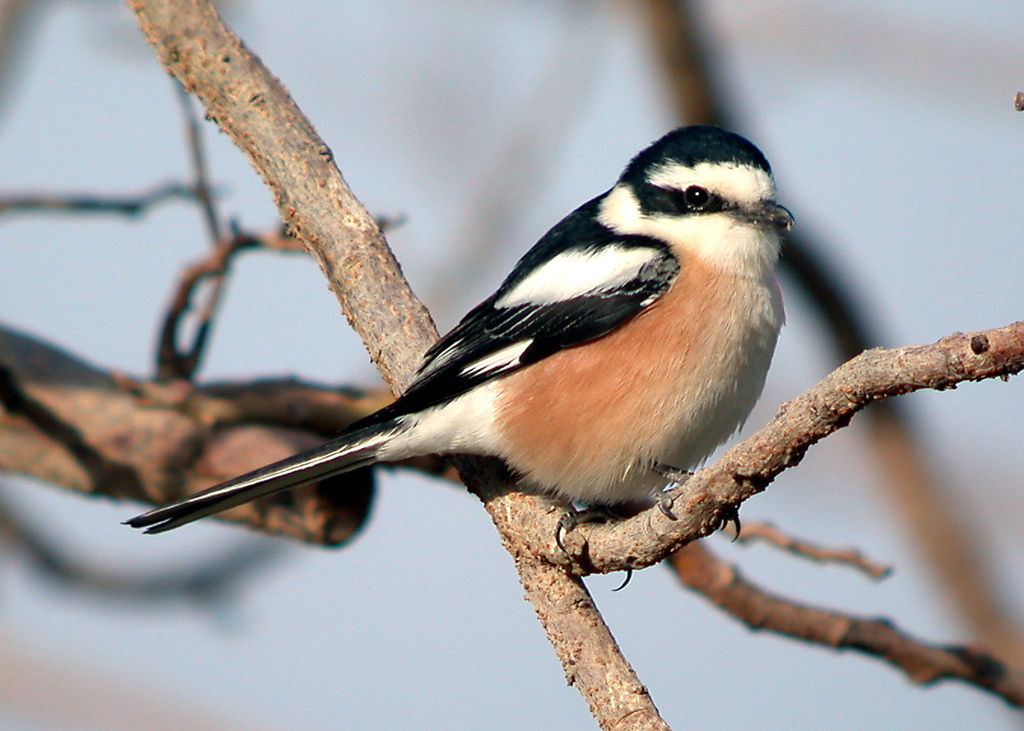
The masked shrike (Lanius nubicus) is a species of bird in the shrike family, Laniidae. It breeds in southeastern Europe and at the eastern end of the Mediterranean, with a separate population in eastern Iraq and western Iran. It is migratory, wintering mainly in northeast Africa. Although it is a short-range migrant, vagrants have occurred widely elsewhere, including northern and western Europe. It is the smallest member of its genus, long-tailed and with a hooked bill. The male has mainly black upperparts, with white on its crown, forehead and supercilium and large white patches on the shoulders and wings. The throat, neck sides and underparts are white, with orange flanks and breast. The female is a duller version of the male, with brownish black upperparts and a grey or buff tone to the shoulders and underparts. The juvenile has grey-brown upperparts with a paler forehead and barring from the head to rump, barred off-white underparts and brown wings аpart from the white primary patches. The species' calls are short and grating, but the song has melodic warbler-like components.
The masked shrike's preferred habitat is open woodland with bushes and some large trees. It is less conspicuous than its relatives, avoiding very open country and often perching in less exposed locations. The nest is a neat cup built in a tree by both adults, and the clutch is normally 4–6 eggs, which are incubated by the female for 14–16 days until hatching.
From the article Masked shrike on Wikipedia (CC BY-SA), quoted section by section
Description
The masked shrike is the smallest of its genus, a slender bird which usually weighs 20–23 g (0.71–0.81 oz), measuring 17–18.5 cm (6.7–7.3 in) long with a 24–26.5 cm (9.4–10.4 in) wingspan. It has a long tail and relatively small bill, on each side of which is a tomial tooth; the upper mandible bears a triangular ridge which fits a corresponding notch in the lower mandible. This adaptation is otherwise only found in falcons. The male has mainly black upperparts, a white crown, forehead and supercilium. There are large white patches on the shoulders and primaries, and the outermost tail feathers are also white. The throat, neck sides and underparts are white, with orange on the flanks and breast. The iris is brown, the bill is black and the legs are dark brown or black. The female is a duller version of the male, with brownish-black upperparts and a grey or buff tinge to the white shoulder patches and underparts. The juvenile has grey-brown upperparts with darker bars from the head to rump, a paler grey forehead, barred off-white underparts and brown wings with white primary patches. Masked shrikes are most similar in appearance to woodchat shrikes, but are smaller, more slender and longer-tailed. …
Range & habitat
The masked shrike breeds in the Balkans and Western Asia: southern Bulgaria, eastern Republic of North Macedonia, northeast Greece and some of the Greek islands, Turkey, Cyprus and from Syria south to Israel. It also nests in eastern Iraq and western Iran. The range in the east is uncertain, and may include Afghanistan and northern Saudi Arabia. It is migratory, wintering south of the Sahara, mainly in Chad, Sudan and Ethiopia. Smaller numbers are found west to eastern Mali and Nigeria, and in northern Kenya and southern Saudi Arabia. Most birds leave the breeding areas in late August and September, and return north in February and March. This species is seen in Egypt, Jordan and Israel much more often in spring than autumn, suggesting that the southern movement may be concentrated further east. Birds will hold small territories on about 0.5 hectares (1.2 acres) on migration, and, unlike other shrikes, may congregate in significant numbers. More than 100 have been seen in one locality in Israel, with five in a single bush. This shrike has occurred as a vagrant in Algeria, Finland, Kenya, Libya, Spain, Sweden, Mauritania and Turkmenistan. At least three individuals have been documented in Great Britain, and three individuals in Armenia. The masked shrike's preferred habitat is open woodland with bushes and some large trees. …
Wikipedia: “Distribution and habitat”
What it does
The masked shrike is a solitary species except when on migration. It maintains a breeding territory of 2–5 ha (5–12 acres) and is also territorial on the wintering grounds, defending an area of about 3 ha (7 acres). Although unafraid of humans, it is aggressive to its own species and other birds which infringe on its territory. Most other shrikes use high, exposed branches throughout the year, but the masked shrike only uses conspicuous locations at the start of the breeding season, otherwise choosing lower, more sheltered spots. It perches upright, frequently cocking its tail, and has an easy, agile flight. A masked shrike has been recorded as feigning injury when trapped, only to return to normal when the threat receded.
Breeding. Male masked shrikes sing from perches in their territories from early April, sometimes chasing or competing vocally with neighbouring males. The male's courtship display, usually accompanied by singing, starts with the bird perching erect and shivering its wings on an exposed perch, and is followed by the shrike stepping down its branch and bowing, either on the move or while temporarily halted. The male may also give a fluttering, zigzagging flight display. The female is sometimes fed by her mate while she crouches with spread wings and gives begging calls. …
Wikipedia: “Behaviour”
Listen
Looking for field recordings…
Where it lives
Recorded sightings
—
geo-referenced records in GBIF, from museums, herbaria and field observers.
Drag the globe to turn it. Dots are where records exist, not a range map; darker means more records.
In the stacks
Searching the stacks…
Every page naming Lanius nubicus in the Biodiversity Heritage Library →
This page is assembled live from iNaturalist, GBIF, Wikipedia, the Source Library and the Internet Archive. It is not yet part of the hand-edited codex. iNaturalist taxon 12023.