On eBird ↗
Woodchat Shrike
Live sightings near you, the range map, bar charts of when it is seen, and Macaulay Library photos and recordings.
Woodchat Shrike
Lanius senator
The woodchat shrike (Lanius senator) is a member of the shrike family Laniidae. The genus name, Lanius, is derived from the Latin word for "butcher", and some shrikes are also known as "butcher birds" because of their feeding habits. The specific senator is Latin for "senator", so-named because its chestnut cap recalled the colour of the stripe on the toga of a Roman senator. The common name "Woodchat" is an Anglicisation of German waldkatze, literally "woodcat",...
From the article Woodchat shrike on Wikipedia (CC BY-SA), quoted section by section
Description
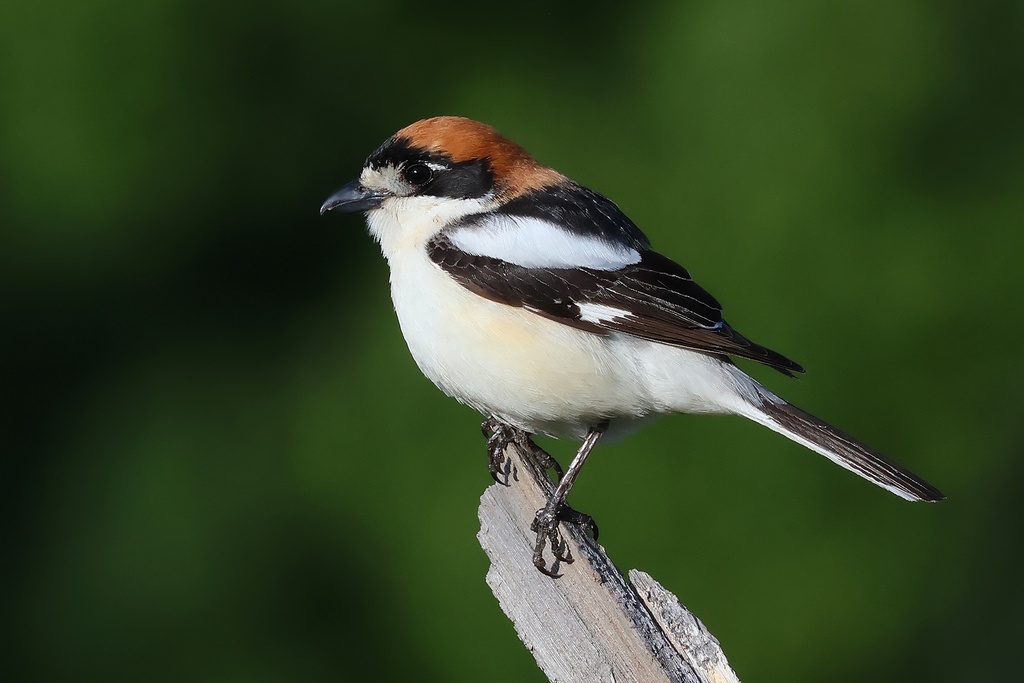
The woodchat shrike is 17–19 cm (6.7–7.5 in) in overall length which is slightly larger than a red-backed shrike. The male is a striking bird with black and white upper parts, a chestnut crown and pure white underparts. The race L. s. badius of the western Mediterranean lacks the large white wing patches. In the female and young birds, the upperparts are brown and white and vermiculated. Underparts are buff and also vermiculated.
Range & habitat
The breeding range of the woodchat shrike is in southern Europe, northern Africa and the Middle East. The range extends from Portugal to Greece, Turkey, Iraq and Iran, and in the Arabian Peninsula including Bahrain and Kuwait, and from Mauritania and Western Sahara in northern Africa to Libya. This bird overwinters in tropical central Africa, its winter range extending from Senegal to Sudan and Ethiopia in the east and southwards to Gabon. This species often overshoots its breeding range on spring migration, and is a rare, but annual, visitor to Great Britain. The Balearic race badius has occurred in Britain around four times as a vagrant, and has also been recorded once in Ireland.
Wikipedia: “Distribution and habitat”
What it does
The woodchat shrike mainly eats insects, particularly beetles, but its diet can include other invertebrates and very occasionally small mammals and small birds. It hunts by perching on an exposed lookout such as on a branch of a tree or on a fence, typically 2–6 m (7–20 ft) above the ground, and then dropping or gliding down to its prey. It also makes sallying flights after flying insects. Small insects are crushed in its bill but large insects are dismembered. Impaling prey on a thorn has been recorded but is unusual. Indigestible material such as chitin, bones and hair is regurgitated as pellets.
Wikipedia: “Food and feeding”
Listen
Looking for field recordings…
Where it lives
Recorded sightings
—
geo-referenced records in GBIF, from museums, herbaria and field observers.
Drag the globe to turn it. Dots are where records exist, not a range map; darker means more records.
In the stacks
Searching the stacks…
Every page naming Lanius senator in the Biodiversity Heritage Library →
This page is assembled live from iNaturalist, GBIF, Wikipedia, the Source Library and the Internet Archive. It is not yet part of the hand-edited codex. iNaturalist taxon 12039.