On eBird ↗
Willow Warbler
Live sightings near you, the range map, bar charts of when it is seen, and Macaulay Library photos and recordings.
Willow Warbler
Phylloscopus trochilus
The willow warbler (Phylloscopus trochilus) is a very common and widespread leaf warbler which breeds throughout northern and temperate Europe and the Palearctic, from Ireland east to the Anadyr River basin in eastern Siberia. It is strongly migratory, with almost all of the population wintering in sub-Saharan Africa.
It is a bird of open woodlands with trees and ground cover for nesting, including most importantly birch, alder, and willow habitats. The nest is usually built in close contact with the ground, often in low vegetation. Like most Old World warblers (Sylviidae), this small passerine is insectivorous. In northern Europe, it is one of the first warblers to return in the spring, though later than the closely related chiffchaff. In spite of its small size, the willow warbler performs one of the longest migrations of any animal.
From the article Willow warbler on Wikipedia (CC BY-SA), quoted section by section
Description
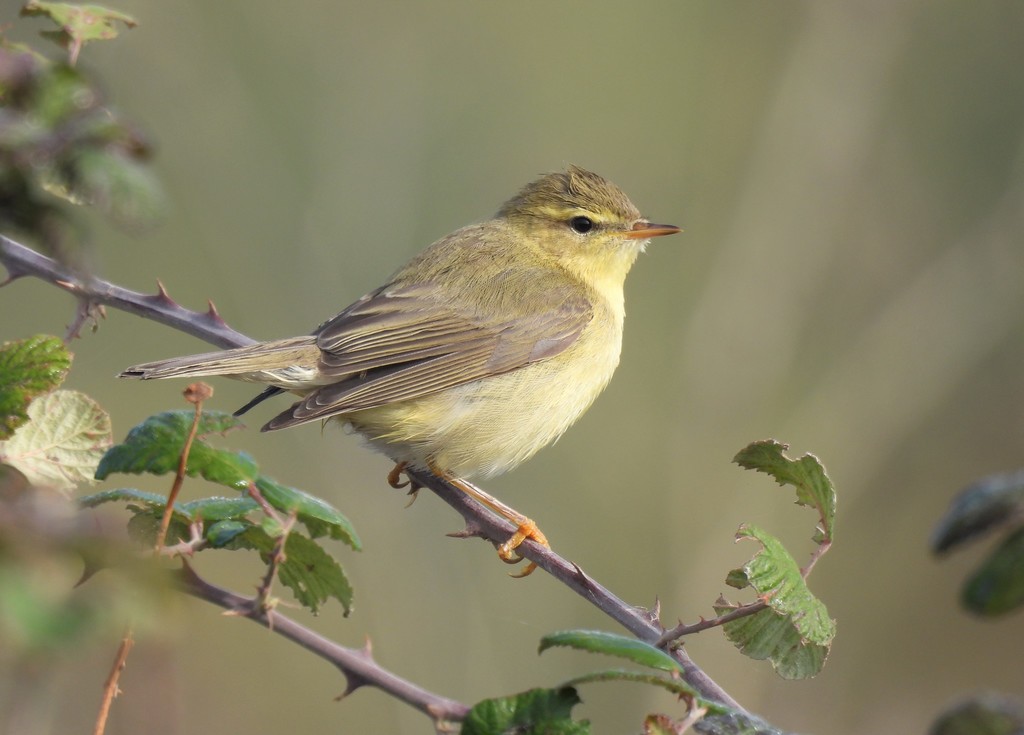
The willow warbler is a typical leaf warbler in appearance, 11–12.5 cm (4.3–4.9 in) long and 7–15 g (0.25–0.53 oz) weight. It is greenish brown above and off-white to yellowish below; the wings are plain greenish-brown with no wingbars. Juveniles are yellower below than adults. It is very similar to the chiffchaff, but non-singing birds can be distinguished from that species by their paler pinkish-yellow legs (dark brown to blackish in chiffchaff), longer paler bill, more elegant shape and longer primary projection (wingtip). Its song is a simple repetitive descending whistle, while the contact call is a disyllabic 'hoo-eet', distinct from the more monosyllabic 'hweet' of chiffchaffs.
What it does
All populations are highly migratory, with the subspecies P. t. yakutensis migrating up to 12,000 km (7,500 mi) from eastern Siberia to southern Africa along the Asian–East African Flyway, one of the longest migrations of any for a bird of its size. Approximate timings are:
October to March: wintering in sub-Saharan Africa. Mid-March to mid-May: migrates and arrives in the breeding range. Late April to August: breeding season, usually only one brood but rarely two. August to October: migrates back to Africa. They are very rare vagrants to Alaska, with sightings in St. Lawrence Island.
Wikipedia: “Behaviour”
Listen
Looking for field recordings…
Where it lives
Recorded sightings
—
geo-referenced records in GBIF, from museums, herbaria and field observers.
Drag the globe to turn it. Dots are where records exist, not a range map; darker means more records.
In the stacks
Searching the stacks…
Every page naming Phylloscopus trochilus in the Biodiversity Heritage Library →
This page is assembled live from iNaturalist, GBIF, Wikipedia, the Source Library and the Internet Archive. It is not yet part of the hand-edited codex. iNaturalist taxon 117055.