On eBird ↗
Long-billed Crombec
Live sightings near you, the range map, bar charts of when it is seen, and Macaulay Library photos and recordings.
Long-billed Crombec
Sylvietta rufescens
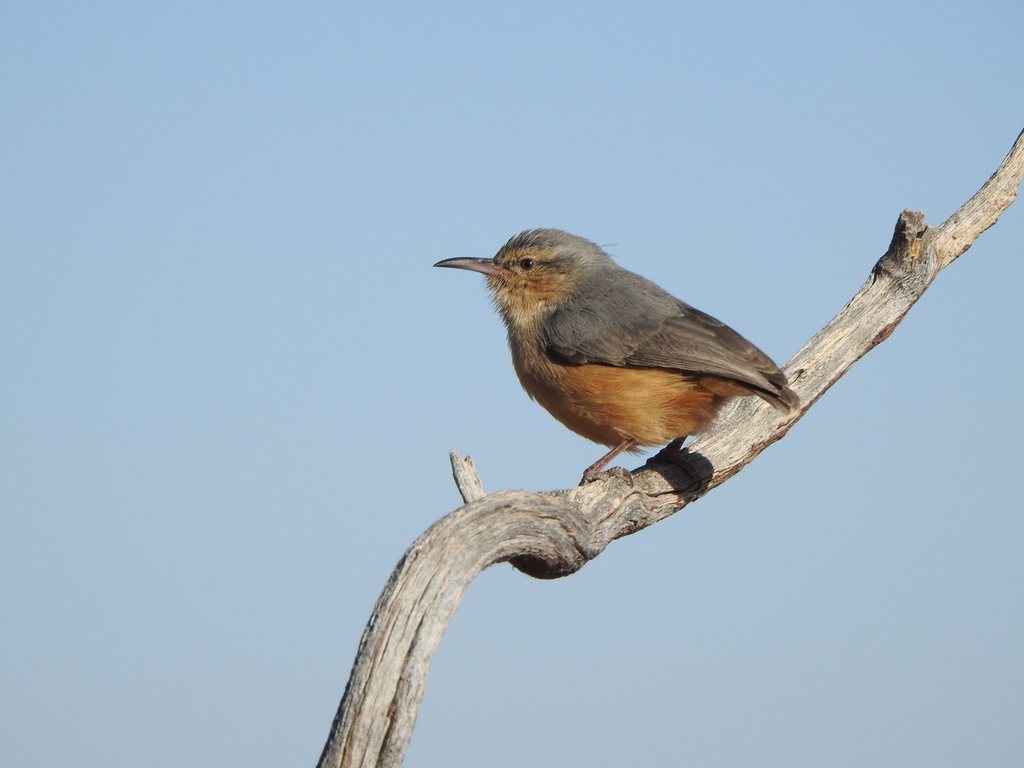
The long-billed crombec or Cape crombec (Sylvietta rufescens) is an African warbler.
The long-billed crombec breeds in southern Africa from the Democratic Republic of the Congo, Zambia and Tanzania southwards to South Africa.
From the article Long-billed crombec on Wikipedia (CC BY-SA), quoted section by section
Description
The long-billed crombec is a small, nearly tailless bird 12 cm long and weighing around 16 g. Its upperparts are brownish grey-brown, and there is a pale grey supercilium, separated from the whitish throat by a dark eye stripe. The whitish breast shades into the buff belly. The long slightly curved bill is blackish. The sexes are similar, and the juvenile resembles the adult. The call is a variable series of trilled notes including trreee-rriiit trreee-rriiit and a harsh pttt.
What it does
The long-billed crombec's nest is a large, hanging bag of grasses, spider webs, and plant fibres, which is attached to the lower limbs of a tree, often an Acacia. The one to three white eggs are incubated for two weeks to hatching, and the chicks are fed by both parents for another two weeks to fledging. This territorial species is monogamous, pairing for life. This bird is usually seen alone, in pairs, or in family groups as it forages methodically from the bottom to the top of bushes and trees for insects and grass seeds. It will join mixed-species feeding flocks. It moves between trees with a bouncy flight.
Wikipedia: “Behaviour”
Listen
Looking for field recordings…
Where it lives
Recorded sightings
—
geo-referenced records in GBIF, from museums, herbaria and field observers.
Drag the globe to turn it. Dots are where records exist, not a range map; darker means more records.
In the stacks
Searching the stacks…
Every page naming Sylvietta rufescens in the Biodiversity Heritage Library →
This page is assembled live from iNaturalist, GBIF, Wikipedia, the Source Library and the Internet Archive. It is not yet part of the hand-edited codex. iNaturalist taxon 15254.