On eBird ↗
Chestnut Munia
Live sightings near you, the range map, bar charts of when it is seen, and Macaulay Library photos and recordings.
Chestnut Munia
Lonchura atricapilla
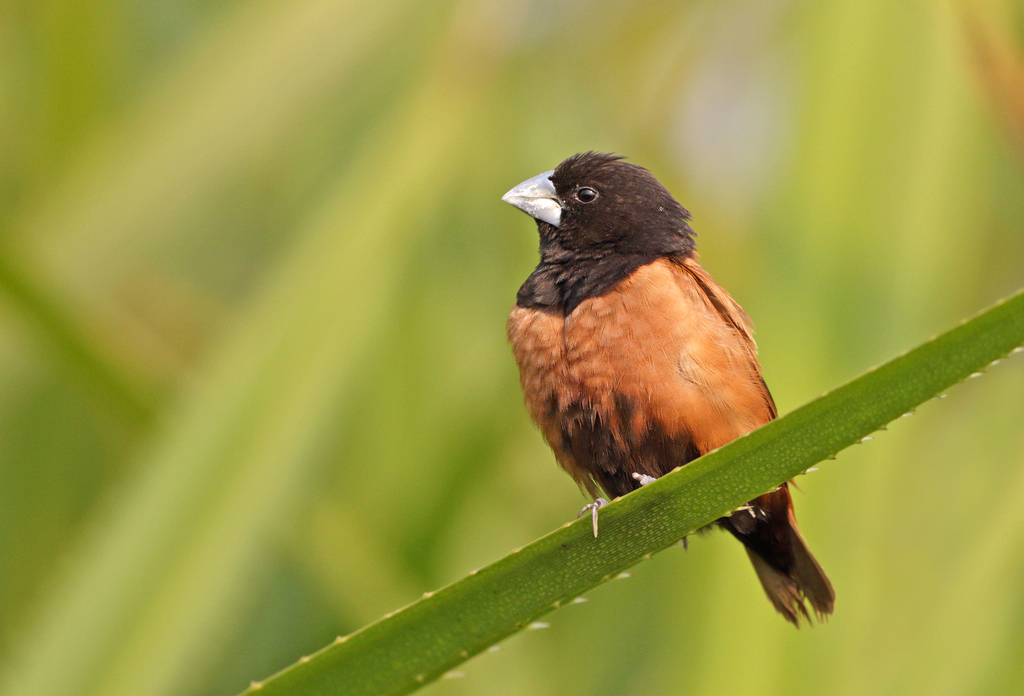
The chestnut munia or black-headed munia (Lonchura atricapilla) is a small passerine. It was formerly considered conspecific with the closely related tricoloured munia, but is now widely accepted as a separate species. This estrildid finch is a resident breeding bird in Bangladesh, Brunei, Cambodia, China, India, Indonesia, Laos, Malaysia, Burma, Nepal, the Philippines, Singapore, Taiwan, Thailand, Vietnam and Hawaii. It also has been introduced to all the Greater Antilles and Martinique in the Caribbean.
Before 1995, it was the national bird of the Philippines, where it is known in Tagalog as mayang pula ("red maya") because of the brick red patch on the lower back which is visible only when it flies. This distinguishes it from other birds locally called maya, notably the predominantly brownish "mayang simbahan" ("church maya", which specifically refers to the Eurasian tree sparrow) which is more common in urban areas.
From the article Chestnut munia on Wikipedia (CC BY-SA), quoted section by section
Description
Small, sexes alike, races differ slightly in intensity of colour. In L. a. jagori, the adult has the whole head, breast, centre of belly, and undertail coverts black; the back, wing, and sides of belly chestnut, brighter on underparts, duller on wings; uppertail coverts dark reddish brown, underpart buff; uppertail coverts and tail as adult. Bill silvery grey; eye chestnut; legs gray.
Range & habitat
The chestnut munia is a small gregarious bird which feeds mainly on grain and other seeds. It frequents open grassland and cultivation. The nest is a large domed grass structure in a bush or tall grass into which 4–7 white eggs are laid.
Wikipedia: “Habitat”
Listen
Looking for field recordings…
Where it lives
Recorded sightings
—
geo-referenced records in GBIF, from museums, herbaria and field observers.
Drag the globe to turn it. Dots are where records exist, not a range map; darker means more records.
In the stacks
Searching the stacks…
Every page naming Lonchura atricapilla in the Biodiversity Heritage Library →
This page is assembled live from iNaturalist, GBIF, Wikipedia, the Source Library and the Internet Archive. It is not yet part of the hand-edited codex. iNaturalist taxon 72989.