On eBird ↗
Bewick's Wren
Live sightings near you, the range map, bar charts of when it is seen, and Macaulay Library photos and recordings.
Bewick's Wren
Thryomanes bewickii
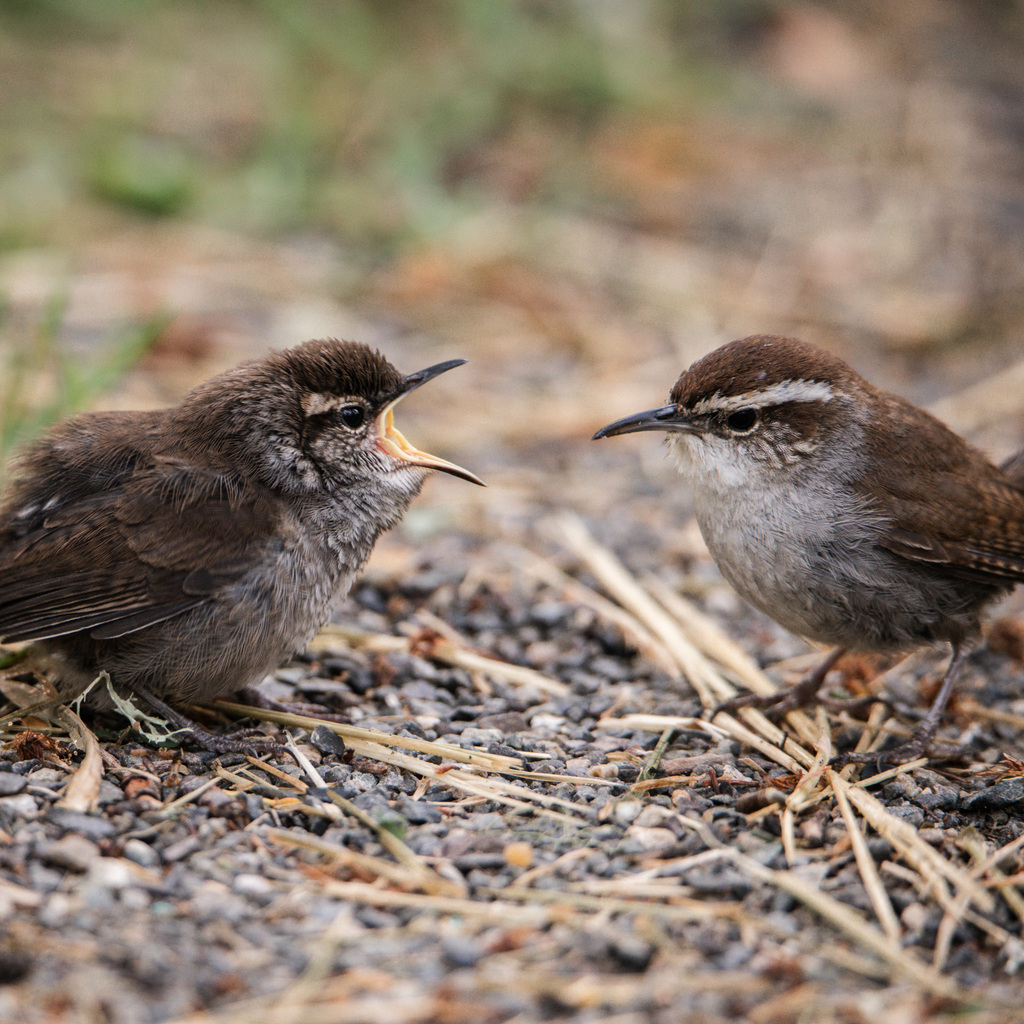
Bewick's wren (Thryomanes bewickii) is a wren native to North America. It is the only species placed in the genus Thryomanes. At about 14 cm (5.5 in) long, it is grey-brown above, white below, with a long white eyebrow. While similar in appearance to the Carolina wren, it has a long tail that is tipped in white. The song is loud and melodious, much like the song of other wrens. It lives in thickets, brush piles and hedgerows, open woodlands and scrubby areas, often near streams. It eats insects and spiders, which it gleans from vegetation or finds on the ground.
Its historic range was from southern British Columbia, Nebraska, southern Ontario, and southwestern Pennsylvania, Maryland, south to Mexico, Arkansas and the northern Gulf States. However, it is now extremely rare east of the Mississippi River.
From the article Bewick's wren on Wikipedia (CC BY-SA), quoted section by section
Description
Bewick's wren has an average length of 13 cm (5.1 in) an average weight of 8–12 g (0.28–0.42 oz), and a wingspan of 18 cm (7.1 in). Its plumage is brown on top and light grey underneath, with a white stripe above each eye. Its beak is long, slender, and slightly curved. Its most distinctive feature is its long tail with black bars and white corners. It moves its tail around frequently, making this feature even more obvious for observers. Juveniles look similar to adults, with only a few key differences. Their beaks are usually shorter and stockier. In addition, their underbelly might feature some faint speckling. Males and females are very similar in appearance.
Vocalizations. Bewick's wrens, like many wrens, are very vocal. Both females and males make short calls while foraging and both use a harsh scolding call when agitated. Males also sing in order to attract mates and protect their territory. The song is broken into two or three individual parts; one individual male may exhibit up to twenty-two different variations on the song pattern, and may even throw in a little ventriloquism to vary it even further. A male wren learns its song from neighboring males, so its song will be different from its father's.
Geographic variation. Geographic differences have been observed in the appearance of Bewick's wren. …
Range & habitat
Bewick's wren once had a range that extended throughout much of the United States and Mexico and parts of Canada. It used to be fairly common in the Midwest and in the Appalachian Mountains, but it is now extremely rare east of the Mississippi River. It is still found along the Pacific Coast from Baja California to British Columbia, in Mexico, and in a significant portion of the Southwest, including Texas, Arizona, New Mexico, and Oklahoma. Western populations do not tend to migrate. Eastern populations, prior to their decline, used to migrate from its northern range to the Gulf Coast. The preferred habitat of Bewick's wren is that of arid open woodlands and brush-filled areas such as hillsides and uplands, but will reside in humid areas locally (Subtropical and Temperate zones). They are more common than house wrens in drier habitats, such as those found in the Southwest. In California, Bewick's wrens inhabit a shrubland area called chaparral.
Wikipedia: “Distribution and habitat”
What it does
Bewick's wrens are insect eaters. They glean insects and insect eggs from vegetation, including the trunks of trees. They typically do not feed on vegetation higher than 3 meters, but they will forage on the ground. Bewick's wrens are capable of hanging upside down in order to acquire food, such as catching an insect on the underside of a branch. When it catches an insect, it kills the insect prior to swallowing it whole. Bewick's wrens will repeatedly wipe their beaks on its perch after a meal. Bewick's wrens will visit backyard feeders. They will eat suet, peanut hearts, hulled sunflower seeds, and mealworms. Like many insect-eating birds, Bewick's wren widens its diet to include seeds in the winter.
Wikipedia: “Feeding”
Listen
Looking for field recordings…
Where it lives
Recorded sightings
—
geo-referenced records in GBIF, from museums, herbaria and field observers.
Drag the globe to turn it. Dots are where records exist, not a range map; darker means more records.
In the stacks
Searching the stacks…
Every page naming Thryomanes bewickii in the Biodiversity Heritage Library →
This page is assembled live from iNaturalist, GBIF, Wikipedia, the Source Library and the Internet Archive. It is not yet part of the hand-edited codex. iNaturalist taxon 7576.