On eBird ↗
Village Weaver
Live sightings near you, the range map, bar charts of when it is seen, and Macaulay Library photos and recordings.
Village Weaver
Ploceus cucullatus
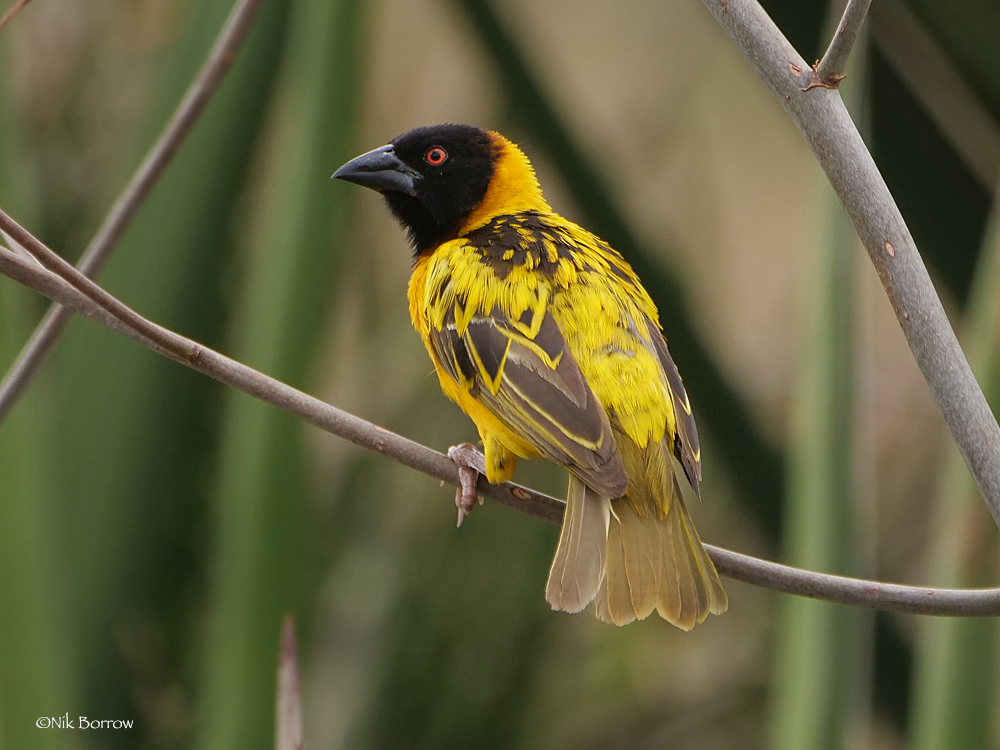
The village weaver (Ploceus cucullatus), also known as the spotted-backed weaver or black-headed weaver (the latter leading to easy confusion with P. melanocephalus), is a bird species in the family Ploceidae found in much of sub-Saharan Africa. It has also been introduced to Portugal and Venezuela as well as to the islands of Hispaniola, Martinique, Puerto Rico, Mauritius and Réunion.
This often abundant species occurs in a wide range of open or semi-open habitats, including woodlands and human habitation, and frequently forms large noisy colonies in towns, villages, and hotel grounds. This weaver builds a large coarsely woven nest made of grass and leaf strips with a downward-facing entrance, which is suspended from a branch in a tree. Two or three eggs are laid. Village weavers are colonial breeders, so many nests may hang from one tree.
From the article Village weaver on Wikipedia (CC BY-SA), quoted section by section
Description
The village weaver is a stocky, 15–17 cm (5.9–6.7 in) bird with a strong conical bill and dark reddish eyes. In the northern part of its range, the breeding male has a black head edged by chestnut (typically most distinct on the nape and chest). Towards the southern part of its range, the amount of black and chestnut diminish, and the breeding males of the southernmost subspecies only have a black face and throat, while the nape and crown are yellow. In all subspecies, the breeding male has a black bill, black and yellow upperparts and wings, and yellow underparts. The nonbreeding male has a yellow head with an olive crown, grey upperparts and whitish underparts. The wings remain yellow and black. The adult female has streaked olive upperparts, yellow and black wings, and pale yellow underparts. Young birds are like the female, but browner on the back.
Range & habitat
The village weaver is among the more common weaver species, and is widespread in sub-Saharan Africa, but is absent from the arid regions in the southwest and northeast. It has been introduced to islands in the Indian Ocean and the Caribbean, where it has adapted well to the climates similar to its original range.
Wikipedia: “Distribution and habitat”
What it does
Village weavers forage and roost in large groups, often with other weaver species. In some areas, they move periodically along fixed routes. The birds look for food on the ground, but also look up to search vegetation and trees. Village weavers nest in colonies and are very active during the breeding season. Birds fly in and leave again constantly, making significant noise. Colonies can contain as many as 150 nests, but eight to a hundred nests in a single tree are usual. A village weaver's nest is 14–17 cm (5.5–6.7 in) long and 11–13 cm (4.3–5.1 in) high. The entrance is mostly extended into a tube of 4–8 cm (1.6–3.1 in) long. The male weaves the structure of the nest using long strips of leaf that he has torn from palms or large grass species such as Arundo donax. The nest is roofed, ovoid or kidney-shaped, internally consisting of a nesting chamber that is separated by a ground sill from an antechamber, that has the entrance of the entire nest at the bottom. On the inside, the ceiling is made of strips of grass or other leaves, which are simply inserted instead of woven in. The floor on the inside is lined by short, thatched strips of palm, grass blades or heads, and feathers. The nest requires about 300 long strips of leaf, which the male tears off and transports one by one. …
Wikipedia: “Behavior and ecology”
In human culture
The first English name, "weever oriole" was given by John Latham, an early British ornithologist, whose work was often cited by Linnaeus. "Village weaver" has been designated the official name by the International Ornithological Committee. Other English names are "black-headed weaver", "Layard's black-headed weaver", "black-hooded weaver", "mottled-backed weaver", "mottled weaver", "spotted-backed weaver", "spot-backed weaver", and "V-marked weaver".
Wikipedia: “Etymology”
Listen
Looking for field recordings…
Where it lives
Recorded sightings
—
geo-referenced records in GBIF, from museums, herbaria and field observers.
Drag the globe to turn it. Dots are where records exist, not a range map; darker means more records.
In the stacks
Searching the stacks…
Every page naming Ploceus cucullatus in the Biodiversity Heritage Library →
This page is assembled live from iNaturalist, GBIF, Wikipedia, the Source Library and the Internet Archive. It is not yet part of the hand-edited codex. iNaturalist taxon 13796.