 NL·0458
Herbarium of the Nature Library
- Name
- Fringilla coelebs
- Family
- Fringillidae
- Native to
- Europe, western Siberia, Turkey, the Caucasus, northern Iran and western Central Asia; North African birds are now often treated as a separate species
- Habitat
- Temperate forest, Woodland, Farmland, Gardens and parks
On eBird ↗
Common Chaffinch
Live sightings near you, the range map, bar charts of when it is seen, and Macaulay Library photos and recordings.
Common chaffinch
Fringilla coelebs
Also calledShurshur (Arabic) · İspinoz (Turkish) · Buchfink (German) · Pinson des arbres (French) · Pinzón vulgar (Spanish)
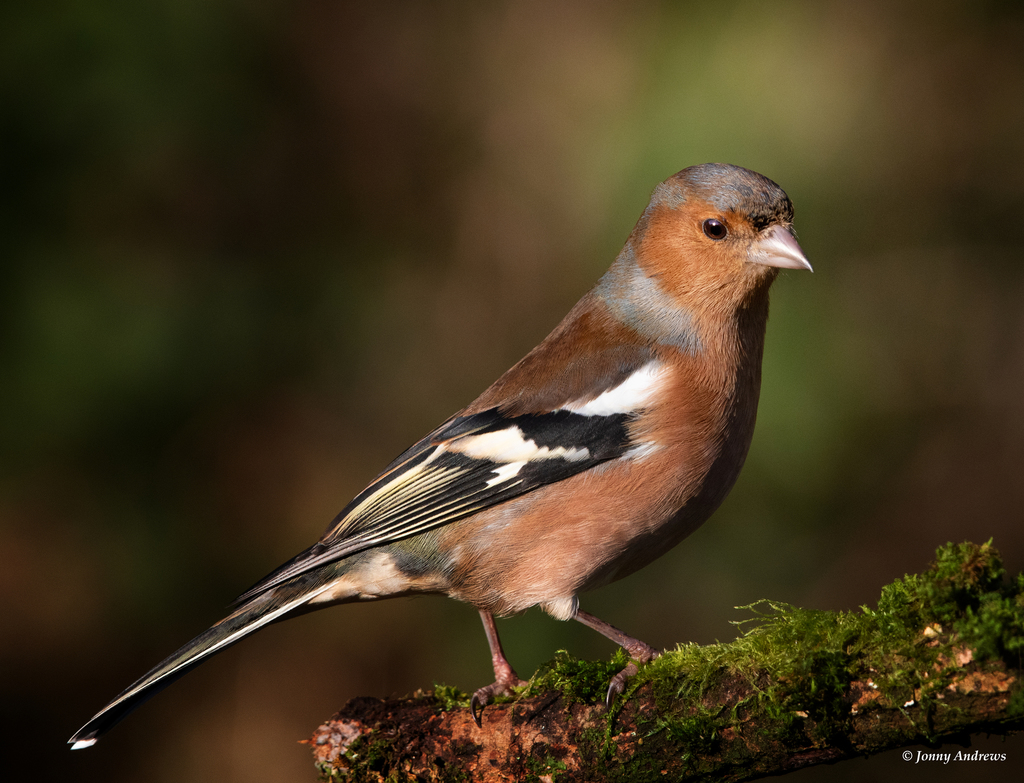
One of Europe's most abundant birds: a pink-breasted, blue-capped finch with bold white wing bars. Its short song has regional dialects learned by young birds, making it a classic species for studies of how birds learn to sing.
The Eurasian chaffinch, common chaffinch, or simply the chaffinch is a common and widespread small passerine bird – in the finch family. The male is brightly coloured with a blue-grey cap and rust-red underparts. The female is more subdued in colouring, but both sexes have two contrasting white wing bars and white sides to the tail. The male bird has a strong voice and sings from exposed perches to attract a mate. Wikipedia
What it can do
- iYoung males learn their songs in a sensitive period and refine them the next spring, as shown by W. H. Thorpe in the 1950s
- iiSong shows local dialects that differ between valleys and woods
- iiiFemales and young migrate further south than adult males, so northern winter flocks are largely male
- ivHuge visible migrations pass coastal headlands in autumn
In the field
Field marks
- aMale: blue-grey crown and nape, pinkish-orange face and breast, chestnut back
- bTwo bold white wing bars and white outer tail feathers in both sexes
- cFemale olive-brown with the same wing pattern
- dGreenish rump
- Voice
- Song an accelerating descending rattle ending in a flourish, 'chip-chip-chip-tell-tell-cherry-erry-tissi-cheweeo'; call a sharp 'pink' and a rising 'hweet' rain call.
- Not to be confused with
- Brambling has an orange breast and shoulder, and a white rump. Female house sparrow lacks the bold white wing bars. Common rosefinch males are red rather than pink-and-blue.
- Where to see it
- Any European woodland, park or farmland; Falsterbo (Sweden) and the Curonian Spit see vast autumn passage.
- When
- Resident in the west; summer visitor in the north and east; winter visitor to the Mediterranean and Middle East
Listen
Looking for field recordings…
Life & habits
- Diet
- Seeds from the ground in winter; caterpillars and other insects in summer
- Habitat
- All kinds of woodland, hedgerows, parks, gardens and farmland
- Size
- 14.5–16 cm; 18–29 g
- Lifespan
- Typically 2–3 years
Feeds on the ground with a shuffling walk, often in mixed winter flocks with bramblings.
Where it lives
Recorded sightings
—
geo-referenced records in GBIF, from museums, herbaria and field observers.
Native range
Europe, western Siberia, Turkey, the Caucasus, northern Iran and western Central Asia; North African birds are now often treated as a separate species
Drag the globe to turn it. Dots are where records exist, not a range map; darker means more records.
In the old herbals & bestiaries
Woodcuts and engravings matched from the Source Library’s scanned books by name. Plates marked “relative” show a close kin rather than this exact species. Click a plate to read the page it came from, with translation.

The Natural History of Carolina, Florida and the Bahama Islands, Vol. 1
Mark Catesby · 1777 · p.152

The Natural History of Carolina Florida and Bahama Islands Vol. 2
Mark Catesby · 1743 · p.316

Garden of Health
Jacob Meydenbach · 1491 · p.756

François Le Vaillant — Histoire naturelle des promerops et des guêpiers (1807)
François Le Vaillant · 1807 · p.488

François Le Vaillant — Histoire naturelle des promerops et des guêpiers (1807)
François Le Vaillant · 1807 · p.520

Georg Wolfgang Knorr; Johann Ernst Immanuel Walch — Schnecken und Muscheln (1770)
Georg Wolfgang Knorr; Johann Ernst Immanuel Walch · 1770 · p.109

François Bouchard — Recueil de cent-trente-trois oiseaux des plus belles especes (1775)
François Bouchard · 1775 · p.159

History of Animals, Book I: On Viviparous Quadrupeds
Conrad Gessner · 1554 · p.560

The natural history of Carolina, Florida, and the Bahama Islands : containing two hundred a...
Catesby, Mark, bioloog, kunstenaar · 1743 · p.48

Mark Catesby — Piscium, serpentum, insectorum (pt. 1) (1750)
Mark Catesby · 1750 · p.46
In the stacks
Searching the stacks…
Every page naming Fringilla coelebs in the Biodiversity Heritage Library →
Marginalia
Linnaeus named it 'coelebs', meaning bachelor, because in Sweden only males stay through the winter. Belgian 'vinkenzetting' contests, in which caged males are scored on how many songs they sing in an hour, go back centuries.
Curiosity
Hand-reared chaffinches that never hear an adult sing develop only a simple, abnormal song, which showed that birdsong is partly learned.
Kinship
Fact-checked: 1 correction made to this sheet. Photographs: iNaturalist contributors under the licences shown. Records: GBIF.org. Historical plates: Source Library (CC BY-SA 4.0; originals public domain). Summary text: Nature Library editors and Wikipedia (CC BY-SA). Medicinal and edibility notes are historical and educational, not advice. iNaturalist taxon 10070.