On eBird ↗
Brambling
Live sightings near you, the range map, bar charts of when it is seen, and Macaulay Library photos and recordings.
Brambling
Fringilla montifringilla
The brambling (Fringilla montifringilla) is a small passerine bird in the finch family Fringillidae. It has also been called the cock o' the north and the mountain finch. It is widespread and migratory, often seen in very large flocks.
From the article Brambling on Wikipedia (CC BY-SA), quoted section by section
Description
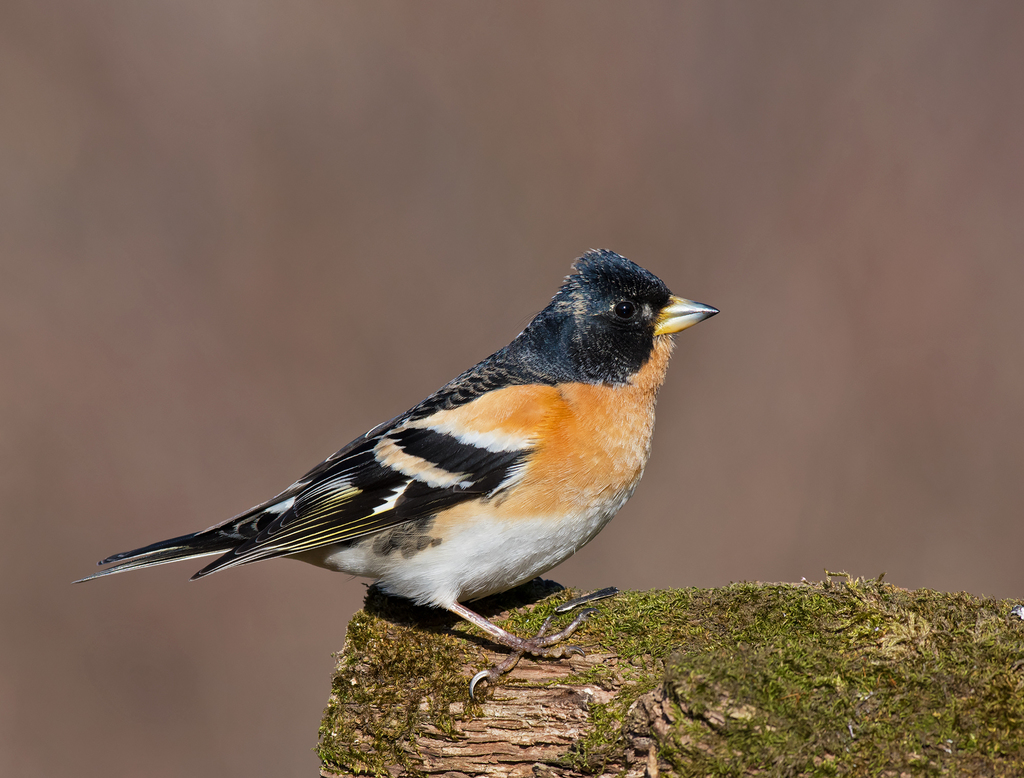
The brambling is similar in size and shape to a common chaffinch. Breeding-plumaged male bramblings are very distinctive, with a black head, dark upperparts, orange breast and white belly. Females and younger birds are less distinct, and more similar in appearance to some chaffinches. In all plumages, however, bramblings differs from chaffinches in a number of features:
the brambling has a white rump, whereas that of the common chaffinch is grey-green; the breast is orange, contrasting with a white belly, on the brambling, whereas on the common chaffinch, the underparts are more uniformly coloured (pink or buff); the brambling's scapular feathers are orange, whereas the common chaffinch's are grey or grey-brown; the flanks are dark-spotted on the brambling, plain on the common chaffinch; bramblings lack the white outer tail feathers of common chaffinches. An additional difference for all plumages except breeding-plumaged males is the bill colour - yellow in the brambling, dull pinkish in the common chaffinch (breeding-plumaged male bramblings have black bills, common chaffinches in the corresponding plumage have grey bills). Measurements:
Length: 16 cm Weight: 23–29 g Wingspan: 25–26 cm
Range & habitat
This bird is widespread, in the breeding season, throughout the forests of northern Europe and east across the Palearctic. It is migratory, wintering in southern Europe, North Africa, northern India, northern Pakistan, China, and Japan. It frequently strays into Alaska during migration and there are scattered records across the northern United States and southern Canada. The global population of bramblings is about 100 to 200 million, with a decreasing trend. Open coniferous or birch woodland is favoured for breeding.
Migration. This species is almost entirely migratory. In Europe, it forms large flocks in the winter, sometimes with thousands or even millions of birds in a single flock. Such large gatherings occur especially if beech mast is abundant. Bramblings do not require beech mast in the winter, but winter flocks of bramblings will move until they find it. This may be an adaptation to avoid competition with the common chaffinch.
Wikipedia: “Distribution and habitat”
Listen
Looking for field recordings…
Where it lives
Recorded sightings
—
geo-referenced records in GBIF, from museums, herbaria and field observers.
Drag the globe to turn it. Dots are where records exist, not a range map; darker means more records.
In the stacks
Searching the stacks…
Every page naming Fringilla montifringilla in the Biodiversity Heritage Library →
This page is assembled live from iNaturalist, GBIF, Wikipedia, the Source Library and the Internet Archive. It is not yet part of the hand-edited codex. iNaturalist taxon 10069.