On eBird ↗
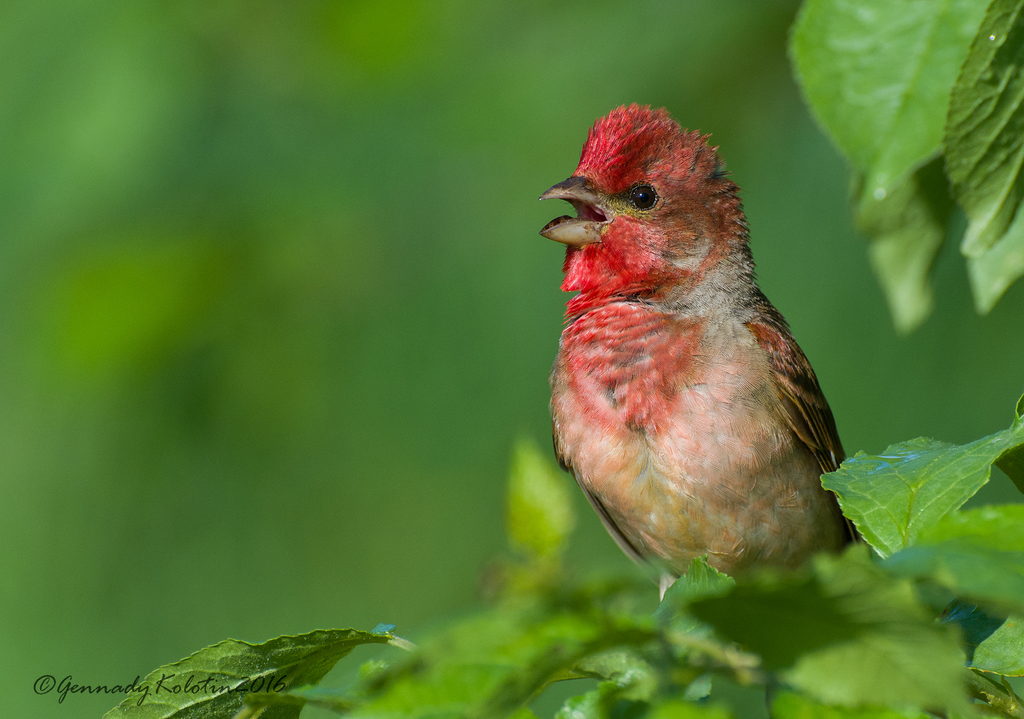
Common Rosefinch
Live sightings near you, the range map, bar charts of when it is seen, and Macaulay Library photos and recordings.
Common Rosefinch
Carpodacus erythrinus
The common rosefinch (Carpodacus erythrinus) or scarlet rosefinch is the most widespread and common rosefinch of Asia and Europe.
From the article Common rosefinch on Wikipedia (CC BY-SA), quoted section by section
Description
The common rosefinch is 13–15 cm (5.1–5.9 in) in length. It has a stout and conical bill. The mature male has brilliant rosy-carmine head, breast and rump; heavy bill; dark brown wings with two indistinct bars, and a white belly. Females and young males are dull-colored with yellowish-brown above, brighter on the rump and greyer on head; buff below. Adults moult in their winter quarters, between September and November. After moulting the red of male is subdued, and becomes brighter during the winter due to wear of the feathers. A rare form exists, in which the red colouring of males is replaced by yellow. The cause is environmental, rather than genetic, being affected by diet and the presence of parasites.
Range & habitat
It has spread westward through Europe; in recent decades, it has been observed in Portugal, and has occurred in the British Isles as a rare visitor, with some breeding records in recent years. Common rosefinches breed from the Danube valley, Sweden, and Siberia to the Bering Sea; the Caucasus, northern Iran and Afghanistan, the western Himalayas, Tibet and China; to Japan between latitudes 25° and 68°. In winter they are found from southern Iran to south-east China, India, Burma, and Indochina. It occurs as a vagrant in Sri Lanka. They are found in summer in thickets, woodland and forest edges near rivers and in winter in gardens and orchards, wetlands and locally in dry oak woods.
Wikipedia: “Distribution and habitat”
What it does
The nest is placed low in a bush. The eggs are dark blue with coarse dark brown spots, and a typical clutch contains five eggs.
Wikipedia: “Behaviour”
Listen
Looking for field recordings…
Where it lives
Recorded sightings
—
geo-referenced records in GBIF, from museums, herbaria and field observers.
Drag the globe to turn it. Dots are where records exist, not a range map; darker means more records.
In the stacks
Searching the stacks…
Every page naming Carpodacus erythrinus in the Biodiversity Heritage Library →
This page is assembled live from iNaturalist, GBIF, Wikipedia, the Source Library and the Internet Archive. It is not yet part of the hand-edited codex. iNaturalist taxon 9639.