On eBird ↗
Gray Catbird
Live sightings near you, the range map, bar charts of when it is seen, and Macaulay Library photos and recordings.
Gray Catbird
Dumetella carolinensis
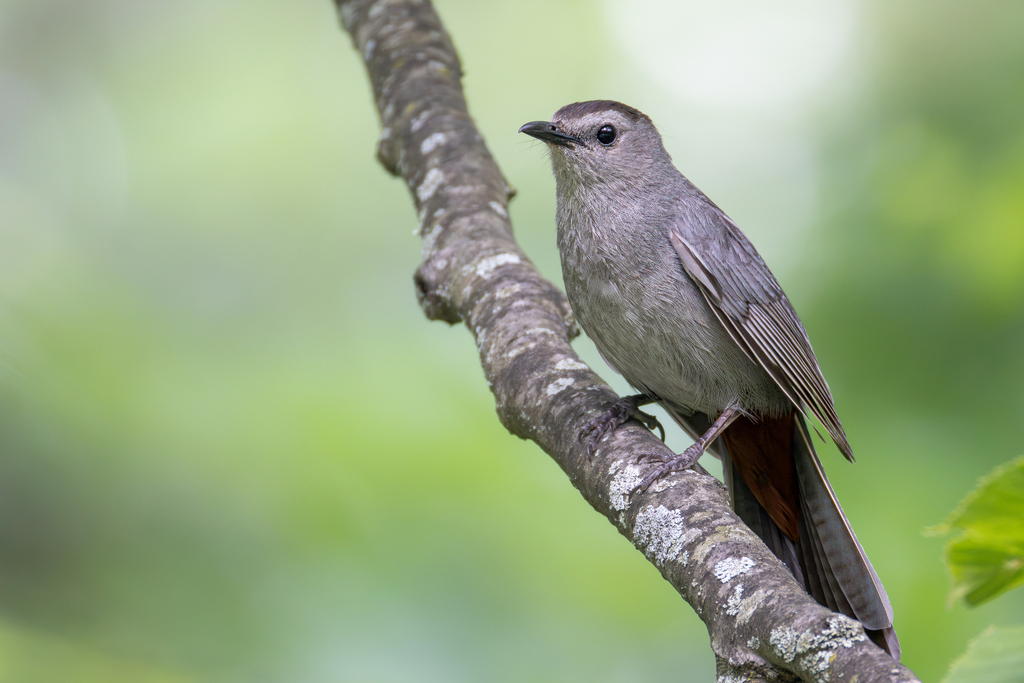
The gray catbird (Dumetella carolinensis), also spelled grey catbird, is a medium-sized North American and Central American perching bird of the mimid family. It is the only member of the "catbird" genus Dumetella. Like the black catbird (Melanoptila glabrirostris), it is among the basal lineages of the Mimidae, probably a closer relative of the Caribbean thrasher and trembler assemblage than of the mockingbirds and Toxostoma thrashers. In some areas it is known as the slate-colored mockingbird.
From the article Gray catbird on Wikipedia (CC BY-SA), quoted section by section
Description
Adults weigh from 23.2 to 56.5 g (0.8 to 2.0 oz), with an average of 35–40 g (1.2–1.4 oz) They range in length from 20.5 to 24 cm (8.1 to 9.4 in) and span 22 to 30 cm (8.7 to 11.8 in) across the wings. Among standard measurements, the wing chord is 8.4 to 9.8 cm (3.3 to 3.9 in), the tail is 7.2 to 10.3 cm (2.8 to 4.1 in), the culmen is 1.5 to 1.8 cm (0.6 to 0.7 in) and the tarsus is 2.7 to 2.9 cm (1.1 to 1.1 in). Gray catbirds are plain lead gray almost all over. The top of the head is darker. The undertail coverts are rust-colored, and the remiges and rectrices are black, some with white borders. The slim bill, the eyes, and the legs and feet are also blackish. Males and females cannot be distinguished by their looks; different behaviours in the breeding season is usually the only clue to the observer. Juveniles are even plainer in coloration, with buffy undertail coverts.
Vocalizations. This species is named for its cat-like call. Like many members of the Mimidae (in particular mockingbirds), it also mimics the songs of other birds, as well as those of Hylidae (tree frogs), and even mechanical sounds. Because of its well-developed songbird syrinx, it is able to make two sounds at the same time. …
Range & habitat
Native to most of temperate North America east of the Rocky Mountains, gray catbirds migrate to the southeastern United States, Mexico, Central America, and the Caribbean in winter; except for the occasional vagrant they always stay east of the American Cordillera. They are extremely rare vagrants to western Europe. Normally present on the breeding grounds by May, most leave for winter quarters in September/October; as it seems, this species is increasingly extending its stay in the summer range, with some nowadays remaining until mid-winter as far north as Ohio. The gray catbird is a migratory species. Spring migration ranges from March to May, and in the fall ranges from late August to November. The catbird tends to avoid dense, unbroken woodlands, and does not inhabit coniferous, pine woodland. Catbirds prefer a dense vegetative substrate, especially if thorny vegetation is present. Scrublands, woodland edges, overgrown farmland and abandoned orchards are generally among the preferred locations of the catbird. In Bermuda, its preferred habitats are scrub and myrtle swamp. During the winter season, the catbird has an affinity for berry-rich thickets, especially within proximity of water sources.
Wikipedia: “Distribution and habitat”
What it does
Gray catbirds are omnivores, and approximately 50% of their diet is fruit and berries. They tend to peck more fruit than they can eat. They also eat mealworms, earthworms, beetles, and other bugs. In summer, gray catbirds will eat mostly ants, beetles, grasshoppers, caterpillars, and moths. They also eat holly berries, cherries, elderberries, poison ivy, bay, and blackberries. They also often peck the eggs of other species of birds, but it is unknown if they do this to supplement their diet or to reduce competition for food from other birds.
Wikipedia: “Feeding”
Listen
Looking for field recordings…
Where it lives
Recorded sightings
—
geo-referenced records in GBIF, from museums, herbaria and field observers.
Drag the globe to turn it. Dots are where records exist, not a range map; darker means more records.
In the old herbals & bestiaries

In the stacks
Searching the stacks…
Every page naming Dumetella carolinensis in the Biodiversity Heritage Library →
This page is assembled live from iNaturalist, GBIF, Wikipedia, the Source Library and the Internet Archive. It is not yet part of the hand-edited codex. iNaturalist taxon 14995.