On eBird ↗
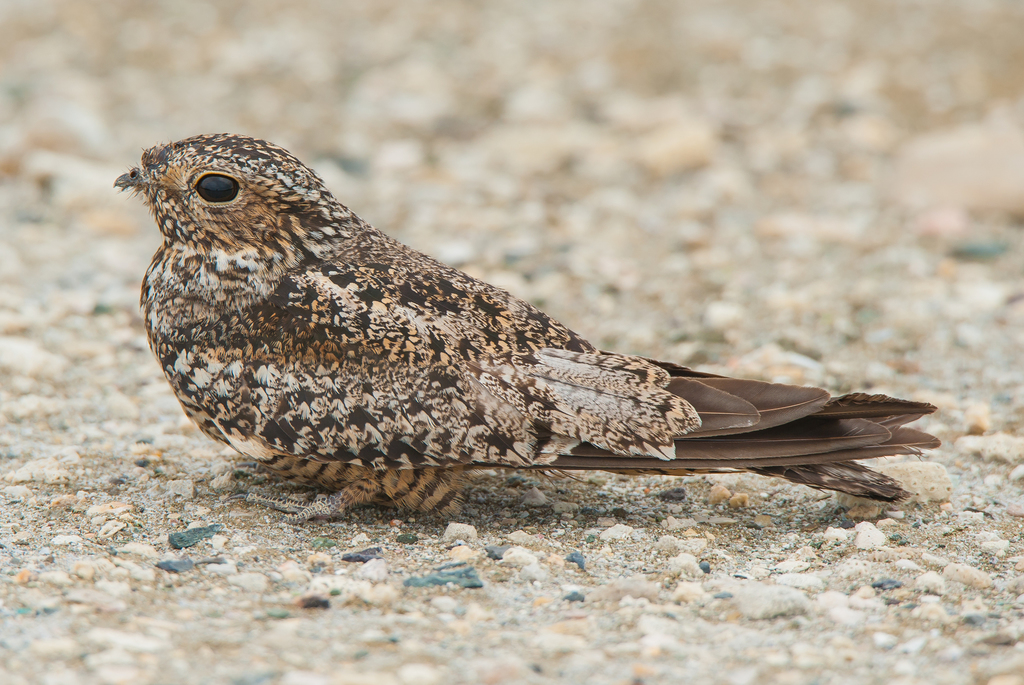
Antillean Nighthawk
Live sightings near you, the range map, bar charts of when it is seen, and Macaulay Library photos and recordings.
Antillean Nighthawk
Chordeiles gundlachii
The Antillean nighthawk (Chordeiles gundlachii) is a nightjar native to the Caribbean, The Bahamas, and Florida Keys.
Its specific epithet, gundlachii, is in honor of Cuban naturalist Juan Gundlach.
From the article Antillean nighthawk on Wikipedia (CC BY-SA), quoted section by section
Description
The adults are dark with brown, grey and white patterning on the upperparts and breast; the long wings are black and show a white bar in flight. The tail is dark with white barring; the underparts are white with black bars. The adult male has a white throat; the female has a light brown throat. The most distinguishing characteristic to determine its identity from its closest relative the common nighthawk are the contrasting pale tertials near the back of the wings of a sitting bird. There are two color morphs, a gray and a rufous type. Like other nighthawks, this bird will display by flying upward with a distinctive call note, then diving, pulling out of the dive only a few feet from the ground. This creates a rush of air and distinctive sound.
Range & habitat
Their breeding habitat is open country of the Greater Antilles, the Lesser Antilles, the Bahamas, and the Florida Keys in the United States. They usually nest on bare ground, sometimes in raised locations including stumps or gravel roofs. They especially favor recently cleared areas in forests, airport fields, cane fields and pastures. Little is known about migration habits, although there is some evidence of migration routes to North and Central South America.
Wikipedia: “Habitat and distribution”
What it does
They catch flying insects on the wing, mainly foraging near dawn and dusk (crepuscular) or sometimes at night with a full moon.
Wikipedia: “Diet”
Listen
Looking for field recordings…
Where it lives
Recorded sightings
—
geo-referenced records in GBIF, from museums, herbaria and field observers.
Drag the globe to turn it. Dots are where records exist, not a range map; darker means more records.
In the stacks
Searching the stacks…
Every page naming Chordeiles gundlachii in the Biodiversity Heritage Library →
This page is assembled live from iNaturalist, GBIF, Wikipedia, the Source Library and the Internet Archive. It is not yet part of the hand-edited codex. iNaturalist taxon 19602.